In recent years, China’s industrial robot industry has made significant progress, maintaining its position as the world’s largest robot market for several consecutive years. However, behind the joy of scale expansion, the industry needs to calmly consider: is the current development merely a “catch-up” to international advanced levels, or has it entered a new stage of “pioneering” new technological tracks?
It is common in the industry to evaluate corporate strength based on indicators such as sales volume, market share, and shipment volume of the main body. While these are important, what truly determines the height of the industry in the future of intelligent manufacturing is the strategic determination and original capabilities of enterprises in their choice of technological paths and innovation of business models.
This article, based on a review of Chinese industrial robot companies and combined with a long-term focus on intelligent systems and advanced manufacturing research, proposes supplements and enhancements to the industrial development path, aiming to grasp the essence and direction of technological evolution more accurately.
1. Mainstream Path: System Integration is a Realistic Choice, but Beware of “Technological Hollowing”
Companies like Huichuan, Estun, Siasun, and Efort have chosen the path of “independence in core components + body manufacturing + system integration,” which aligns with the phased characteristics of China’s manufacturing industry moving from “large to strong” and meets the urgent demand for automated production lines in pillar industries such as automotive, 3C, and new energy.
However, analysis indicates that system integration capability does not equate to original technology capability. If companies remain in a state of “assembly-style integration” for a long time, overly relying on imported high-precision reducers and high-end servo systems, even if they lead in sales, they will still struggle with the dilemma of “technological dependence”.
It is commendable that some companies have shown efforts to move towards “full-stack controllability”: Huichuan is deeply engaged in the drive and control layer, Siasun is focused on special robots and national major projects, and Estun is achieving technological leaps through acquisitions. These practices are a crucial step for China’s robot industry to transition from “quantitative change” to “qualitative change”.
2. Collaborative Robots: Opening the Door to “Human-Machine Integration”, but Not Yet Touching the Core of Manufacturing
Companies like JAKA, Youjiang, and Aobo are exploring collaborative robots, lowering the automation threshold and promoting small and medium-sized enterprises to undergo “micro-transformation and light upgrades”, demonstrating strong vitality in non-traditional industrial scenarios such as education, healthcare, and services.
However, it is important to recognize that collaborative robots currently mainly address the “flexible access” issue and have not yet deeply participated in core industrial processes such as heavy manufacturing, hazardous operations, and large-scale assembly. Their load capacity, operational space, and environmental adaptability are still limited, serving more as a supplement to traditional robots rather than a replacement.
Therefore, we must not confuse “ease of use” with “strategic significance”. True intelligent manufacturing requires not only “collaborative robotic arms” but also intelligent entities that can “bear heavy loads, travel long distances, and operate in hazardous environments”.
3. Cable-Driven Robots: A Redefinition of “Spatial Intelligence”
Among the cases reviewed, the most notable is Nanjing Cable-Driven Robot Technology Co., Ltd. and its technological path. This represents not just the rise of a single enterprise but a breakthrough in technological paradigms.
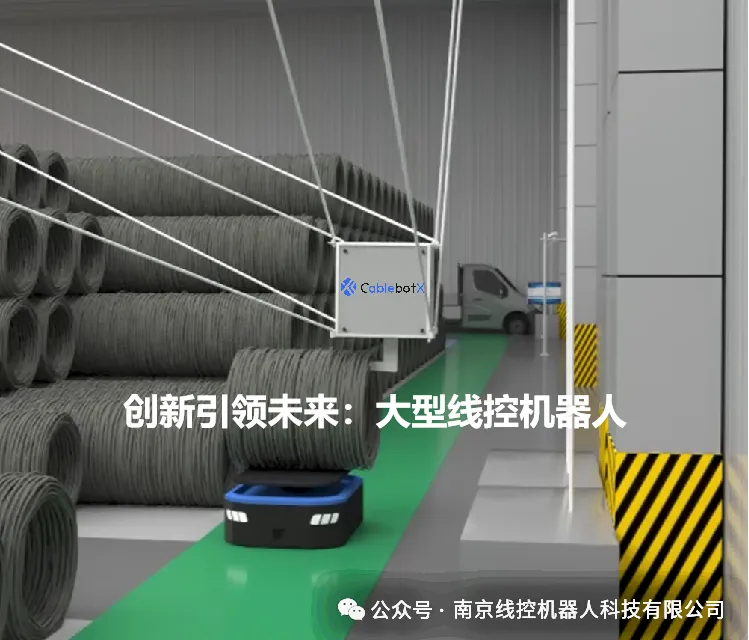
Traditional industrial robots are essentially “ground-constrained mechanical systems”—relying on tracks, foundations, and fixed supports, with limited degrees of freedom in movement. In contrast, cable-driven robots expand the operational space from “plane” to “three-dimensional” through multi-cable collaborative drive, achieving a revolutionary transformation of “exchanging structure for space and exchanging rigidity for control”.
This breakthrough is supported by several core technologies:
- • Multi-motor collaborative tension control;
- • Millimeter-level positioning accuracy under large spans;
- • Active vibration suppression under dynamic loads;
- • Deep integration of three-dimensional digital twins and AI scheduling.
More importantly, this technology is naturally adaptable to the many existing old factories, irregular spaces, and heavy material handling scenarios in China, achieving a “low-cost, high-efficiency, and quick deployment” intelligent upgrade, which is precisely the “accessible technology” that many small and medium-sized enterprises need.
Thus, cable-driven robots are seen as representatives of “new industrial spatial intelligence”. They are not just tools for transportation but also serve as “aerial nerve endings” connecting the physical and digital worlds, becoming indispensable “mobile execution nodes” in future smart factories.
4. Future Direction: From “Machine Automation” to “System Intelligence”
The competition among industrial robots has shifted from a comparison of individual equipment performance to a contest of system-level intelligence.
Companies need to transition from “selling equipment” to “providing intelligent services”. For example, Nanjing Cable Technology’s AI scheduling engine, digital twin system, and heat map optimization algorithms have transcended traditional automation boundaries, moving towards a higher form of “autonomous decision-making, dynamic optimization, and continuous evolution”.
This aligns with the concept of Human-Information-Physical Fusion Systems (HCPS): future manufacturing systems should be organic entities deeply integrating physical devices, digital models, and human wisdom.
Conclusion: Encourage Originality, Support Exploration, Cultivate “Asymmetric Advantages”
The transformation and upgrading of China’s manufacturing industry cannot rely solely on “catching up”; it must also dare to “pioneer”. We should support companies like Huichuan and Siasun in strengthening and expanding in mainstream tracks, while also valuing the exploration of companies like Nanjing Cable Technology in non-mainstream, high-potential technological paths.
Although the current market scale of cable-driven robots is limited, the concepts they represent—”spatial reconstruction”, “flexible control”, and “lightweight deployment”—may be the “golden key” to solving the challenges of China’s manufacturing industry, which include “complex structures, difficult transformations, and cost sensitivity”.
To this end, we call for:
- • Policymakers to increase support for original and disruptive technologies;
- • Investment institutions to pay attention to “small but beautiful, specialized and refined” technology explorers;
- • Enterprises to bravely step out of their “comfort zones” and seek the future in “unmanned areas”.
Only in this way can China’s industrial robot industry achieve a historical leap from “following” to “keeping pace with” and then to “leading”.
Copyright Statement: The copyright of this original article belongs to Nanjing Cable-Driven Robot Technology Co., Ltd. If reproduced, please indicate the link to this article. No modifications or theft of the article are allowed without permission. Thank you for your reading and support!
Any information marked as sourced from other sources is reprinted from other media, and the purpose of reprinting is to convey more information, and does not represent this account’s endorsement of its views or responsibility for its authenticity. If the author has any objections to the reprint, please message us, and we will correct it in a timely manner.
We are an internationally leading technology research and integrated application solution delivery company for cable-driven robots, dedicated to providing optimal automation solutions for factories, representing the forefront of robotic technology applications. Our cable-driven robots are highly integrated hardware terminal products with autonomous movement and perception capabilities, suitable for various industrial scenarios involving large spaces and heavy workpieces, better integrating with process equipment and fitting into the factory’s digital environment.
Company Website
http://www.cablebotx.com/

Previous Recommendations
1
Nanjing Smart Future: 2024 Industrial Robot Development
Conference and the Innovative Path of Nanjing Cable
2
Industrial Robot Production Continues to Rise,
November Year-on-Year Growth of 29.3% Hits New High