 Abstract: Antibody-drug conjugates (ADCs) represent a precise therapy for cancer, and their efficacy is closely related tocoupling technology. This article categorizes ADC coupling technologies from a popular science perspective intonon-specific, site-specific non-selective, and fully site-specific selective types, analyzing the characteristics, advantages, disadvantages, and clinical applications of mainstream technologies such as lysine coupling and cysteine coupling. It also discusses the challenges and future directions in this field, allowing readers to intuitively understand the core secrets of ADCs’ “precise strikes” on cancer cells.
1. ADC: The “Precision Missile” in Cancer Treatment
In cancer therapies, antibody-drug conjugates (ADCs) are considered “precision missiles”—they combine the targeting ability ofantibodies with the lethality ofcytotoxic drugs, enabling precise identification and destruction of tumor cells while minimizing damage to normal cells. As of the research preparation stage, 15 ADCs have been approved for market by the US FDA, China’s NMPA, and other agencies, with over 70 entering clinical phases II/III, becoming an important direction in cancer treatment.The design of ADCs involves multiple aspects such as antibody, linker, and payload selection, while thecoupling method between the drug and antibody (coupling technology) is the core key. It directly affects the stability, efficacy, and pharmacokinetic (PK) characteristics of ADCs, and even determines the final therapeutic effect. Due to the fragility of biological macromolecules, the coupling reaction must also be conducted in aqueous solutions within limited pH and temperature ranges, making the development of coupling technologies challenging.Traditionally, coupling technologies are divided into random coupling and site-specific coupling, while this article refines them intonon-specific (random coupling), site-specific non-selective, and fully site-specific selective, a classification that better aligns with the current technological development.
2. Non-Specific Coupling: Classic Yet Limited “Random Assembly”
Random lysine coupling is the most mature ADC coupling technology, utilizing approximately 40 nucleophilic lysine residues’ NH2 groups on the antibody to react with the linker-payload without the need to modify the antibody itself. Currently, five marketed ADCs employ this technology, and scientists have developed various linkers such as N-hydroxysuccinimide (NHS) and benzoyl fluoride to optimize this process.Under stable production conditions, the distribution of coupling sites in lysine coupling is reproducible, ensuring product reliability. However, its limitations are also evident: the reaction can producehighly heterogeneous drug-antibody ratios (DAR), and this heterogeneity may lead to rapid clearance of ADCs and even cause toxicity. For instance, the early marketed Mylotarg® was withdrawn due to toxicity issues related to heterogeneity, and it was only re-approved after adjusting the dosage and target population. However, with technological advancements, some low-reactivity linkers have enabled site-selective modification of lysine, revitalizing this classic technology.
3. Site-Specific Non-Selective Coupling: Enhanced Precision, Yet Limitations Remain
This technology restricts the coupling sites to specific regions but cannot achieve single-site selection, mainly includinginterchain cysteine coupling, enzyme-mediated coupling, glycoengineering coupling, and affinity peptide coupling.
(1) Interchain Cysteine Coupling: The Most Widely Used in Clinical Applications
IgG1 antibodies have four pairs of interchain disulfide bonds, and after reduction, they can yield eight free thiol groups. The nucleophilicity of thiols allows them to react with linkers such as maleimide to form antibody-drug conjugates. This technology is simple, has high yield, and low cost, making it the most widely used coupling method in clinical applications—10 out of 15 marketed ADCs employ maleimide-mediated cysteine coupling.However, maleimide-thiol conjugates are prone to reverse Michael addition reactions, leading to premature release of the payload and affecting the stability of ADCs. To address this, scientists have developed new linkers such as KTHIOL™ and P5™, and also created theWuXiDAR4™ platform: through a “hinge shielding” mechanism, it allows ADCs to achieve over 70% purity of DAR4, which can exceed 95% after column chromatography enrichment, significantly improving uniformity (Figure 1B). Additionally, disulfide bridge technology can prepare ADCs with DAR4/8/16, but it may produce “half-antibody” isomers that could affect the cytotoxic activity of the antibody.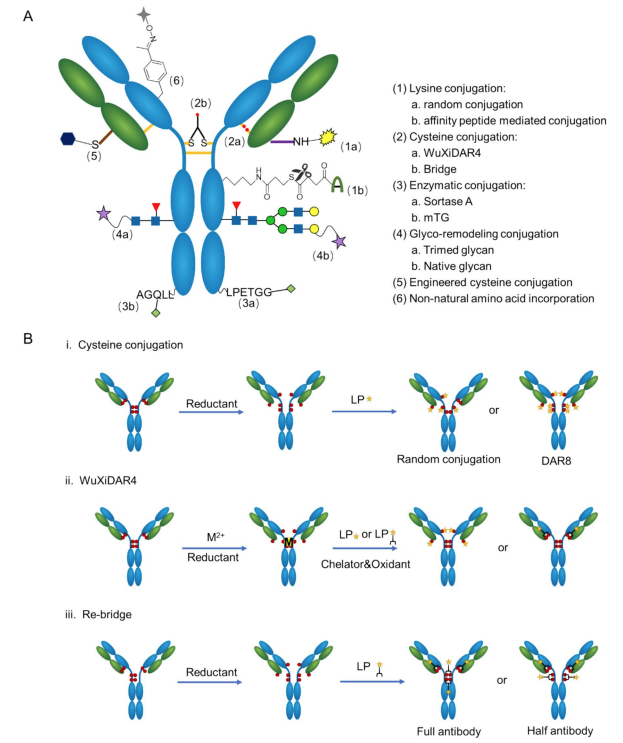 Note: Figures 1A/B in the text illustrate the site-specific coupling technology of ADCs and the process of interchain cysteine coupling.
(2) Enzyme-Mediated and Glycoengineering Coupling: Precision Modification Using “Biological Tools”
Enzyme-mediated coupling utilizes the property of enzymes to recognize specific amino acid sequences to attach the payload to the antibody, achieving high uniformity of ADCs. For example, Sortase A and transglutaminase (mTG) have been used in preclinical or clinical ADC development, but this technology requires sequence engineering modifications of the antibody and may introduce immunogenic risks, complicating the production process.Glycoengineering coupling targets the glycan chain at the N297 site of the antibody, introducing new glycosyl groups through enzymatic reactions, followed by click chemistry to connect the payload. Synaffix’s GlycoConnect™ technology has propelled six ADCs into clinical trials, but this process requires multiple enzymatic reactions, increasing production difficulty and costs; whereas endo S2 enzyme technology can achieve one-step coupling, potentially reducing CMC costs (Table 2).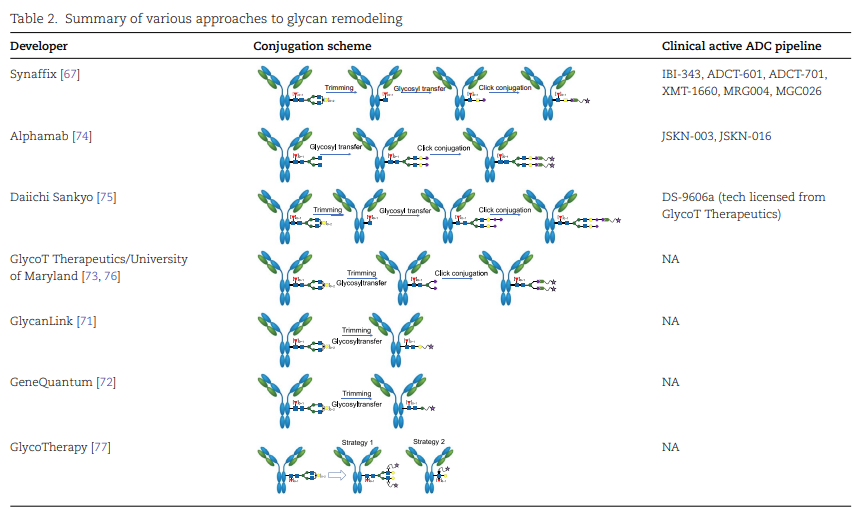
(3) Affinity Peptide Coupling: Using “Peptide Navigation” for Targeted Coupling
This technology utilizes affinity peptides derived from protein A/G to guide the linker-payload binding near specific lysine residues in the Fc region, achieving site-specific coupling. However, large non-natural peptides may affect the Fc function of the antibody, and the current mainstream research direction is to develop seamless affinity peptide coupling technologies to minimize interference with the antibody structure.
4. Fully Site-Specific Selective Coupling: The “Ultimate Goal” of ADC Coupling
This technology enables precise modification at a single site, includingengineered cysteine coupling and non-canonical amino acid (ncAA) coupling, allowing for the preparation of highly uniform ADCs that significantly improve their pharmacokinetics and safety.
(1) Engineered Cysteine Coupling: Customizing “Coupling Sites”
By genetically engineering specific amino acids in the antibody to cysteine, exclusive coupling sites (i.e., ThioMabs) can be created. Studies have shown that the position of the coupling site affects the stability of ADCs—for instance, the LC-V205C site of trastuzumab allows for greater stability, while the HC-S239C site’s conjugate hydrolyzes slowly, exhibiting stronger stability. Currently, several ADCs utilizing this technology have entered clinical phases I/II (Table 3), but some products have shown adverse reactions such as ocular toxicity, and their clinical advantages still require more data validation.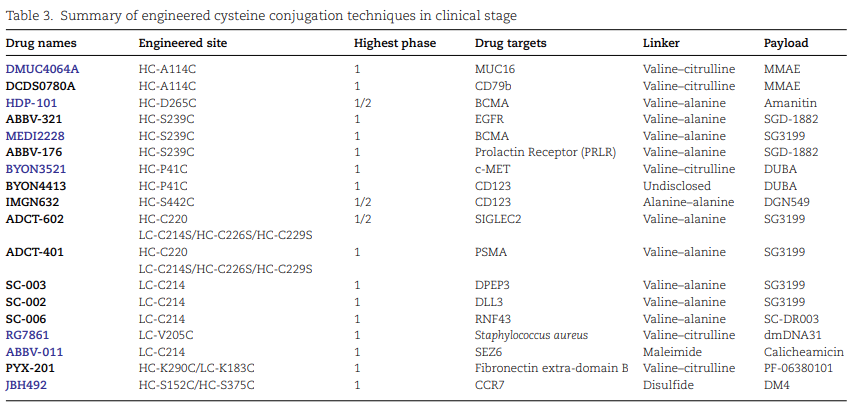
(2) Non-Canonical Amino Acid Coupling: Adding a “New Code” to Antibodies
By employing genetic code expansion technology, non-canonical amino acids (such as pAcF) can be introduced at specific sites in the antibody, followed by bioorthogonal reactions to connect the payload, resulting in highly uniform ADCs with a DAR of about 2. Ambrx’s EuCODE platform has propelled ncAA-ADCs targeting HER2 and PSMA into clinical trials, demonstrating superior PK and safety. However, the bottleneck of this technology lies inlow antibody expression levels, and scientists are addressing this issue by optimizing expression systems and utilizing cell-free expression platforms.
5. Challenges and Future Directions of ADC Coupling Technologies
Despite the continuous emergence of new coupling technologies, there remains a “translational gap” from preclinical to clinical applications: some technologies that perform excellently in animal models have not demonstrated expected advantages in human trials. Additionally, new technologies face CMC (Chemistry, Manufacturing, and Control) challenges, such as difficulties in antibody expression for non-canonical amino acid coupling and complex impurity removal in enzyme-mediated coupling.In the future, the development of coupling technologies will focus onenhancing uniformity, reducing immunogenicity, and simplifying production processes as the three main directions. With a deeper understanding of the mechanisms of ADCs and the accumulation of clinical data, coupling technologies that better meet therapeutic needs will continue to emerge, bringing more effective precision therapies to cancer patients.