
Introduction
Many people wonder about the conditions under which Wi-Fi signals are good or bad. Typically, we judge Wi-Fi signal quality by the number of bars displayed on the signal icon. But is there a quantifiable value or calculation formula for Wi-Fi signals? The answer is yes, and this chapter will introduce you to Wi-Fi signals.
01
Basics of Wireless Signals
In previous articles, it was mentioned that Wi-Fi transmits data through electromagnetic waves, which weaken as the distance increases and are easily obstructed, reflected, or refracted by obstacles.
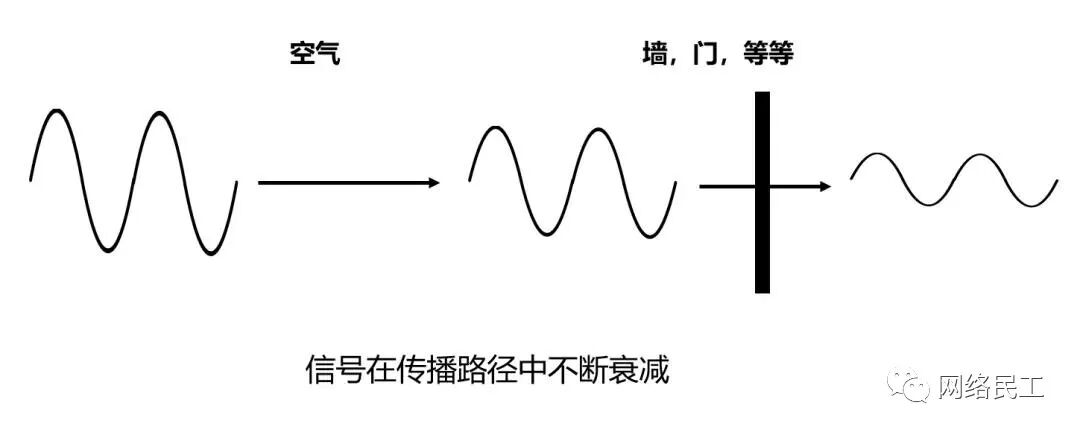
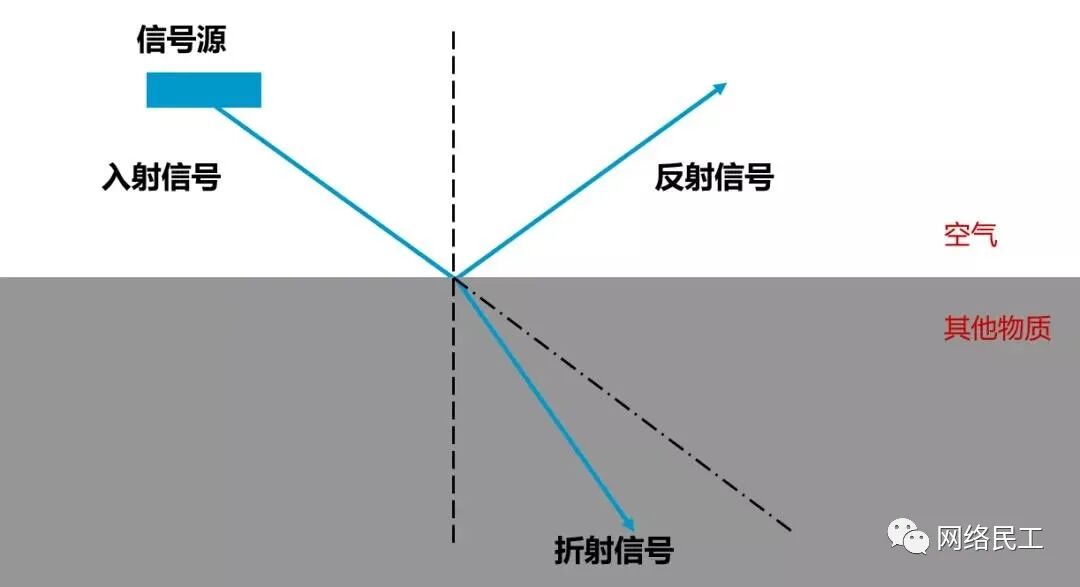
What we refer to as signal strength is actually power. The Radio Administration of China stipulates that the maximum transmission power for indoor APs cannot exceed 100mW, while for outdoor APs, it cannot exceed 500mW.
Wireless signals attenuate during transmission, and the power received by the user is a very small value. To make it easier to remember and express, we convert the unit of power into a more memorable value, which is the commonly used signal measurement unit in wireless networks: dBm.
The units for calculating wireless power include: dB, dBm, dBW, dBi.
Relative power is expressed in dB, which is the logarithmic form of the ratio of any two powers. For example, it is used to describe “gain” and “loss” in dB units.
Absolute power is expressed in dBm and dBW, which represent the dB value of the power to be measured against a known power, allowing for the measurement of absolute power magnitude.
The reference power is expressed in dBm when the reference power is 1mW.
The reference power is expressed in dBW when the reference power is 1W.
How do we convert wireless power to dBm?
The conversion formula from mW to dBm is: 10 × lg (measured power / reference power)
For example, if the transmission power of the AP is 100mW, substituting into the formula gives: 10 × lg (100mW / 1mW) = 10dBm × 2 = 20dBm. Therefore, we can also say that the transmission power of the AP is 20dBm. The most commonly used unit in wireless is dBm, so it is essential to understand the above calculation process.
Another commonly used unit is dBi, which is used to represent antenna gain and can be directly added or subtracted from dBm. For example, if an antenna has a gain of 3dBi, it means that the antenna can enhance the signal by 15dBm.
dB is a relative value and is only used when comparing two values. For example, if Computer 1 receives a power that is 2dB higher than Computer 2, the calculation formula is = 10 × lg (P1 / P2), which is a relative value without units and is used less frequently.
After reading the above explanation, if you still feel a bit confused, don’t worry; this is normal and takes time to digest. To convert mW to dBm, just use the formula. But how do we convert dBm back to mW?
There are two methods:
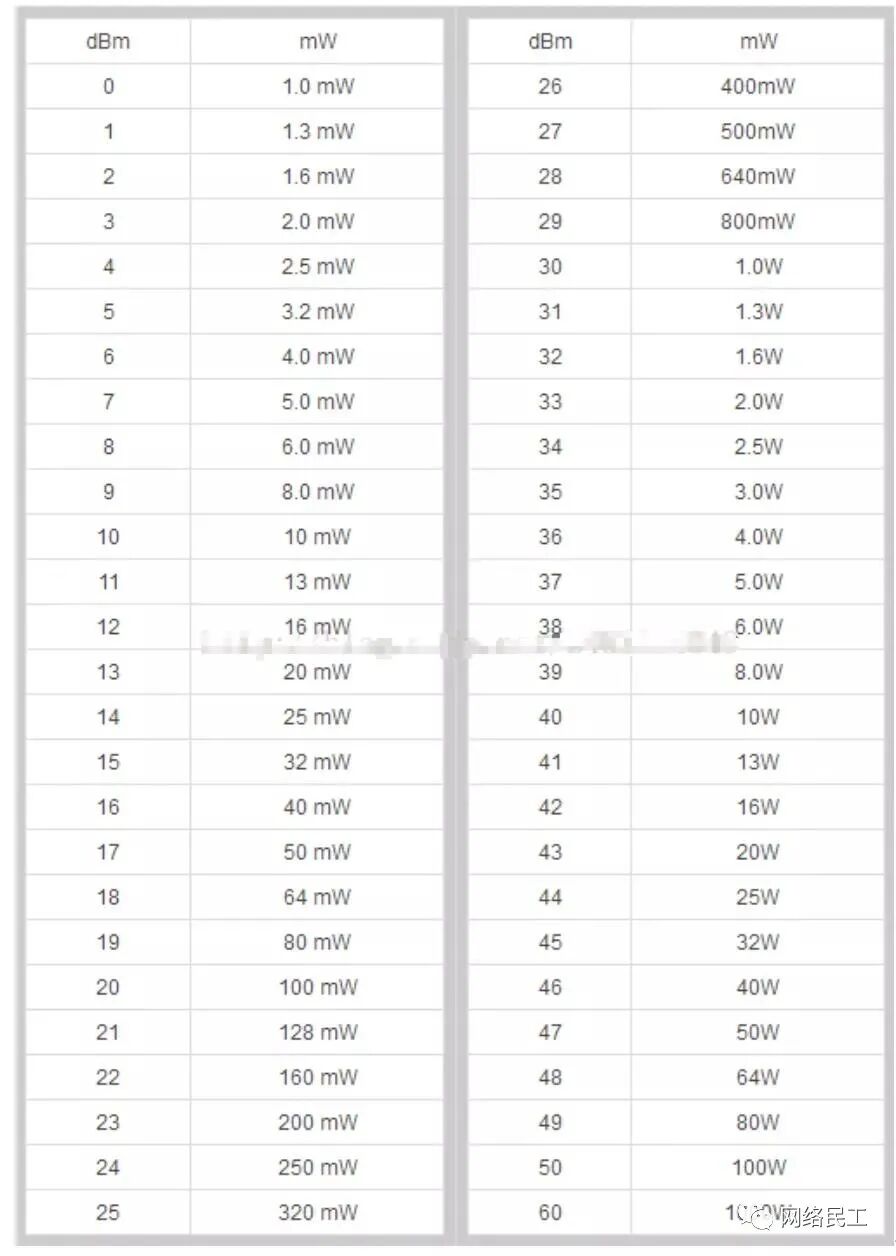
First Method: Look it up in a table
The conversion table for dBm and mW is as follows; remember a few key values: 0dBm, 20dBm, 27dBm.
Second Method: Split Calculation Method
For example, how much is 23dBm in mW? Remember the following rules:
dBm increases by 10, mW multiplies by 10; dBm decreases by 10, mW divides by 10;
dBm increases by 3, mW multiplies by 2; dBm decreases by 3, mW divides by 2.
First, break down 23dBm: 23dBm = 0dBm + 10dBm + 10dBm + 3dBm
0dBm represents 1mW, not 0mW, which is crucial to remember!
0dBm + 10dBm means multiplying the power by 10: 1mW * 10 = 10mW
0dBm + 10dBm + 10dBm means multiplying the power by 10 again: 10mW * 10 = 100mW
0dBm + 10dBm + 10dBm + 3dBm means multiplying by 2: 100mW * 2 = 200mW
Alternatively, you can remember that 20dBm = 100mW,
Then 23dBm = 20dBm + 3dBm, since dBm did not decrease by 3, mW is multiplied by 2, so the power at 23dBm = 100mW * 2 = 200mW.
02
Calculating Wireless Signal Attenuation
We usually use RSSI (Received Signal Strength Indication) to represent signal strength, which can be measured through software:
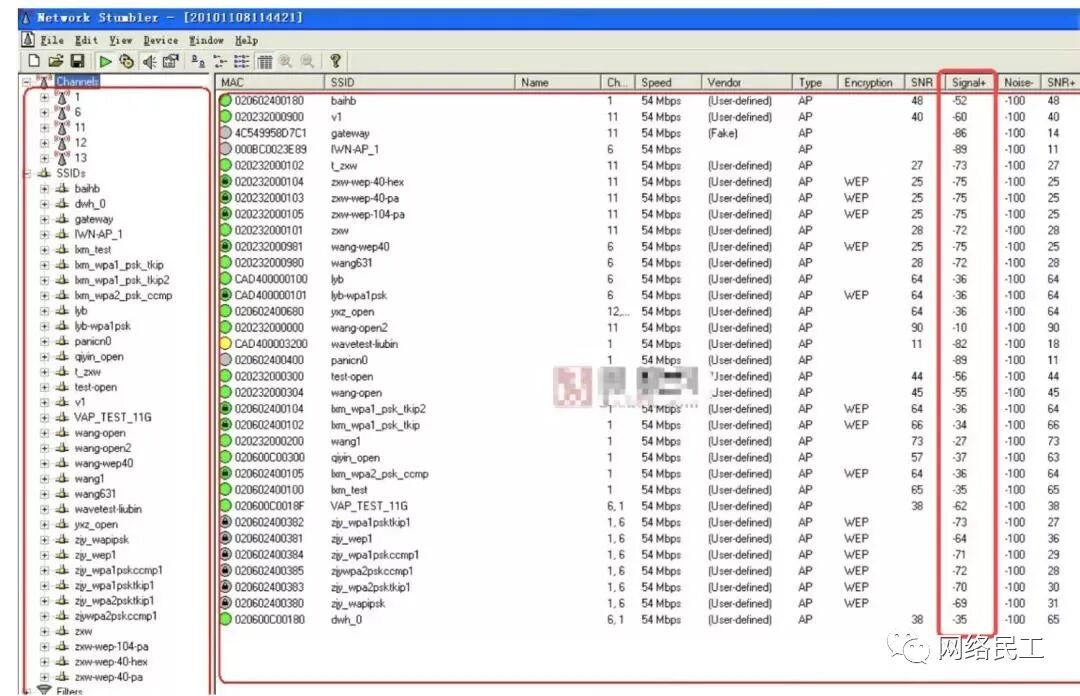
RSSI can be calculated using the following formula:

AP Transmission Power:This is easy to understand; as mentioned earlier, the maximum power for indoor APs is 20dBm, and for outdoor APs, it is 27dBm, with adjustable AP power.
Antenna Gain:All APs have antennas, but enterprise-grade APs usually have built-in antennas for aesthetic reasons. Antennas can enhance signals, with indoor AP antenna gain generally less than 10dBi, while outdoor AP antenna gain can reach 15dBi-18dBi.
Receiver Antenna Gain:Understanding the transmitting antenna makes it easy to understand the receiving end. Laptops and mobile phones have Wi-Fi antennas, but the antenna gain is generally small, as higher gain consumes more power.
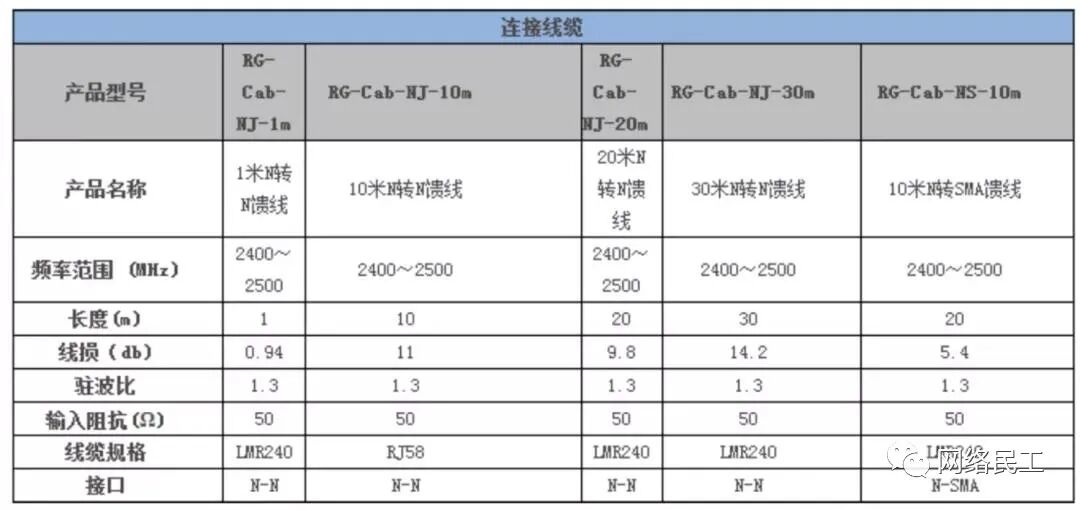
Line Loss:This is generally considered in indoor distribution/X distribution schemes. If the antenna feed line is long, such as 3-5 meters, the signal loss in the feed line needs to be calculated.
Free Space Loss:Wireless signals also experience loss when propagating through space, calculated using the following formula:
PathLoss(dB) = 46 + 10*n*LogD(m)
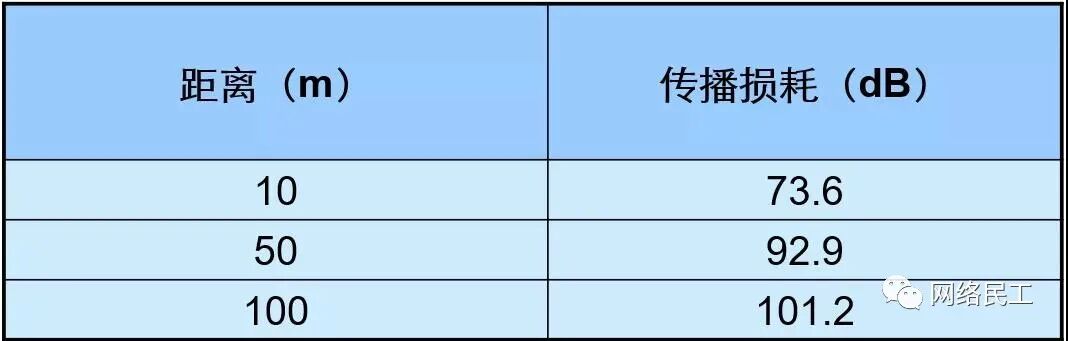
In general office environments, the value of n is taken as 2.76.
Obstacle Loss
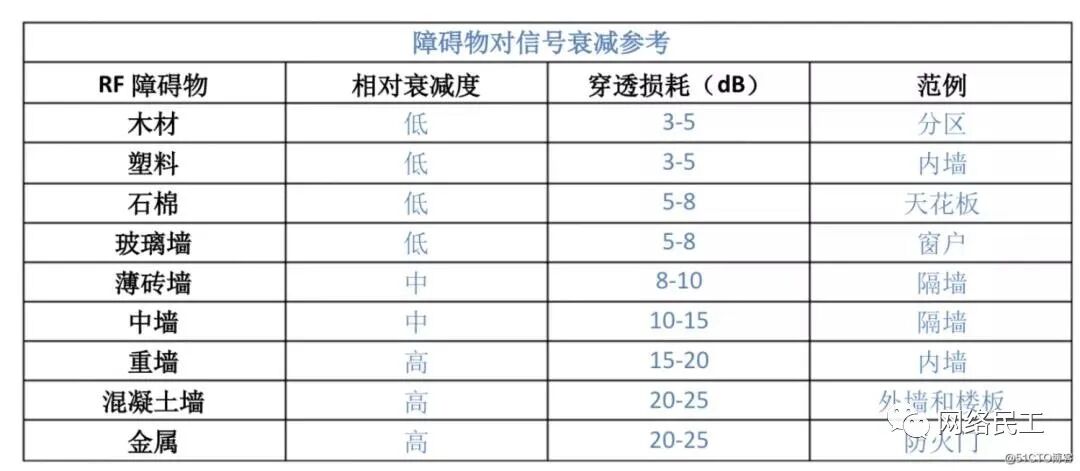
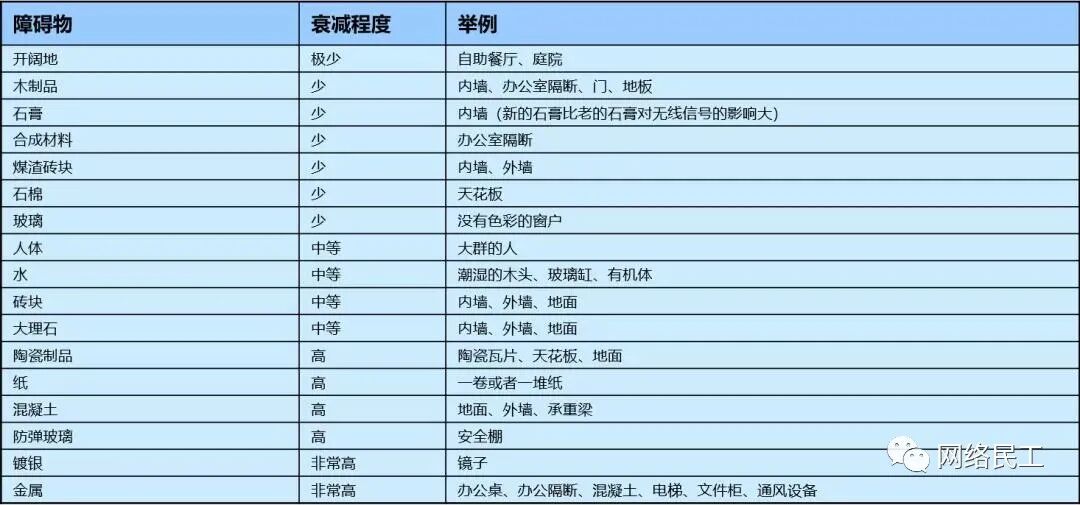
Attenuation Calculation Case Study: Indoor WLAN Signal Attenuation

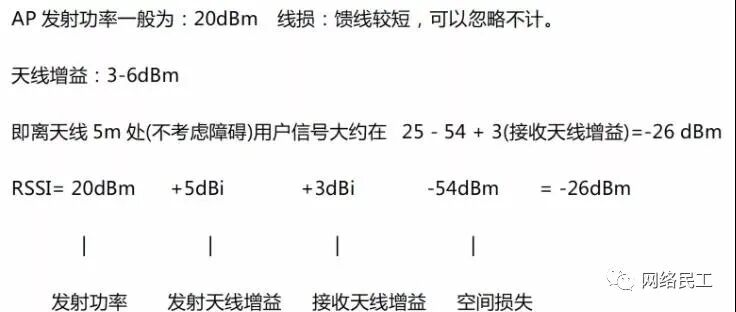
Based on experience: for most terminals, a signal strength of -75dBm or better is suitable. For handheld devices like smartphones and PDAs, -65dBm is the critical value.
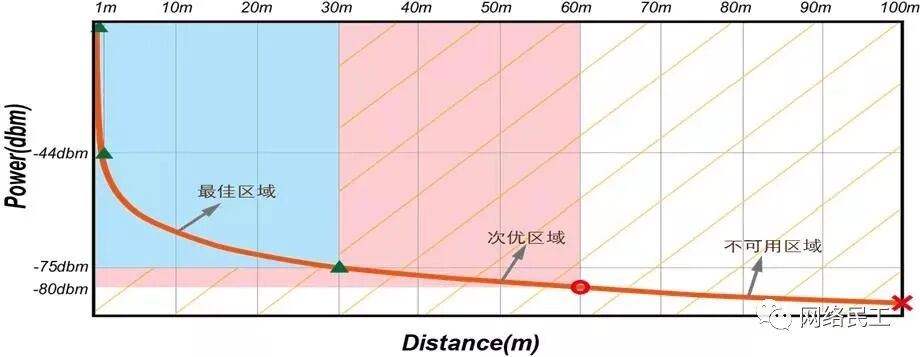
Therefore, the calculated user reception signal is -26dBm, which is less than -65dBm, allowing all types of terminals to have strong signal strength and a good wireless experience. Of course, this value does not consider obstacle attenuation, which is an ideal value; in real scenarios, it is impossible to have no obstacle attenuation.
Alright, this concludes the introduction to quantifying and calculating wireless signals.
03
Why is the Signal Good but the Internet Speed Poor?
Why can we receive Wi-Fi signals well in outdoor scenarios like tourist attractions and airports, but cannot connect to the internet or have a poor wireless experience?
1. These scenarios generally use outdoor APs,which have high transmission power and use high-gain antennas. You can receive the AP’s transmitted signal, and the signal is strong. However, your terminal has low transmission power and low antenna gain, so the data you send back to the AP may not reach it. Communication is bidirectional; if data cannot be returned or is lost in large amounts, the internet will naturally be slow or even inaccessible.
2. Too many terminals connected to the AP,exceeding the AP’s processing capacity. When the number of connections exceeds the AP’s capacity, either you cannot connect, or the experience is very poor.
3. Interference from co-frequency or other devices,leading to high air utilization of the AP. In this case, even if the signal strength is strong, the wireless experience can still be very poor.


Screenshots of Electronic Books in the Resource Collection

Complete Hardware Resource Collection