Stretchable Hydrogel Optical Memristor for Photonic Near-Sensor Neuromorphic Skin
DOI::10.1002/adfm.202419937
Corresponding Authors:Professors Zhang Shiming and Wang Zhongrui from the University of Hong Kong
Literature Link:
https://doi.org/10.1002/adfm.202419937

The development of skin-like optical memristors is crucial for wearable photonic neuromorphic computing, enabling ultra-fast artificial neural networks for edge information processing. However, most existing optical memristors are made from rigid materials, which pose challenges when integrating with soft photonic sensors and increase the risk of device failure under large strains. Additionally, the photonic matrix of strain-disturbed vector multipliers (PMVM) may fail when stretched. This paper proposes a design strategy utilizing hydrogel waveguides with transverse surface coloring (TSC) to create stretchable optical memristors that achieve strain-invariant PMVM. These stretchable optical memristors provide over 4 different non-volatile storage states (>10⁴ seconds). By using the stretchable optical memristors as bending sensors and strain-invariant PMVM, we demonstrate a system capable of real-time gesture recognition (latency <0.5 ns) with an accuracy of 95.5%, functioning normally even under 30% strain. This seamless integration of sensing, storage, and processing capabilities in photonic near-sensor neuromorphic skin paves the way for the development of future wearable photonic devices.

The emergence of artificial intelligence has sparked widespread interest in developing integrated skin-like photonic neuromorphic computing systems that process optical data locally with high parallelism, low latency, and large bandwidth. This presents tremendous potential for applications such as smart wearable photonic sensors and human-machine interfaces. However, for such photonic neuromorphic systems to be wearable or implantable, they must exhibit mechanical flexibility and stretchability. It has proven challenging to create a photonic computing system that closely resembles human skin, primarily due to the differences between the soft, dynamic characteristics of human skin and the rigid, brittle components of contemporary photonic computing elements, such as micro-ring resonators (which modulate light through precise coupling and resonance), Mach-Zehnder interferometers (which adjust transmission matrices through nanoscale optical path modulation), diffraction layers (which manipulate electromagnetic field distributions through interference and diffraction), and absorption waveguide-based optical memristors (which modulate light through absorption segments). This physical mismatch often leads to device failure, discomfort during wear, and incompatibility with soft photonic sensors and actuators.
So far, two approaches have been used to achieve stretchability in wearable devices: strain engineering, which involves mechanical geometric designs (i.e., mechanical geometric designs such as wave patterns, serpentine, buckling, origami, and kirigami), and utilizing inherent stretchable materials (i.e., elastic insulators/semiconductors/conductors). For photonic neuromorphic systems, adhering to strict requirements for optical coupling distances, optical path lengths, and layer-by-layer architecture complicates strain engineering. This is where the potential of photonic neuromorphic devices built on inherent stretchable materials (such as stretchable optical memristors) lies. Stretchable optical memristors can be fabricated into waveguide structures, featuring low-cost, solution-based manufacturing processes compatible with soft and stretchable materials. Furthermore, optical signals maintain their integrity in stretchable optical memristors as they are encoded as light intensity, regardless of coherence, phase, or attenuation wave coupling distances, all of which are highly strain-sensitive. The non-volatile nature of optical memristors and their analog “memory” can be developed into photonic matrix vector multipliers (PMVM), which perform most operations in neuromorphic computing.
However, according to Beer-Lambert’s law, the transmittance and strain loss coefficient of optical memristors depend on the concentration of dopants and the absorption coefficient. Therefore, optical memristors with lower transmittance degrade faster during stretching, disrupting the functionality of PMVM. This emphasizes the necessity of developing strain-invariant PMVM, a key but underreported milestone for skin-like photonic neuromorphic systems.
Here, we propose a novel and universal solution for skin-like photonic neuromorphic computing using stretchable optical memristors (see Figure 1). We first developed a photochromic hydrogel composed of polyacrylamide (PAAm) doped with polyoxometalates (POMs), which has inherent stretchability (see Figure S3 (Supporting Information) for optical images of POM-doped PAAm hydrogel). The POM-doped PAAm hydrogel is a negative feedback photochromic material that transitions between a reduced state with transverse surface coloring (TSC) and a colorless oxidized state under ultraviolet irradiation and oxygen exposure, as shown in Figure 1b (see Note S1, Supporting Information). By fabricating waveguides with this hydrogel, as shown in Figure 1c, we demonstrate its ability to retain information in a non-volatile manner during programming via transverse ultraviolet pulses (Figure 1d), establishing the status of hydrogel waveguides as stretchable optical memristors. Our measurements show a maximum attenuation of 12 dB, with 16 different memory levels, and a retention time exceeding 10 dB^4 seconds. Additionally, we demonstrate that stretchable optical memristors can function as bending sensors, utilizing frustrated total internal reflection (Figure 1e). By integrating the bending sensor with PMVM (see Figure 1f), we achieve a proof of concept for a photonic near-sensor neuromorphic skin capable of real-time gesture recognition. Importantly, stretchable optical memristors can maintain a constant normalized transmittance under strain (Figure 1g), enabling strain-invariant PMVM to recognize gestures (Figure 1h), whether in a relaxed state (Figure 1i) or stretched state (Figure 1j). Our findings overall provide a new paradigm for the next generation of photonic near-sensor neuromorphic skin, encompassing theoretical analysis, material development, device design, and conceptual demonstrations.

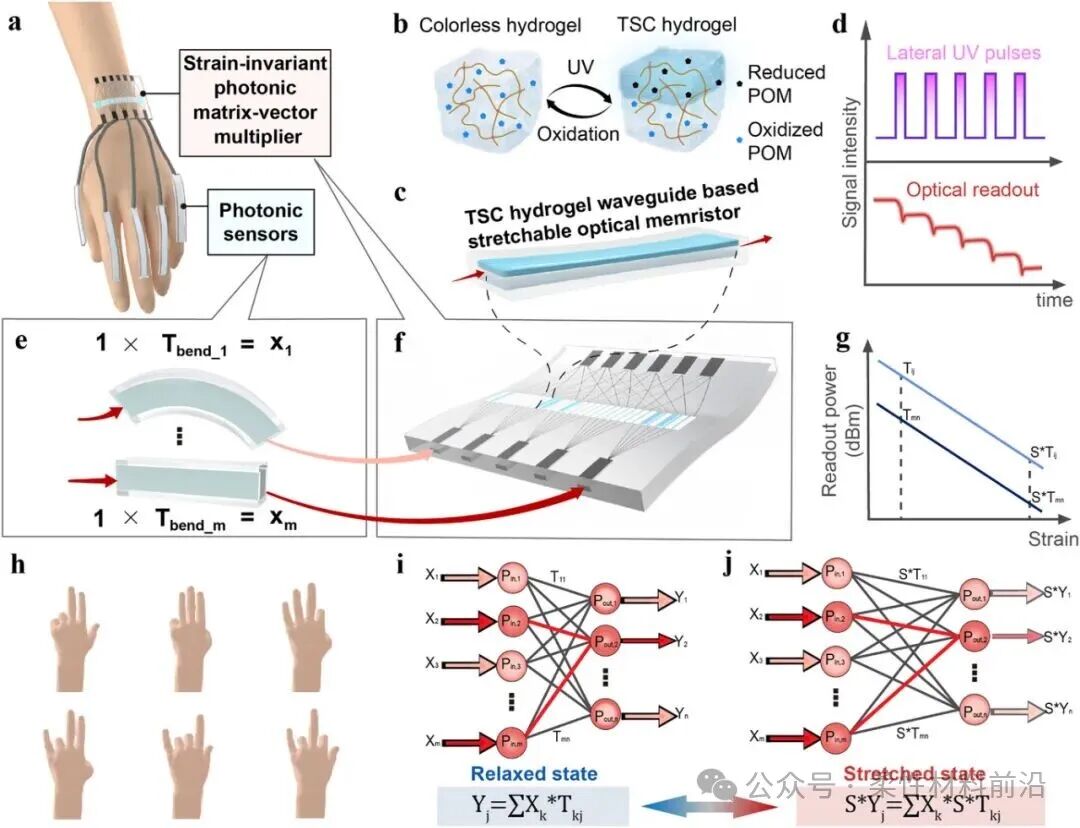
Figure 1. Stretchable optical memristor based on transverse surface coloring hydrogel waveguides for photonic near-sensor neuromorphic skin

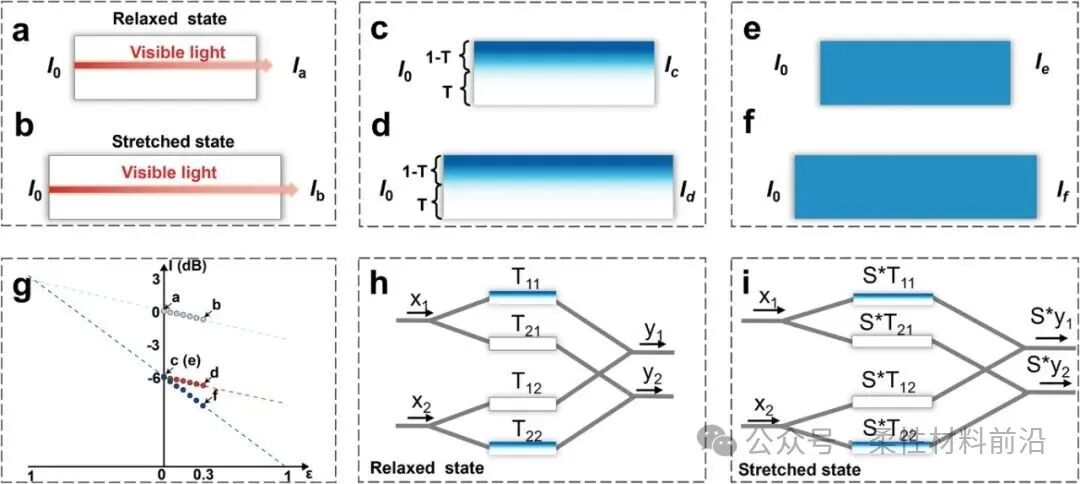
Figure 2. Theoretical analysis of strain-invariant PMVM TSC waveguides. a–f) Optical loss diagrams in hydrogel waveguides under different coloring and strain states. Visible inferred light with input power I0 enters the left wall of the waveguide, producing output power measured on the right wall (e.g., Ia or Ib). Due to inherent losses, the colorless relaxed waveguide (a) shows the highest output intensity at point “a” in panel (g). Stretching the colorless waveguide (b) causes additional strain losses, reducing output intensity, marked as point “b” in panel (g). Transverse ultraviolet irradiation converts the transparent negative feedback photochromic dopant into an absorbing element, producing TSC (c), with output intensity marked as point “c” in panel (g). Stretching this TSC waveguide (d) causes the same strain losses as the colorless waveguide, marked as point “d” in panel (g). In contrast, ultraviolet irradiation modulates the transmittance of the positive feedback photochromic dopant, leading to body coloring (e). Stretching this bulk-colored waveguide (f) results in greater strain losses, marked as point “f” in panel (g). g) Theoretical (dashed line) and experimental validation (solid points) of the strain-invariant behavior of hydrogel waveguides under mechanical deformation. The transmission power of hydrogel waveguides was measured under three conditions: colorless state, TSC, and BC. The strain loss coefficient of TSC-modulated waveguides (slope “cd”) is the same as that of colorless waveguides (slope “ab”), confirming the strain-invariant normalized transmittance. In contrast, BC-modulated waveguides show a greater strain loss coefficient (slope “ef”), indicating their unsuitability for strain-invariant photonic matrix vector multiplication (PMVM). h, i) Schematic of a strain-invariant PMVM based on 2×2 TSC hydrogel waveguide arrays in relaxed state (h) and stretched state (i).
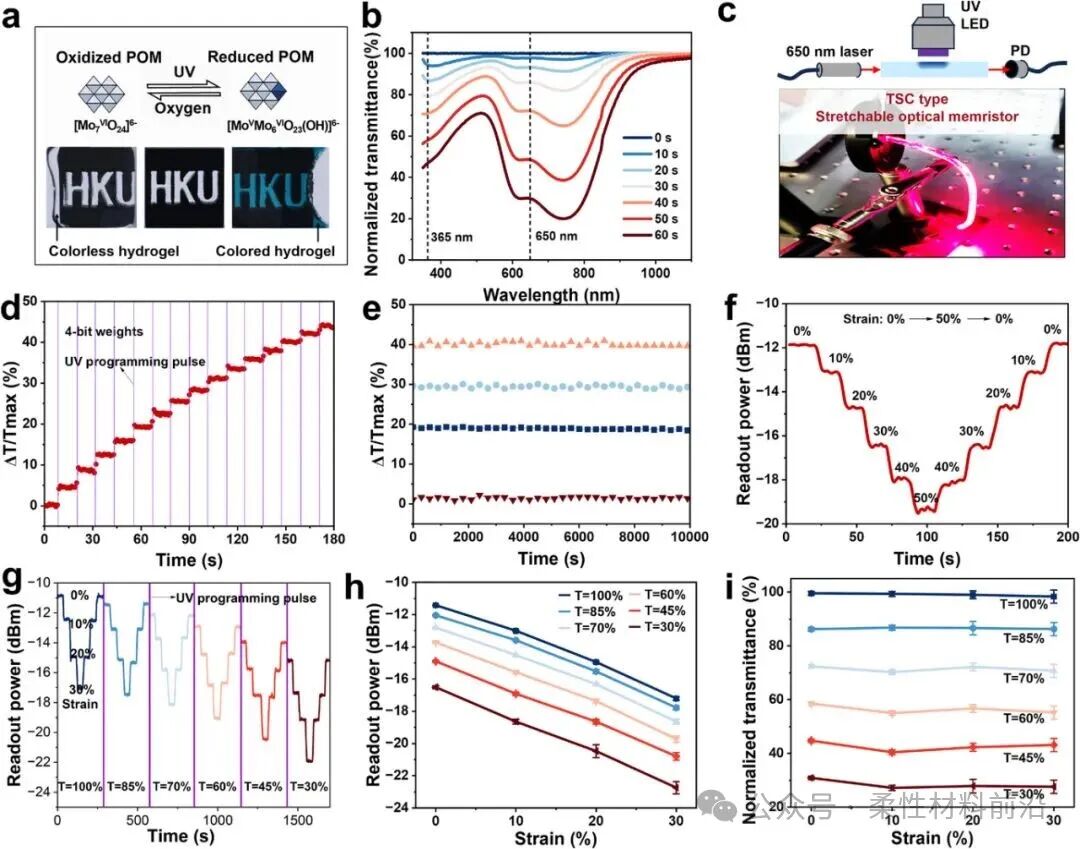
Figure 3. Experimental demonstration of stretchable optical memristors based on TSC hydrogel waveguides. a) Schematic and photo demonstration of the ultraviolet-induced reduction and oxygen-induced oxidation of polyoxometalate (POM) dopants in photochromic hydrogels (bottom image). b) Transmission spectra of photochromic hydrogels under ultraviolet irradiation. The changes in transmittance at 365 nm and 650 nm wavelengths under 365 nm ultraviolet light indicate a negative feedback photochromic response. c) Schematic of the photochromic programming and readout process of hydrogel waveguides (top image), and optical image of stretchable optical memristors based on TSC hydrogel waveguides (bottom image). d) The stretchable optical memristor’s 4-bit weight obtained through repeated ultraviolet pulses (0.1 s, 1100 mW cm-2). The purple vertical line indicates the UV programming pulse. e) Achieving a retention time of 104 seconds under low oxygen concentration (100 ppm). f) Time response of the readout power of stretchable optical memristors under staircase strains up to 50%, with increments of 10%. g) Time response of readout power of stretchable optical memristors during cyclic stretching and UV programming. The optical memristor is programmed by ultraviolet pulses at the end of each cycle. h) The decay of readout optical memristors varies with applied strain at different relaxed transmittances. Error bars represent three sets of measurements. A consistent strain loss coefficient is observed from the parallel slopes of the line. i) Normalized transmittance of stretchable optical memristors as a function of strain (with different relaxed state transmittances).
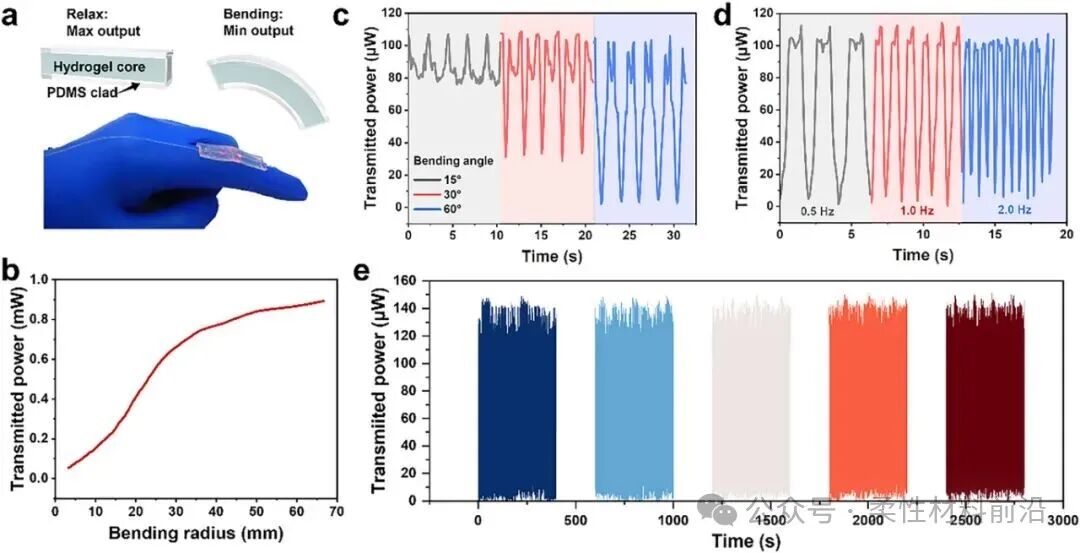
Figure 4. Stretchable optical memristors as photonic bending sensors. a) The upper panel shows the sensing mechanism of stretchable optical memristors. The lower panel is an optical image of a bending sensor based on stretchable optical memristors. Straight (bent) TSC waveguides allow (impede) total internal reflection, resulting in maximum (minimum) readout power. b) The simulated readout power of the bending sensor as a function of bending radius. c, d) Time response of the bending sensor at different bending angles (c) and different frequencies (d), with transmittance decreasing as bending angle increases, but not varying with frequency. e) Mechanical durability of 2000 consecutive bending-relaxation cycles without degradation.
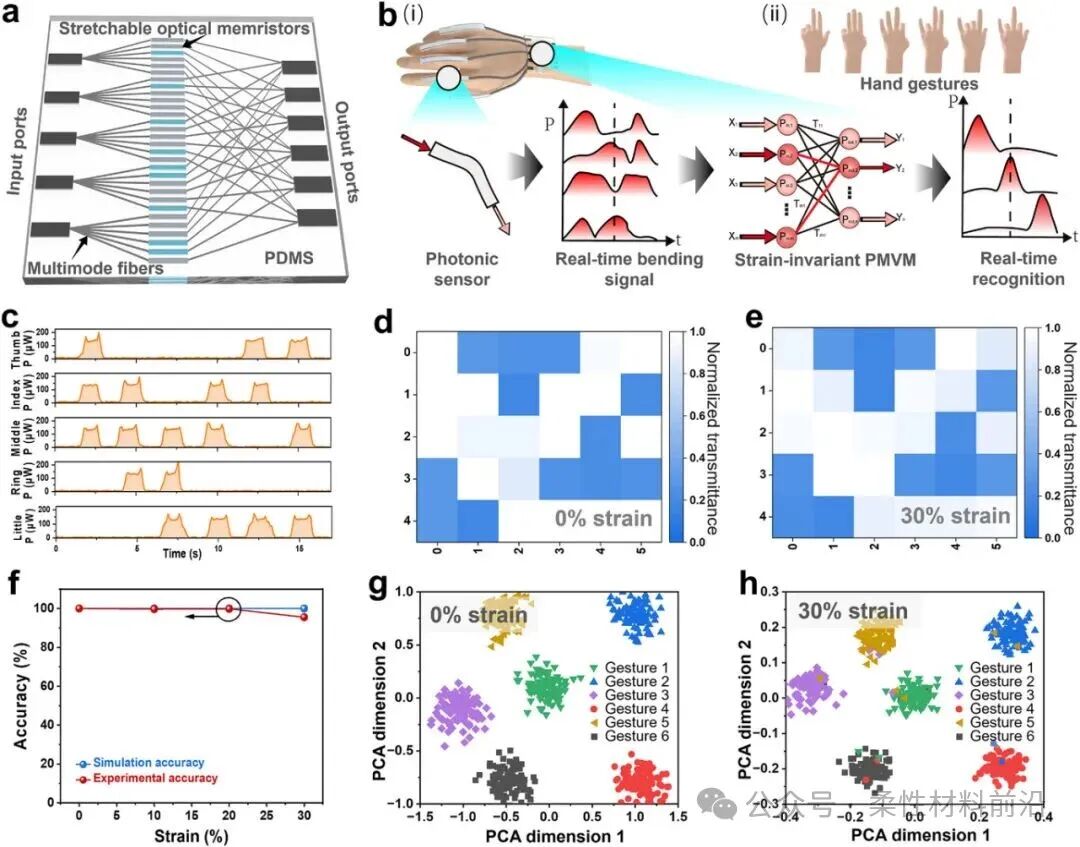
Figure 5. Experimental demonstration of photonic near-sensor neuromorphic skin for real-time gesture recognition. a) Illustration of the stretchable photonic neural network of the neuromorphic skin. b) Schematic of the gesture classification pipeline using photonic neuromorphic skin, along with different categories of gestures. c) Experimental real-time finger bending signals of different gestures (instantaneous readout power of stretchable optical memristors). d, e) Normalized transmittance of stretchable optical memristors under (d) 0% strain and (e) 30% strain. f) Recognition accuracy as a function of strain. g, h) Distribution of outputs from the photonic neuromorphic skin for 600 gestures using principal component analysis (PCA) under (g) 0% strain and (h) 30% strain.
In summary, using TSC hydrogel waveguides, we have developed for the first time stretchable optical memristors and strain-invariant PMVM for the first stretchable photonic neuromorphic computing system (see Supporting Information Table S1). Additionally, the same stretchable optical memristors utilize frustrated total internal reflection functionality as bending sensors. An array of stretchable optical memristors can simultaneously sense and process information across the entire optical domain, achieving a recognition accuracy of 95.5% even under 30% strain, while also exhibiting ultra-low inference latency (<0.5 ns) and inherent electromagnetic interference safety compared to other electronic/photonic skins (see Supporting Information Table S2). To achieve reversible weight programming, we explore an oxygen scavenging mechanism that resets the hydrogel optical memristor to a high transmittance state by exposure to oxygen, oxidizing the POM dopants, thus allowing for further reprogramming (see Supporting Information Note S6). Currently, we provide optical input through an external LED light source connected via multimode optical fibers, but there is potential to directly integrate luminescent polymers or electroluminescent sources into the PDMS cladding of the hydrogel waveguides to enhance practicality (see Supporting Information Note S7). Its flexibility, stretchability, low latency, and resistance to electromagnetic interference make it promising for wearable and implantable AI systems in health informatics, human-computer interaction, and augmented reality.

Molecular Design: Polyoxometalates (POMs) doped polyacrylamide (PAAm) to construct photochromic hydrogels
Structural Characterization: UPS, XPS, SEM, EDS
Performance Applications: Electronic skin, wearable devices, human-computer interaction

 Experts and scholars are welcome to submit manuscripts to [email protected] (please indicate detailed contact information when submitting)