Unveiling the Ultraviolet Nitrate Sensor – Core Definition Interpretation
Ultraviolet nitrate sensors, as specialized devices for accurately detecting nitrate levels in water, utilize the principle of ultraviolet spectral analysis. By measuring the degree of absorption of specific wavelengths of ultraviolet light by water, they can infer the concentration of nitrates. These sensors offer advantages such as real-time monitoring, fast response times, high detection accuracy, and minimal or no chemical reagents required, effectively avoiding the cumbersome processes and secondary pollution risks associated with traditional detection methods. They are essential tools for monitoring nitrate levels in water, widely applicable in fields with strict water quality control requirements such as wastewater treatment, environmental monitoring, and aquaculture.
Global Ultraviolet Nitrate Sensor Market: Scale and Growth Potential
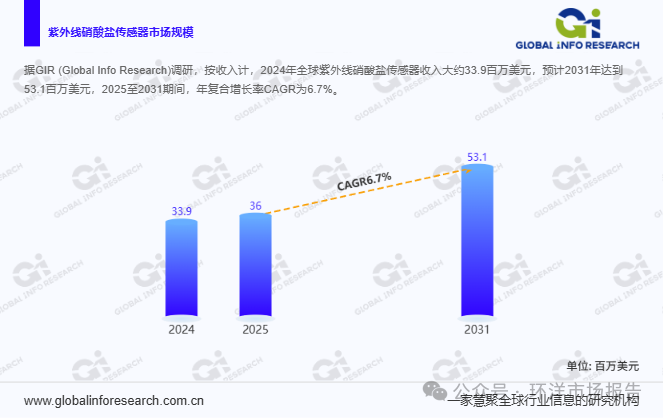
According to the research report “2025 Global Market Overview of Ultraviolet Nitrate Sensors: Overall Scale, Major Manufacturers, Key Regions, Product and Application Segmentation” published by Global Info Research, the global ultraviolet nitrate sensor market revenue is expected to reach approximately $33.9 million by 2024. With the increasing emphasis on water quality safety and stricter environmental protection policies worldwide, this market shows steady growth potential. It is projected that by 2031, global market revenue will rise to $53.1 million, maintaining a compound annual growth rate (CAGR) of 6.7% from 2025 to 2031. The report spans 11 years of industry data, covering historical data from 2020 to 2024 and extending forecast data to 2025 to 2031, providing comprehensive insights into market size, manufacturer product characteristics, and other key information to grasp industry dynamics.
Focus on Classification – Ultraviolet Nitrate Sensor Survey Object Division
Based on the product types of ultraviolet nitrate sensors, they are mainly divided into the following two categories:
- Single-channel ultraviolet nitrate sensor: This type of sensor has only one detection channel, focusing on detecting nitrate levels in a single water sample. Its structure is relatively simple and cost-effective, suitable for scenarios with single detection needs and small sample sizes, such as daily water quality monitoring in small aquaculture farms and small-scale testing in educational and research institutions, meeting basic nitrate concentration monitoring needs.
- Multi-channel ultraviolet nitrate sensor: Multi-channel sensors have multiple independent detection channels, allowing simultaneous monitoring of multiple water samples or different parameters of the same water sample (some models may be compatible with other water quality indicators). They offer higher detection efficiency and more flexible functionality, suitable for large-scale water quality monitoring scenarios, such as real-time monitoring at multiple points in large wastewater treatment plants and synchronized water quality detection in environmental monitoring departments, enhancing monitoring coverage and data acquisition efficiency.
Scenario Adaptation – Downstream Applications of Ultraviolet Nitrate Sensors
The downstream applications of ultraviolet nitrate sensors are closely related to water quality monitoring needs, mainly concentrated in the following key areas:
- Wastewater Treatment: In the treatment of industrial wastewater and domestic sewage, sensors can monitor changes in nitrate concentration in real-time, helping staff accurately adjust treatment processes (such as denitrification stages) to ensure that the nitrate content in the effluent meets discharge standards, preventing eutrophication pollution in natural water bodies. They are important monitoring tools for ensuring compliance in wastewater treatment.
- Aquaculture: High nitrate levels in aquaculture water can harm aquatic life. Sensors can monitor nitrate concentrations in aquaculture water in real-time, providing timely warnings when concentrations exceed safe limits, assisting farmers in adjusting water change frequency or adding conditioning agents to ensure a stable farming environment, improving survival rates and product quality.
- Seawater Desalination: During the desalination process, it is necessary to control the content of impurities such as nitrates to ensure freshwater quality. Sensors can detect nitrate levels in water before and after desalination, verifying the effectiveness of the desalination process while monitoring the stability of desalinated water quality, providing data support for optimizing the operation of seawater desalination equipment.
- Food and Pharmaceuticals: In food processing (such as drinking water preparation and beverage production) and pharmaceutical production, the nitrate content of raw materials and production water must meet strict standards. Sensors can accurately detect water quality to ensure safety during production processes, avoiding nitrate exceedance that could affect product quality and human health.
- Education and Research: Research institutions and universities can use sensors to provide high-precision nitrate concentration data in water quality-related studies (such as aquatic ecological cycles and pollutant migration patterns), assisting researchers in conducting experiments and data analysis, providing reliable technical support for water quality research.
- Environmental Monitoring: Environmental monitoring departments can utilize sensors for long-term fixed-point monitoring of natural water bodies such as rivers, lakes, and reservoirs, keeping real-time track of changes in nitrate levels, promptly identifying issues such as agricultural non-point source pollution and industrial discharges, providing data for water resource protection and pollution control decision-making.
- Other Applications: In addition to the above scenarios, sensors are also used in drinking water pipeline quality monitoring, agricultural irrigation water testing, and other fields. As the emphasis on water quality safety increases, their application scenarios continue to expand.
Driving Growth – Factors Behind the Ultraviolet Nitrate Sensor Market
The robust growth of the global ultraviolet nitrate sensor market is driven by multiple factors. Firstly, the tightening of environmental protection policies in various countries worldwide has raised water quality standards for wastewater discharge and natural water body protection, expanding the mandatory monitoring scope and directly boosting sensor demand. Secondly, industries such as aquaculture and food and pharmaceuticals are increasingly prioritizing product quality safety, proactively increasing investments in water quality monitoring and expanding sensor application scenarios. Additionally, continuous upgrades in sensor technology (such as low power consumption and optimized wireless transmission functions) have enhanced the applicability and convenience of devices in complex environments, while the acceleration of information technology construction in environmental monitoring has promoted the integrated application of sensors in smart water quality monitoring systems, providing sustained momentum for market growth.
Core Enterprises in the Global Ultraviolet Nitrate Sensor Field
Major companies in the global ultraviolet nitrate sensor market include Endress + Hauser, HACH (Veralto), Xylem, Sea-Bird Scientific (Veralto), Bürkert, and OTT HydroMet (Veralto).
Looking Ahead – Future Prospects of the Ultraviolet Nitrate Sensor Market
In summary, the global ultraviolet nitrate sensor market is in a phase of steady growth. With the further popularization of environmental awareness, continuous upgrades in water quality monitoring standards, and advancements in smart monitoring technology, downstream applications will increasingly demand precision, stability, and intelligence (such as wireless data transmission and remote control) from sensors. At the same time, breakthroughs in cost control and functional integration (such as multi-parameter integrated monitoring) by sensor manufacturers will further expand their application boundaries. It is foreseeable that during the forecast period from 2025 to 2031, the global ultraviolet nitrate sensor market will continue to maintain a CAGR of 6.7%, providing key technical support for water quality safety control and offering broad development opportunities for market participants.
The article is excerpted from the “2025 Global Market Overview of Ultraviolet Nitrate Sensors: Overall Scale, Major Manufacturers, Key Regions, Product and Application Segmentation” published by Global Info Research, which deeply analyzes the ultraviolet nitrate sensor market through professional market research methods and thoroughly examines the impact of competitors in the ultraviolet nitrate sensor market on U.S. tariff policies and various countries’ responses, including regional economic performance and supply chain effects.