 01Introduction
 In the legendary stories of wireless communication, the name Hedy Lamarr always shines brightly and is filled with controversy. Not only was she a Hollywood screen goddess, but she was also hailed as the inspiration for Wi-Fi due to her groundbreaking “frequency hopping” technology. However, there are often exaggerations and misunderstandings about her true impact on the birth of Wi-Fi. Today, we will not discuss myths but restore the facts—let us re-understand this woman who truly changed the world of communication through an authoritative interpretation from IEEE.
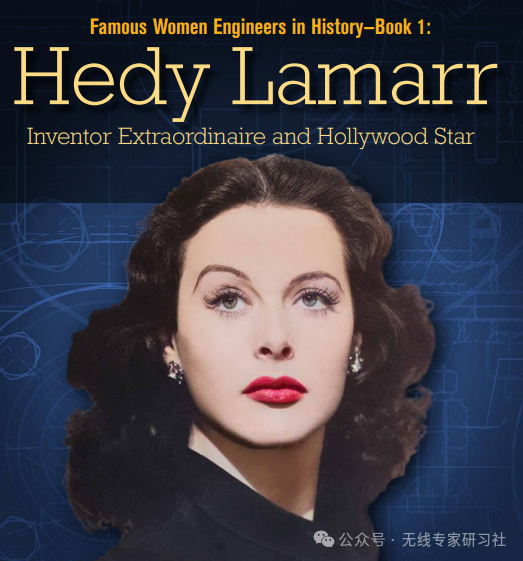 This article references the IEEE Famous Women Engineers in History — Book series edited by Paul Lief Rosengren.02Bringing Order to a Chaotic World
 Hedwig Kiesler (Hedy Lamarr’s original name) enjoyed walking in the woods of Austria with her father, who would explain to her how the world around her worked—not just nature, but also trams, electricity, traffic lights, and machinery. Despite not having formal scientific education, she spent her life utilizing her experiences—observing nature, attending business meetings on ammunition development, or simply contemplating to conceive innovations and inventions.In an interview with journalist Fleming Marks, Kiesler, now known as Hedy Lamarr, remarked, “Maybe I come from a different planet. Who knows? But in any case, inventing comes easily to me.”Unfortunately, for Lamarr, her intelligence was often overlooked or disparaged—because she lacked academic credentials, was from Austria, was a movie star, or simply because she was a woman. She was told early on that she was too beautiful to pursue her interest in science.But this did not stop Lamarr.In the words of Richard Rhodes, who wrote her biography, “Hedy invented to challenge and please herself and to bring order to what she saw as a chaotic world.”Whether to escape a stifling marriage, break free from the control of the studio, aid in the war, increase the speed of airplanes—or simply to improve the flaws she saw in the world around her, Lamarr indeed possessed an engineer’s mind—always working to make the world a better place.03Escape to London
 It was not uncommon for Castle Schwarzenau to host dinners with 20 to 30 guests, but tonight was special. Hedwig Kiesler Mandl persuaded her husband Friedrich Mandl to take out jewelry so she could make an extraordinary entrance (without mentioning her true reason—her impending escape).When Hedwig walked into the room, all the guests, who were the Austrian social elite, immediately fell silent—some even gasped. This was not only because Hedwig was an unparalleled beauty, dressed in the latest Viennese fashion, but also because she was adorned with priceless jewelry that sparkled under the grand chandelier’s light.Many in the room surely envied her for being married to one of the wealthiest men in Austria. Mandl married her when she was just 18, and he was 33. He saw Hedwig in the stage play “Sissy”—a production about Empress Elisabeth of Austria—and became infatuated with the young actress, persistently using his charm and immense wealth to persuade her to marry him. Shortly after their marriage, the couple moved to the family castle near the Czech border.However, the fairy tale was merely an illusion. Mandl was extremely controlling, always worried that his young wife might have an affair. He did not allow Hedwig to socialize without a chaperone; he even had maids listen in on all her phone calls. He forced her to convert to Catholicism to avoid trouble with his German clients (she was Jewish, and Friedrich’s father was as well).The most difficult part for Hedwig was that Mandl also forbade her from pursuing her passion—acting.Lamarr later described her time with Mandl as living in a “golden cage,” saying, “I felt like a doll placed in a beautiful jewelry box. I was watched and guarded day and night.”Mandl also spent nearly $300,000 (equivalent to nearly $5 million today) trying to buy and destroy every copy of the film “Ecstasy” in which Hedwig starred, but he was unsuccessful. He had not seen the film before their marriage, but after returning to the castle, he privately screened it. He was shocked. The film contained scenes of her swimming nude and running naked in the woods, as well as an explicit intimate scene. “Ecstasy” was banned in both the United States and Germany— in the U.S. for immorality; in Germany because the star was Jewish.The dinner guests at the castle included many royal family members and industrial and political elites from across Europe. Italian dictator Benito Mussolini was a guest at one of the gatherings; he insisted on sitting next to Hedwig at dinner. (It is said that after the dinner, he obtained a copy of “Ecstasy” for personal viewing.)Mandl’s father founded a successful arms and ammunition company that performed well during World War I; later, Mandl took over the company; he often traveled for business. Fearing that his beautiful wife would leave his sight, Mandl began taking her on business trips and had her attend meetings.As the war approached, Hedwig was horrified to discover that her husband was selling weapons to the fascist governments of Italy and Germany.Her lack of independence, combined with her husband’s increasingly close ties to the anti-Semitic fascist regimes in Europe, was too much for the young Hedwig.On the night of the party, while putting the jewelry back in the safe, Hedwig successfully hid some of the most valuable jewels. That night, she drugged a maid who looked like her; changed clothes; then hid the jewels in the maid’s skirt lining and left the house, riding the maid’s bicycle out of town. She took a train to Paris—then quickly to London.In 1937, Hedwig would appear in the United States as Hedy Lamarr—both as a dazzling star on screen and an extraordinary inventor.04Hedy Conquers Hollywood
 During her time in London, Louis B. Mayer (the second M in MGM) discovered Lamarr. As the head of MGM, he was one of the highest-paid CEOs in America. He offered her a contract with MGM for $125 a week.Lamarr refused him; then, she booked the same ship that the Mayers were taking to America. Lamarr deliberately encountered them surrounded by adoring and infatuated men (including Douglas Fairbanks Jr.). At the end of the journey, Mayer offered her $500 a week, and she agreed. When they disembarked, he introduced her to New York as “the most beautiful woman in the world.”To restart in America—and to distance herself from the controversy surrounding the film “Ecstasy”—Mayer persuaded Hedwig to change her name. Mayer’s wife chose the name Hedy Lamarr, in honor of Barbara Lamarr, a sultry silent film actress.Hedy Lamarr ultimately starred in over 25 Hollywood films. She was known for playing exotic seductresses. Her first film at MGM was 1938’s “Algiers.” After the film’s release, undergraduates at Columbia University voted her as the woman they most wanted to be stranded on a deserted island with.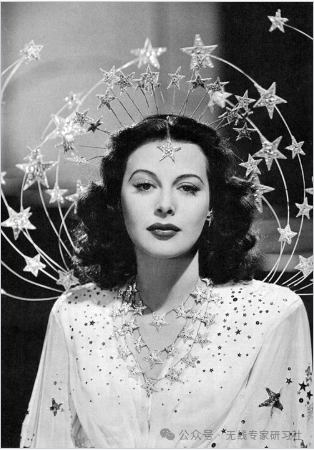
Lamarr worked with many leading men of the time, including Clark Gable (“Boom Town,” “Comrade X,” 1940), Spencer Tracy, and John Garfield (“Tortilla Flat,” 1942) as well as Jimmy Stewart (“Come Live with Me,” 1941). She often tried to break out of her typical roles, including playing a dancer in “The Siegfried Girls” (1942). She was one of three main female roles, performing alongside Judy Garland and Lana Turner (which was her breakthrough performance). The male lead was again Jimmy Stewart. “The Siegfried Girls” was Stewart’s last film before he enlisted, after which he took a five-year hiatus from the big screen.To gain better control over her roles, in 1946, Lamarr left the studio and co-founded her own company. She produced two films, “The Strange Woman” (1946) and “Dishonored Lady” (1947). The studio did not support stars, especially female stars, starting competing companies—Lamarr found it difficult to produce films without studio backing.In 1949, she played Delilah in Cecil B. DeMille’s “Samson and Delilah,” opposite Victor Mature (with Angela Lansbury in a supporting role). This was Lamarr’s most popular performance, and the film was a huge success. “Samson and Delilah” was the most successful film of 1950 and the second highest-grossing film of the 1950s (after “Gone with the Wind”). “Variety” magazine commented that Lamarr was “never more pleasing to the eye and made Delilah a convincing seductress.”After “Delilah,” Lamarr made several films, including 1951’s “My Favorite Spy” with Bob Hope, but none could replicate the success of “Samson and Delilah.” Her last released film was 1958’s “The Female Animal.”Despite achieving much success, Lamarr did not receive the same recognition as her contemporaries. She later commented that her biggest regret in her career was turning down “Gaslight” (1940) and “Casablanca” (1942), both of which became popular films for Ingrid Bergman.To honor her entire body of work, Lamarr received a star on the Hollywood Walk of Fame in 1960.In her obituary (2000), The New York Times referred to her as “the reigning diva of the 1930s and 1940s,” but this underestimates Lamarr’s impact on Hollywood. This influence spanned decades—from being the prototype for Snow White in 1938—to being the inspiration for Halle Berry’s Catwoman in 2004.Her fame would grow louder in her later years and after her death—more so due to her achievements beyond the screen.05The National Inventors Council
 Although she was known in the public eye for her social nature and numerous romances (including six marriages), her son remembers her differently:“After a long day of work, she would rush home to study her latest inventions.”Lamarr’s most notable invention was related to torpedoes.Early submarines used wire-guided systems to control torpedoes. After launch, the torpedoes would head toward their target but remained connected to the ship via wires used to control their movement. By the time the war began, both sides were researching radio-controlled guidance systems, with the Germans far ahead due to underfunded American efforts.American torpedoes were tested under unrealistic conditions and failed miserably, almost always missing their targets. Even when they hit, they often failed to explode. Several American torpedoes returned to German or Japanese ports—embedded in the hulls, unexploded, available for Axis powers to evaluate.German torpedo expert Hellmuth Walter developed a technique that allowed German torpedoes to be guided on one of 18 radio frequencies—allowing 18 independent torpedoes to be guided simultaneously in one battle.As early as 1936, Lamarr had met Walter in Austria, although there are no records of their conversation.America was experimenting with but had not yet implemented radio guidance—one major concern was that the enemy could easily identify and jam any signal, rendering the guidance system ineffective.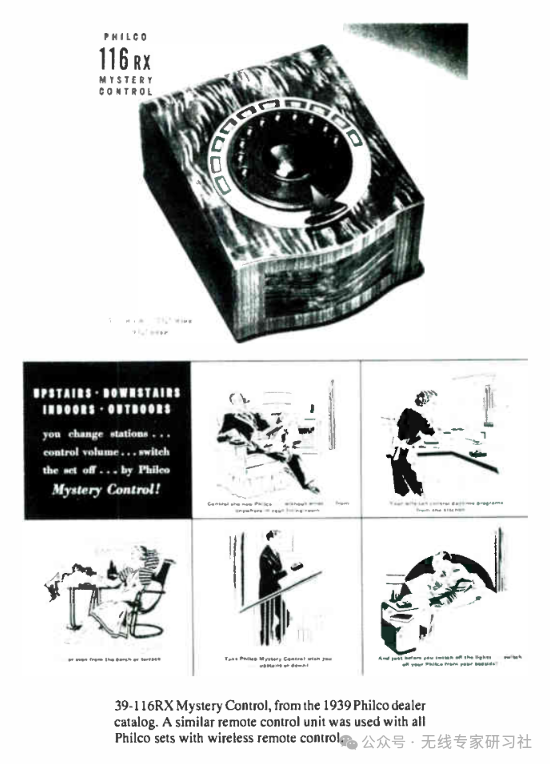
At this time, the launch of the first remote-controlled home radio, the “Philco Mystery Controller,” may have also piqued Lamarr’s interest. This first remote allowed users to switch between eight different preset stations without getting up from the couch. (They did have to manually turn on the radio). The early systems installed in apartments had a problem that if the neighbor also had one, your neighbor would constantly change your channel.Possibly storing this information in her mind, Lamarr attended a party hosted by actress Janet Gaynor, where she began talking with composer George Antheil. Antheil’s works included a piece called “Ballet Mecanique,” which required multiple player pianos to synchronize—along with electronic clocks, drums, alarms—and a jet propeller. He later composed for television and film and wrote a column for Esquire (under a pseudonym) titled “If… She Wouldn’t Be Faithful.”At this time, during the war, the Allies’ prospects looked bleak. Lamarr had a strong desire to help the war effort, and so did Antheil. His brother was likely the first American casualty in World War II, shot down in a plane after picking up a diplomatic pouch in Estonia.Lamarr and Antheil discussed the war issues, and they began brainstorming inventions that could help. That night, as she left the party, Lamarr hastily wrote her phone number on George Antheil’s car windshield with lipstick.The next day, the two met and began fleshing out their eventual patent for a “secret communication system.” Lamarr later commented, “The idea was mine; the implementation was George’s.”They created a secret communication system that used rapid instruction pulse trains to control torpedoes, followed by radio silence. Another string of information would follow, using different preset frequencies. Moving between frequencies was called “frequency hopping.”Lamarr and Antheil also researched several other inventions to aid the war effort. The field of air defense was new and not very successful; typically, shells scattered in the sky, rarely hitting targets. Lamarr and Antheil’s idea was to install a device on anti-aircraft shells that would generate a magnetic field. If the magnetic field detected a large metal object, such as an airplane, it would explode.In 1940, Lamarr and Antheil first submitted their torpedo guidance system and improved anti-aircraft shell ideas to the National Inventors Council (NIC). During World War I, the U.S. military established the National Consulting Board (NCB) led by Thomas Edison. The NCB collected thousands of ideas and inventions from amateur inventors wanting to help the war. Led by Charles F. Kettering, then head of research at General Motors, the NIC had the same purpose during World War II. After passing preliminary review, Kettering forwarded Lamarr and Antheil’s guidance ideas to the Navy. Lamarr suggested that while waiting for a response, she could leave Hollywood to work full-time for the National Inventors Council. In response, Kettering suggested that Lamarr, rather than inventing, should continue acting—using her charm, beauty, and star power to help the country.06Promoting Bonds
 Following Kettering’s advice, Lamarr became a regular at the Hollywood USO (United Service Organizations) club, washing dishes and dancing with soldiers. Bette Davis, Lamarr’s daughter Denise’s godmother, founded this club.Lamarr also hit the road—appearing at numerous war bond rallies in just ten days. During her rally segments, she would walk on stage to loud applause and a fair amount of whistles. Lamarr would start with a few jokes, talking about her recent films or some of the stars she had worked with, then she would scan the crowd. After a moment of careful consideration, she would point to a typical American soldier in uniform and invite him on stage.Once he joined her, Lamarr would ask, “Do you want me to kiss you?” He would usually respond, inevitably, sometimes enthusiastically, sometimes shyly, “Yes.” Then she would ask the crowd, “Should I kiss this soldier?” The crowd would shout back, “Yes!” Then she would turn back to the crowd, mischievously looking at the audience, and whisper, “Unless we raise money for the war.” She would set a target for the war bonds to be sold, and volunteers would start collecting money from the crowd. At some point, she would announce that the target had been met and give that soldier an impressive kiss—a kiss he wouldn’t forget for a while. Well, at least not until the next rally, when he would be picked from the crowd again. Yes—he was part of the act.Lamarr’s ten-day rally raised over $25 million for the war.07Patent No. 2,292,387
 Lamarr and Antheil grew tired of receiving no feedback on their ideas, so under Kettering’s suggestion, they began working on applying for a patent for the frequency hopping concept. With the assistance of an engineer recommended by Kettering and a professor from Caltech, they fleshed out the details and developed a workable signal synchronization method.In June 1941, they submitted the application under the names Hedy Kiesler Markey (Gene Markey was her second husband) and George Antheil. The patent stated, “This invention relates primarily to a secret communication system, involving the use of carrier waves of different frequencies, particularly suitable for remote control of manipulable aircraft/ships (such as torpedoes).” It further stated that their idea “is operationally relatively reliable, but at the same time difficult to detect or decipher.”After launch, the radio guidance system would direct the torpedo—whether on a ship or an aircraft—adjusting the torpedo’s direction based on ocean currents or enemy evasive actions. Existing radio guidance systems used one frequency, meaning others could jam the guidance, rendering it ineffective.Lamarr and Antheil proposed that the signal need not stay on one frequency but could move between up to 88 different sub-frequencies in a predetermined manner. Any efforts to jam the signal would only be successful for a short time before the signal moved. They suggested that a method for synchronizing frequency shifts was to use miniature player piano rolls to coordinate the sending and receiving of signals. Their method used 88 frequencies—because player piano rolls have 88 rows of perforations (each key on the piano corresponds to a row). The piano rolls would start simultaneously and move at the same rate. Just as the perforations on the piano roll control the playing of the keys, the perforations on the paper roll would control the closing of a set of switches.The patent also outlined how to periodically synchronize pulses. This synchronization was crucial. Only when the transmitter and receiver were on the same frequency at the same time would moving from one frequency to another be effective. According to their patent: “Of course, it is necessary to make the recording strips of the transmitter and receiver start simultaneously and maintain the proper phase relationship with each other so that the correct perforations in the two records move to their respective control heads at the same time.” To ensure this synchronization, they suggested “keeping the two recording strips in the starting position until the torpedo is launched; then simultaneously releasing the two recording strips so that they can be moved at the same speed by their respective motors.”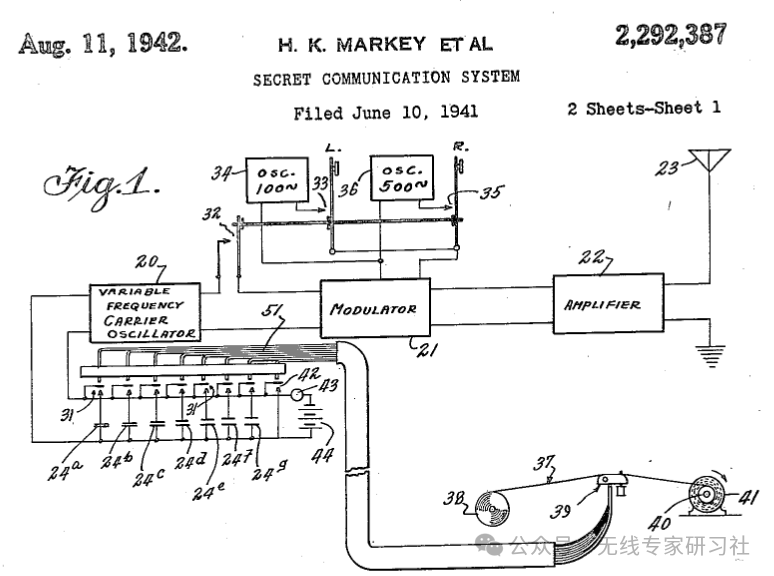
In August 1942, Lamarr and Antheil were granted their patent—Patent No. 2,292,387.08Supporting the War
 The Navy ultimately chose to shelve Lamarr and Antheil’s patent. The piano roll was just one example, as any patent must demonstrate a method that can be implemented. However, Antheil later believed that using the player piano example was a flaw in the patent. The Navy brass could not shake their association with the concept of a player piano and dismissed it as impractical.Later in 1942, the U.S. government seized Lamarr and Antheil’s patent as “alien property” because Lamarr was still an Austrian citizen at the time (she became a U.S. citizen in 1953).She later commented, “I don’t understand. They used me to promote war bonds, and at that time I was not an alien. And when I invent things for this country, I am an alien.”The Navy took some time to use her technology; but ultimately, in 1962, the U.S. Navy used frequency hopping technology adopted by Sylvania Corporation, replacing the piano rolls with electronic circuits to coordinate communications between all ships involved in the Cuban blockade. The U.S. Army used similar technology for drone guidance in Vietnam. Robert A. Scholtz, a professor at the University of Southern California, wrote in a 1982 paper, “Considering that frequency hopping was not used in operations against deliberate interference until 1963, Lamarr and Antheil were twenty years ahead of their time.”After the war, several companies searched for expired patents—applying Lamarr and Antheil’s technology to many products that required signals difficult to intercept; needed privacy; and minimized interference with others using frequencies.In 1976, electrical engineer Robert C. Dixon published “Spread Spectrum Systems,” reviewing the technology and opening the door for broader commercial applications of frequency hopping. In 1981, Patent No. 2,292,387 was declassified.Since then, frequency hopping technology has proven crucial for providing widespread access to Wi-Fi, GPS, and Bluetooth connections, ensuring privacy in mobile phone calls, and extending satellite and nuclear communications.If you downloaded this book using a Wi-Fi connection, you are using technology made possible by the work of Lamarr and Antheil.09Helping Howard Hughes
 One of Lamarr’s advantages was her connections in Hollywood, such as with filmmakers, high-speed aircraft developers, pilots, and the future owner of Trans World Airlines (TWA), the notorious playboy—Howard Hughes. Like many top stars in Hollywood, Lamarr had a brief romance with Hughes. After their romantic interest ended, their friendship continued, built on mutual respect for each other’s intelligence and extraordinary drive.Hughes took Lamarr on tours of his aircraft manufacturing and design facilities. She commented that these designs were not suitable for speed. Lamarr then set out to study the fastest birds and fish; she pointed out to Hughes that these animals shared a commonality in their smooth, streamlined designs—while his planes, especially the wings, were square.Hughes was so impressed by Lamarr’s observations that he arranged for a team of engineers to be at her disposal. He even set up a chemistry lab in the trailer on the set of Lamarr’s films so she could conduct scientific experiments during breaks in filming.Hughes’s aircraft designs did indeed become more streamlined over time, although it is difficult to determine how many improvements were due to Hedy Lamarr. Hughes later set multiple speed records with his planes.10Late but Well-Deserved Recognition
 Although best known for frequency hopping, Lamarr’s other inventions included developing a cube that, when dissolved in water, could create soda. She thought soldiers who couldn’t get soda could use it. Unfortunately, the result tasted chemical. Lamarr also found that the differences in water quality across the country led to varying degrees of dissolution, resulting in inconsistent final products. A similar product, Fizzies, was launched in the U.S. in 1957 and was nationally promoted in 1962. It sold strongly in the late 1960s—but ultimately fizzled out, so to speak, and was discontinued in the early 1970s.Whenever Lamarr saw problems in the world around her, she would hastily jot down possible solutions in her “invention book.” Her other ideas included improving traffic lights; developing a device attached to tissue boxes for handling used tissues; creating a device to assist disabled individuals in getting in and out of bathtubs; and proposals for fluorescent dog collars.In the entertainment industry, recognition for outstanding performances comes quickly. When you are on stage, you hear it from the audience. For the big screen, you receive feedback in the form of box office sales. You also receive feedback from critics, who either lavish praise or offer sharp criticism.For science, exceptional achievements are rarely recognized immediately; the case of inventor Hedy Lamarr is no exception. Recognition for her achievements beyond the screen came late in her career and after her death. Awards include the Electronic Frontier Foundation Award in 1998; the Viktor Kaplan Medal awarded by the Austrian Patent Holders Association in 1998; and her induction into the U.S. Inventors Hall of Fame in 2014. Now, every November 9th, around the world, especially in Austria, Germany, and Switzerland, is celebrated as International Inventors’ Day in honor of Hedy Lamarr.Since her death in 2000, there has been a renewed public interest in Hedy Lamarr’s life, with multiple children’s books, biographies, and documentaries emerging, as well as at least two dramas about her life.In 2003, according to Lamarr’s wishes, her children took her ashes to Vienna. They scattered her ashes in the woods where her father had once explained to her how the world worked.Like it? Follow usOh
 Give us a thumbs upLike
 ClickTo SeeWhat’s Best
About the Wireless Expert Study Society public account
The Wireless Expert Study Society is a professional communication platform focused on the forefront of wireless short-range technology and academic development, helping technology enthusiasts and practitioners keep up with industry trends. We not only focus on cutting-edge academic information and technology analysis but also regularly pay attention to career development, periodically pushing employment information and job-seeking experiences, assisting every member in exploring a broader future in the wireless field.
Public Account Editorial Team
-
XU Fangxin Zhihu Wi-Fi field answerer (Organizer)
-
Cheng Wei Northwestern Polytechnical University
-
Chi Guoxuan Tsinghua University
-
Zhou Wei Keysight Technologies
-
Hu Tairan Xingji Meizu
Community Communication QQ Groups
-
494974703
-
251992871