1. Shift in Wi-Fi Philosophy: Experience-Centric Over the past 20 years, the upgrade of Wi-Fi standards has resembled a “speed marathon”: Wi-Fi 5 (802.11ac) increased speeds to 3.5Gbps, Wi-Fi 6 (802.11ax) doubled that to 9.6Gbps, and Wi-Fi 7 even surpassed 30Gbps. However, user experience has not improved in tandem with these speed increases—places like shopping malls, office buildings, and subways still encounter situations where “signal strength is full but pages won’t load”. The root of these issues is not “insufficient speed”, but rather “uneven network resource allocation”, “multi-device interference”, and “poor roaming stability”.
Wi-Fi 8 (802.11bn, referred to as Ultra High Reliability, UHR) marks a transition in Wi-Fi standards from a “speed-oriented” approach to an “experience-oriented” one. It no longer pursues “higher peak speeds” but focuses on “maintaining stable performance in complex scenarios”. Official data indicates that compared to Wi-Fi 7, Wi-Fi 8 places greater emphasis on user experience:
Data throughput in edge signal scenarios is increased by 25%,
Average latency and worst-case latency are both reduced by 25%,
And the packet loss rate during roaming is decreased by 25%.
2. Multi-AP Coordination Technology Makes Wi-Fi 8 ‘Stable as Wired’
The stability of Wi-Fi 8 relies on a set of “coordinated technology systems”—by utilizing multiple access points (APs) in conjunction, a coordination mechanism is introduced to address these issues, allowing the access points to operate as a unified system, thereby reducing conflicts and improving spectrum efficiency.
1) Coordinated Spatial Reuse (Co-SR)
This allows participating APs in spatial reuse to collaborate, forming a master-slave relationship, where the master AP precisely controls the transmission power of the slave APs to eliminate interference from the slave APs to the master AP and increase the gain of the slave APs, thus achieving optimal transmission results.
(1) Why is CoSR needed?
In high-density scenarios, due to the dense deployment of APs, there is often a certain degree of co-channel interference. Wi-Fi has designed a detection mechanism for co-channel interference—Carrier Sense Multiple Access/Collision Avoidance (CSMA/CA). By utilizing CSMA/CA, it can effectively detect co-channel interference and avoid conflicts. However, this also means that as long as AP1 and AP2 are on the same channel and can hear each other, even if the communication between AP1 and STA1 is unrelated to AP2, AP1 and STA1/AP2 and STA2 still cannot communicate simultaneously. The traditional Clear Channel Assessment (CCA) is no longer sufficient to meet the demands.
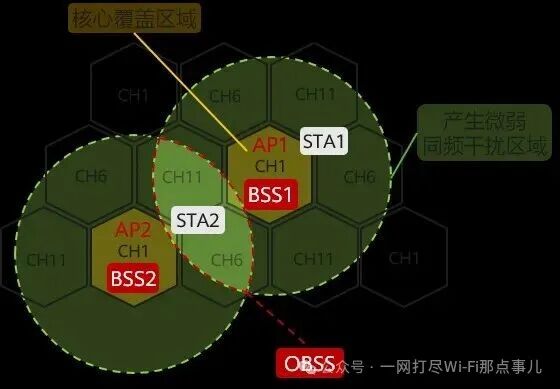
(2) Co-channel Interference
The existing spatial reuse approach sets two thresholds for APs: the outer threshold is the MYBSS protocol threshold, and the inner threshold is the OBSS protocol threshold. The MYBSS protocol threshold can be lowered (larger range) to avoid missing messages from MYBSS (the same BSS). The OBSS protocol threshold can be raised as high as possible (smaller range), so as long as it is within the OBSS protocol threshold, the terminal considers there to be no co-channel interference. AP2 can still communicate with STA2, achieving the effect of spatial reuse.
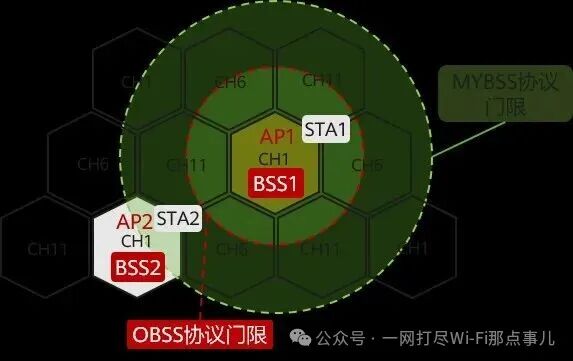
However, there is a problem: the transmission power of AP2 is determined autonomously by AP2, but the information available to AP2 is limited, which can lead to inaccuracies in selecting transmission power, thereby interfering with the data transmission of AP1.
(3) How does CoSR work?
CoSR enables participating APs in spatial reuse to collaborate, with the master AP precisely controlling the transmission power of the slave APs to eliminate interference from the slave APs to the master AP and increase the gain of the slave APs.
Coordinated scheduling is key to CoSR. To perform coordinated scheduling effectively, coordinated scheduling measurement is required, which is also a prerequisite for CoSR’s coordinated scheduling, allowing co-channel APs to timely grasp information about other co-channel APs.
Coordinated Scheduling Measurement
The approach of CoSR is for APs to periodically measure the signal strength of terminals on the same channel, including associated and non-associated terminals. At the same time, APs will exchange measurement information with co-channel APs, mainly sending the measurement information of terminals associated with neighboring APs to those neighboring APs. AP1 will measure the signal strength of STA1 (associated terminal) and STA2 (non-associated terminal) on the same channel and synchronize the signal strength of the non-associated terminal STA2 to the co-channel neighboring AP2. The same process applies to other co-channel neighboring APs.
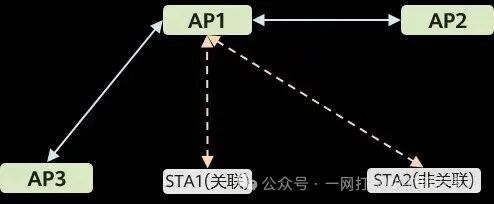
It is worth mentioning that at this point, there is no distinction between master and slave APs; all co-channel APs will conduct coordinated scheduling measurements, so co-channel neighboring AP2 will also synchronize the signal strength of STA1 measured to AP1. This information synchronization is crucial, as it will be used in subsequent coordinated scheduling, such as the selection of slave APs.
How to determine which APs and terminals participate in CoSR?
First, the master AP needs to be determined. Once an AP seizes the air interface resources, that AP becomes the master AP; let’s assume AP1 is the master AP. The master AP has significant authority, as it can determine the terminals that need to communicate within its cell (referred to as master STA) and select slave APs for spatial reuse with the master AP. From the perspective of maximizing efficiency in air interface reuse, the selected slave AP should be as far away from the master AP as possible.
To determine the proximity of the slave APs, the previously mentioned coordinated scheduling measurement information is utilized.
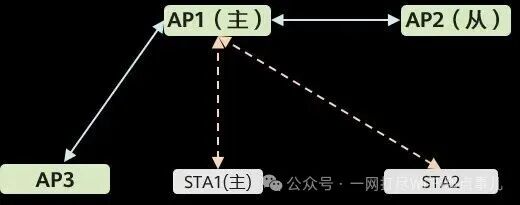
Once the master and slave APs are determined, the master AP first sends a coordinated frame during the current transmission window to notify the slave APs to perform coordinated transmission. At the same time, the master AP will specify the maximum transmission power of the slave APs to ensure that the two co-channel APs do not interfere with each other during data transmission. The master AP then sends its data frame. The slave AP, based on the coordinated frame from the master AP, selects a terminal in its cell (slave STA, selected based on the best signal and proximity to the slave AP) to synchronize and send the data frame. This completes one instance of CoSR.
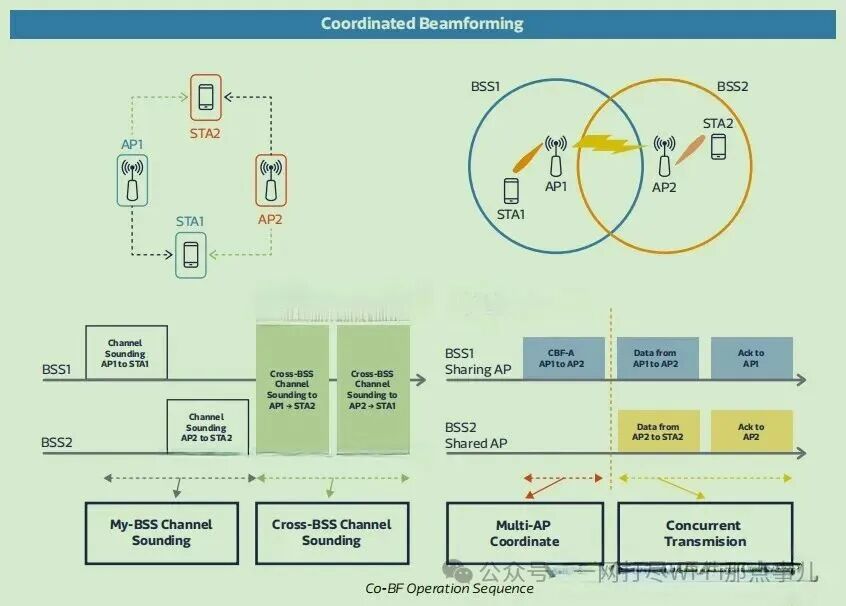
2) Coordinated Beamforming (Co-BF):
Access points utilize advanced antenna control technology to focus signals on clients and eliminate interference with adjacent access points. This can improve signal quality, reduce contention, and allow for more effective spectrum reuse in high-density deployments.
3) Seamless Roaming SMD: Improved Roaming and Multi-Link Operations Across Access Points (APs)
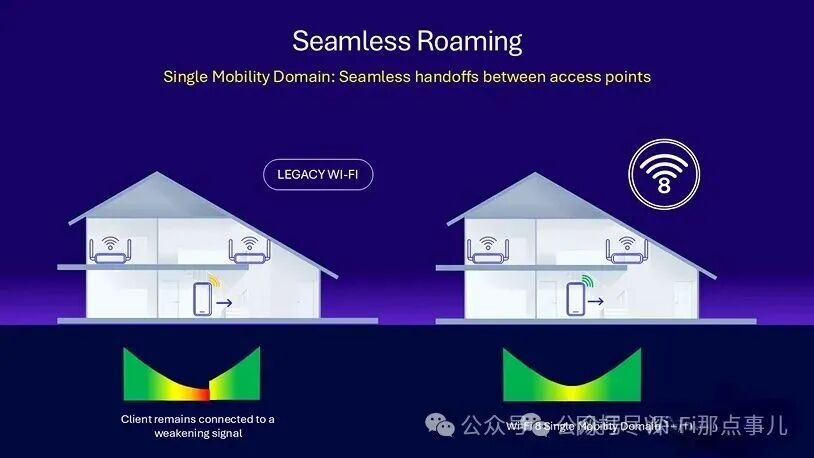
Traditional Wi-Fi roaming methods require disconnecting from one access point before reconnecting to another (including re-association and security settings), which introduces delays and data interruptions. This disconnection and reconnection method can lead to peak delays and packet loss, causing audio/video glitches during mobility and degrading user experience.
Wi-Fi 8 introduces the concept of Single Mobile Domain (SMD), allowing devices to connect to two APs simultaneously during the switching process. When users move with Wi-Fi 8-enabled laptops or smartphones, the network works collaboratively to seamlessly switch the device to the best AP (establishing a connection before disconnecting, similar to soft handover in cellular networks). This collaboration includes pre-establishing security keys and transferring in-flight data packets destined for the device from the source AP to the target AP. The practical benefit of seamless roaming is that switching between APs occurs with almost no delay—video calls or games do not experience stuttering during the switch. This greatly enhances the Wi-Fi experience for enterprises and mesh networks.
4) Co-TWT: Making IoT Devices ‘More Energy Efficient’ and Reducing ‘Traffic Contention’
With the rise of smart homes, the number of IoT devices (such as smart lights, smart plugs, and smart sensors) is increasing. These devices are characterized by “low power consumption and high frequency”—they do not require much bandwidth but need to send data frequently (for example, smart sensors send temperature data every 10 seconds). The traditional Wi-Fi “wake-up mechanism” is “always on standby”: devices remain connected even when there is no data to send, periodically “polling” the AP, leading to “traffic contention”—for instance, if 100 smart sensors simultaneously “poll” the AP, it occupies a large amount of bandwidth, causing video stuttering on phones.
Wi-Fi 8’s “Coordinated Target Wake Time (Co-TWT)” technology allows IoT devices to “wake up on demand”. It enables multiple IoT devices to “schedule” their wake-up times: for example, smart lights wake up at 8 PM, smart sensors at 8:01 PM, and smart plugs at 8:02 PM. This way, they do not “poll” the AP simultaneously, reducing “traffic contention”. More importantly, Co-TWT can lower the energy consumption of IoT devices—for instance, the battery life of smart sensors can be extended from 1 year to 2 years. This is undoubtedly good news for smart home users: no more frequent battery replacements for smart devices.
3. Conclusion: Wi-Fi 8 is Not the End of Speed, but the Beginning of Experience
In summary, Wi-Fi 8 introduces a series of innovative technologies aimed at meeting the demands of modern connectivity, allowing Wi-Fi to enter a wider range of application scenarios. These innovative technologies work together to enable the system to operate with the precision, responsiveness, and reliability of traditional wired infrastructure while providing significantly improved wireless connections in scenarios where traditional Wi-Fi struggles.
The arrival of Wi-Fi 8 is still some time away, especially with the long road to terminal adoption. Manufacturers are transplanting some Wi-Fi 8 technologies that are not related to terminal compatibility (such as CoSR and CoBF) into existing Wi-Fi devices to enhance the experience, which is a positive development, allowing users to access leading technologies early while enhancing the competitiveness of enterprise products. Introducing an intermediate generation (7.5 or called Advanced) between Wi-Fi 7 and 8 is also a viable option.
Regardless, the network is transitioning from “usable” to “user-friendly”, which is a good thing for everyone!