Significant Advances in Edge Computing: Humanity’s First AI Integration into Microelectromechanical Systems

Significant Advances in Edge Computing: Humanity's First AI Integration into Microelectromechanical Systems

To participate in the Meet 35 conference, please click ↑ To achieve edge computing (computations close to the data source) on devices such as 5G networks and the Internet of Things, it is necessary to deploy sufficient computing power on micro devices. To realize this idea, future efforts will focus on utilizing artificial intelligence (AI) … Read more

Revolutionary MCU with Dramatically Reduced Power Consumption

(Source: spectrum)By mimicking the operation of the brain, neuromorphic processors can significantly reduce energy consumption in certain application scenarios compared to traditional technologies. Now, the Dutch company Innatera has launched what it claims to be the world’s first commercially available neuromorphic microcontroller, aimed at promoting the large-scale market application of this emerging technology.Innatera states that … Read more

Neuromorphic Computing: Entering Edge AI

Neuromorphic Computing: Entering Edge AI

Currently, there is a growing desire among humans to retire the “Von Neumann architecture”. Due to the issues of memory wall and power wall, the Von Neumann architecture is increasingly hitting a bottleneck. Neuromorphic chips are one of the routes to break through the “Von Neumann architecture”. They are chips that highly simulate the computational … Read more

Pulse Neural Network Chip for Smart Sensors: Innatera’s Chip Aims to Reduce Latency and Power Consumption in Edge AI

Pulse Neural Network Chip for Smart Sensors: Innatera's Chip Aims to Reduce Latency and Power Consumption in Edge AI

Innatera’s new neuromorphic chip is optimized for artificial intelligence at the network edge. Innatera by mimicking the way the brain operates, neuromorphic processors consume significantly less power in certain applications compared to traditional technologies. Today, the Dutch company Innatera has launched what it claims to be the world’s first commercial neuromorphic microcontroller, hoping to drive … Read more

Nano Energy: Wafer-Level Flexible Two-Dimensional PtSe2 Layers with Bidirectional Wavelength Tunability for All-Optical Synaptic Operations

Nano Energy: Wafer-Level Flexible Two-Dimensional PtSe2 Layers with Bidirectional Wavelength Tunability for All-Optical Synaptic Operations

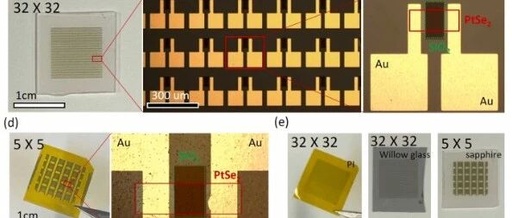
Artificial synapses are promising fundamental components in the field of neuromorphic computing, providing new pathways to overcome the inherent limitations of the von Neumann architecture. Compared to traditional memristors controlled by electricity, optically controlled synaptic devices are attracting widespread attention due to their unique advantages. This study demonstrates, for the first time, an all-optical synaptic … Read more

Neuromorphic Event-Driven Vision Sensors for Motion Recognition

Neuromorphic Event-Driven Vision Sensors for Motion Recognition

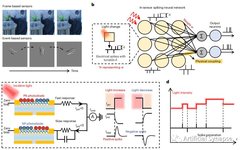
Click the blue words to follow us Research Background The traditional frame-based image sensors transmit absolute light intensity at a fixed frame rate, regardless of whether features change, leading to a large amount of redundant visual data with limited information. Inspired by biological retinas, event-driven vision sensors respond only to relevant changes in the scene. … Read more