The Korea Advanced Institute of Science and TechnologySungwoo Hong and his team reported a direct skeletal editing strategy that succinctly converts pyridine to pyridazine by replacing carbon atoms with nitrogen atoms. This practical method demonstrates broad functional group tolerance, allowing the transformation of various complex molecules and commercially available drugs into their biologically equivalent pyridazine analogs.
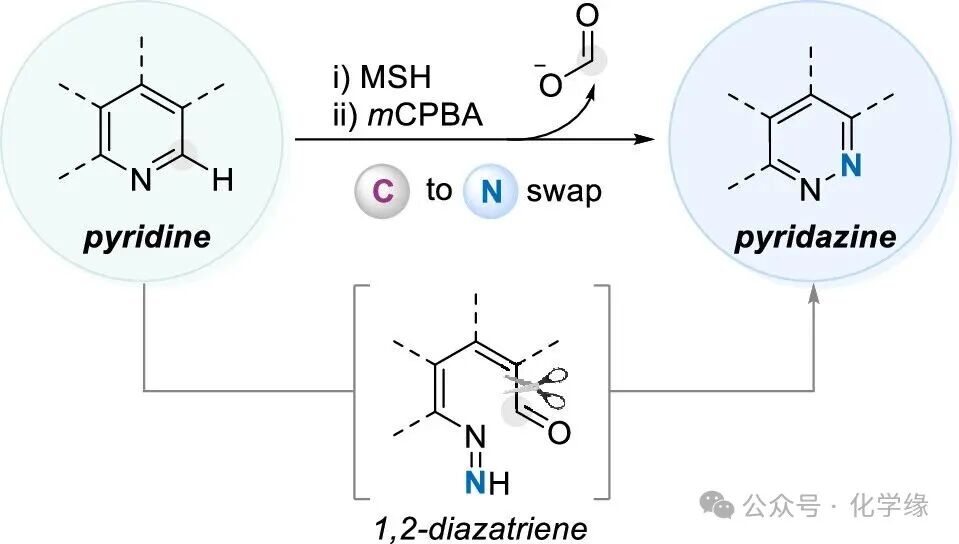
Abstract
Nitrogen-containing heterocycles underpin many pharmaceuticals, where subtle atomic rearrangements can markedly alter efficacy and safety. Pyridines are ubiquitous scaffolds in pharmaceuticals, yet their close analogues, pyridazines with two adjacent ring nitrogens, remain underexplored owing to limited synthetic access. Here, we report a skeletal editing strategy that converts pyridines into pyridazines by replacing one ring carbon with nitrogen while preserving aromaticity. The sequence comprisesN-amine assembly, followed by an m-chloroperoxybenzoic acid (mCPBA)-mediated ring-remodeling sequence proceeding via a 1,2-diazatriene intermediate to effect carbon-to-nitrogen substitution. The two-step process is operationally simple, runs at ambient temperature in air, and requires no UV irradiation or preinstalled groups. The method shows broad functional-group tolerance, including complex, drug-derived molecules, providing rapid, scalable access to pyridazines. This platform expands heterocyclic chemical space and enables late-stage diversification for drug discovery.
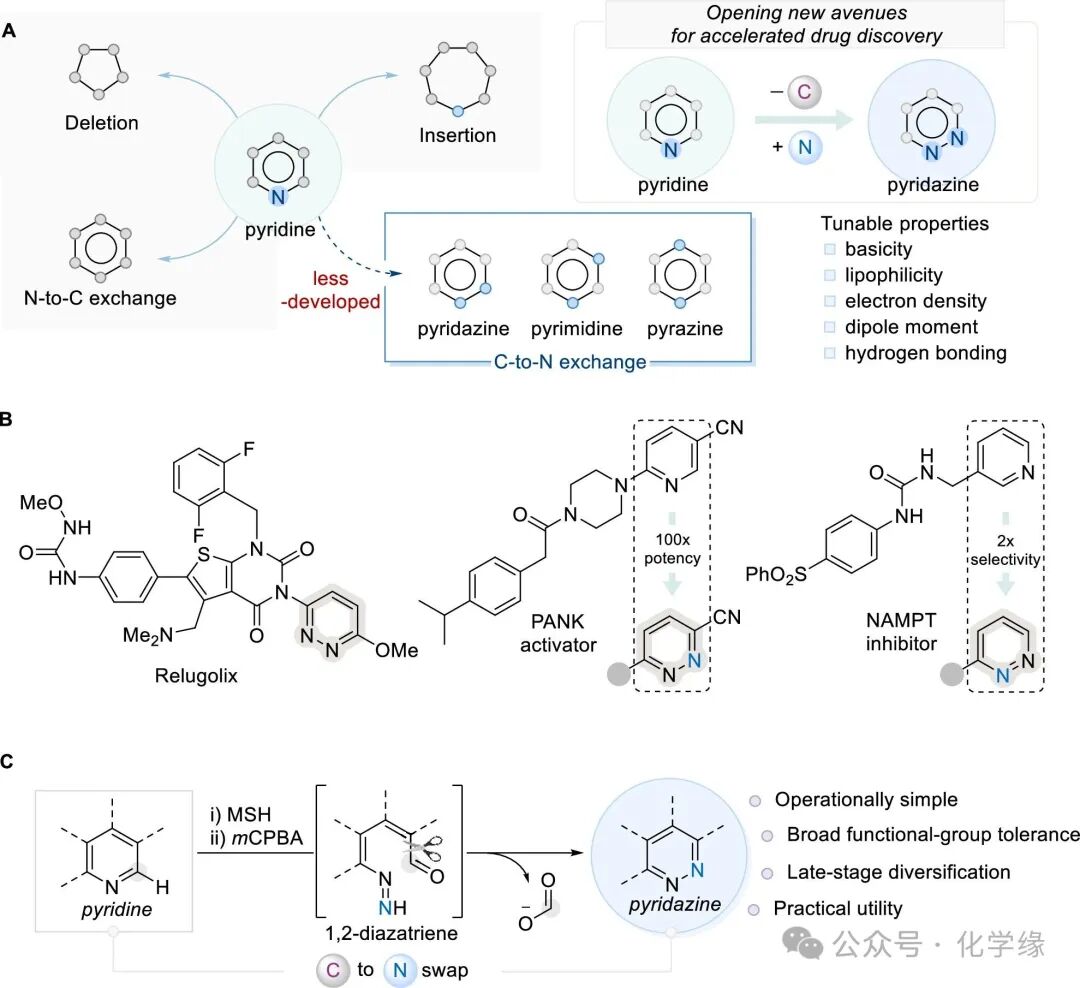
Figure 1 Structural diversification achieved through C-N atom substitution in pyridine
The strategic modification of molecular scaffolds is central to modern synthetic chemistry, providing powerful means to expand chemical space and accelerate drug and material discovery. Traditional construction of complex structures from scratch often involves lengthy linear pathways, limiting scaffold diversification. In contrast, skeletal editing techniques allow for direct modification of advantageous scaffold structures by selectively inserting, deleting, or replacing individual atoms within a pre-assembled molecular core, thereby efficiently obtaining structurally diverse analogs. Pyridine compounds, due to their widespread presence in bioactive molecules and reliable synthetic accessibility, have become highly attractive substrates for skeletal editing. However, their aromatic stability poses challenges for such transformations. Nevertheless, these conversions remain highly appealing as they can rapidly yield pharmacologically relevant yet underexplored scaffold structures. Among various strategies, atom relocation techniques stand out—this technique replaces individual atoms in the cyclic framework while maintaining ring size and connectivity, allowing for fine-tuning of key physicochemical properties related to hydrogen bonding patterns, metabolic stability, and other pharmacological optimizations.
While the nitrogen-to-carbon atom conversion strategy from pyridine to benzene has been established, the reverse conversion—obtaining pyridazine through carbon-nitrogen embedding—remains in its early stages of development. Due to the unique physicochemical properties of pyridazine, obtaining such nitrogen-rich scaffolds holds significant value. In particular, the diazine structure containing two adjacent ring nitrogens is rare in nature and poses significant synthetic challenges, limiting its application in drug development. However, compared to pyridine, its unique characteristics—including reduced basicity, diminished lipophilicity, significant electron deficiency, high dipole moment, and two hydrogen bond acceptors—continue to attract attention in the field of drug discovery. Therefore, developing simple and practical synthetic strategies will greatly enhance the accessibility of diazine scaffolds and accelerate the exploration and optimization of drug candidates.
Levin and his team reported a method for synthesizing piperazine via 2-chloropyridine-derived 2-azido-N-aminopyridinium salts. Although this method holds significant value, the process of obtaining the 2-chloropyridine precursor requires additional steps—specifically, oxidation of pyridine with mCPBA followed by chlorination mediated by POCl₃. Furthermore, this method necessitates the presence of electron-withdrawing substituents on the pyridine ring, requires near-UV light irradiation (390 nm), and generates toxic byproducts (HN₃ and HCN). While these limitations may be acceptable under certain conditions, they complicate structure-activity relationship studies and hinder straightforward retrosynthetic route planning.
The authors report a direct skeletal editing strategy that succinctly converts pyridine carbon atoms to nitrogen atoms to obtain pyridazine. This practical method demonstrates broad functional group tolerance, allowing the transformation of various complex molecules and commercially available drugs into their biologically equivalent pyridazine analogs. Achieving this pyridine-to-pyridazine editing requires the simultaneous identification of effective nitrogen donors and viable reaction intermediates. O-(meta-Dimethylphenylsulfonyl)hydroxylamine (MSH) was selected as the electrophilic nitrogen source, which exhibits excellent yields in the pyridine N-aminomethylation reaction. The resulting salt is cleaved to yield a 1,2-diazatriene intermediate, which is then precisely converted to the target pyridazine through a 6π electrocyclization reaction.
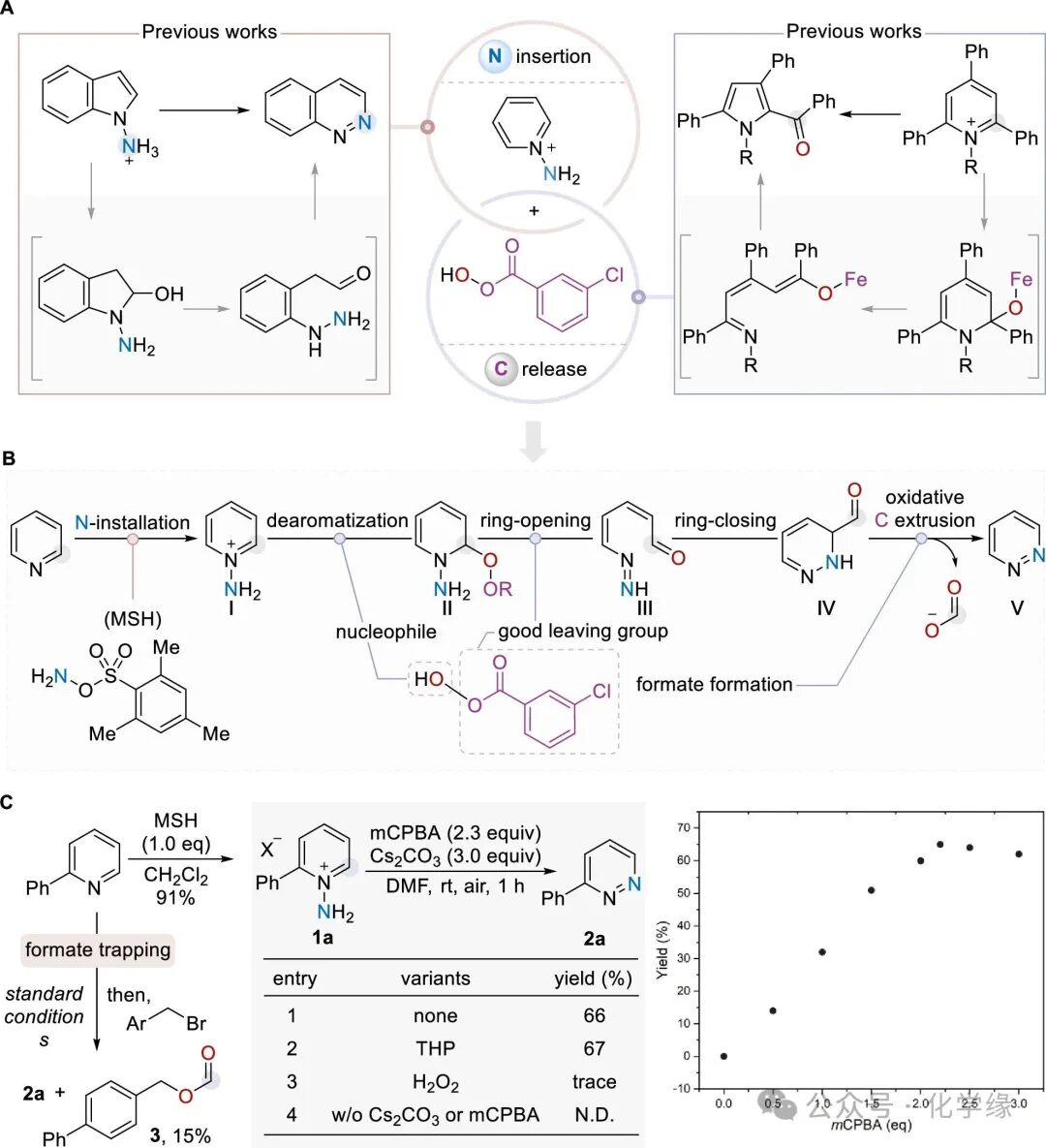
Figure 2 Development of the reaction
The authors designed a new strategy to convert pyridine to pyridazine. It is hypothesized that the N-aminosubstituent on pyridine could serve as the nitrogen atom embedded in subsequent reconstructions. Additionally, it is envisioned that the nucleophilic oxygen atom and potential leaving group of mCPBA could replace iron-hydroxide complexes, playing a similar role.
The key challenge lies in overcoming the influence of aromatic stability to achieve selective nitrogen insertion while simultaneously expelling ring carbon. It is assumed that this obstacle can be overcome through a cascade of reactions involving de-aromatization, ring-opening, ring-closing, carbon expulsion, and re-aromatization. The sequence begins with the addition of mCPBA to N-aminopyridine salt (I), promoting controlled de-aromatization to generate the intermediate II. This species undergoes selective ring-opening to form the 1,2-diazatriene III, which then undergoes a 6π electrocyclization reaction to yield the diazine precursor containing adjacent nitrogen atoms (IV). Re-aromatization requires the removal of the formyl group, but this group is difficult to remove directly due to its poor leaving ability. To overcome this obstacle, a mCPBA-mediated Baeyer–Villiger oxidation reaction is employed to convert the formyl group into a formate ester with enhanced leaving potential, thereby facilitating efficient re-aromatization (V). Experimental capture confirmed the formation of the formate ester intermediate, validating the proposed oxidative expulsion pathway.
Based on this modular design, selective carbon-nitrogen transposition reactions in pyridine were achieved: first, N-amine assembly, followed by mCPBA-mediated ring reconstruction, efficiently producing pyridazine. The pyridine salt prepared from 2-phenylpyridine 1a reacted with mCPBA in DMF under basic conditions with Cs2CO3 at room temperature for 1 hour, yielding pyridazine 2a in up to 66% yield. When DMF was replaced with easily removable tetrahydropyran (THP), the yield remained unchanged. Other peracids produced only trace amounts, while omitting Cs₂CO₃ or mCPBA resulted in negligible conversion, highlighting the critical roles of the base and oxidant. By adjusting the oxidant amount, it was found that when mCPBA was used at 2 equivalents, the conversion rate significantly increased, after which further improvements were limited, consistent with the mechanism requiring two equivalents of oxidant.
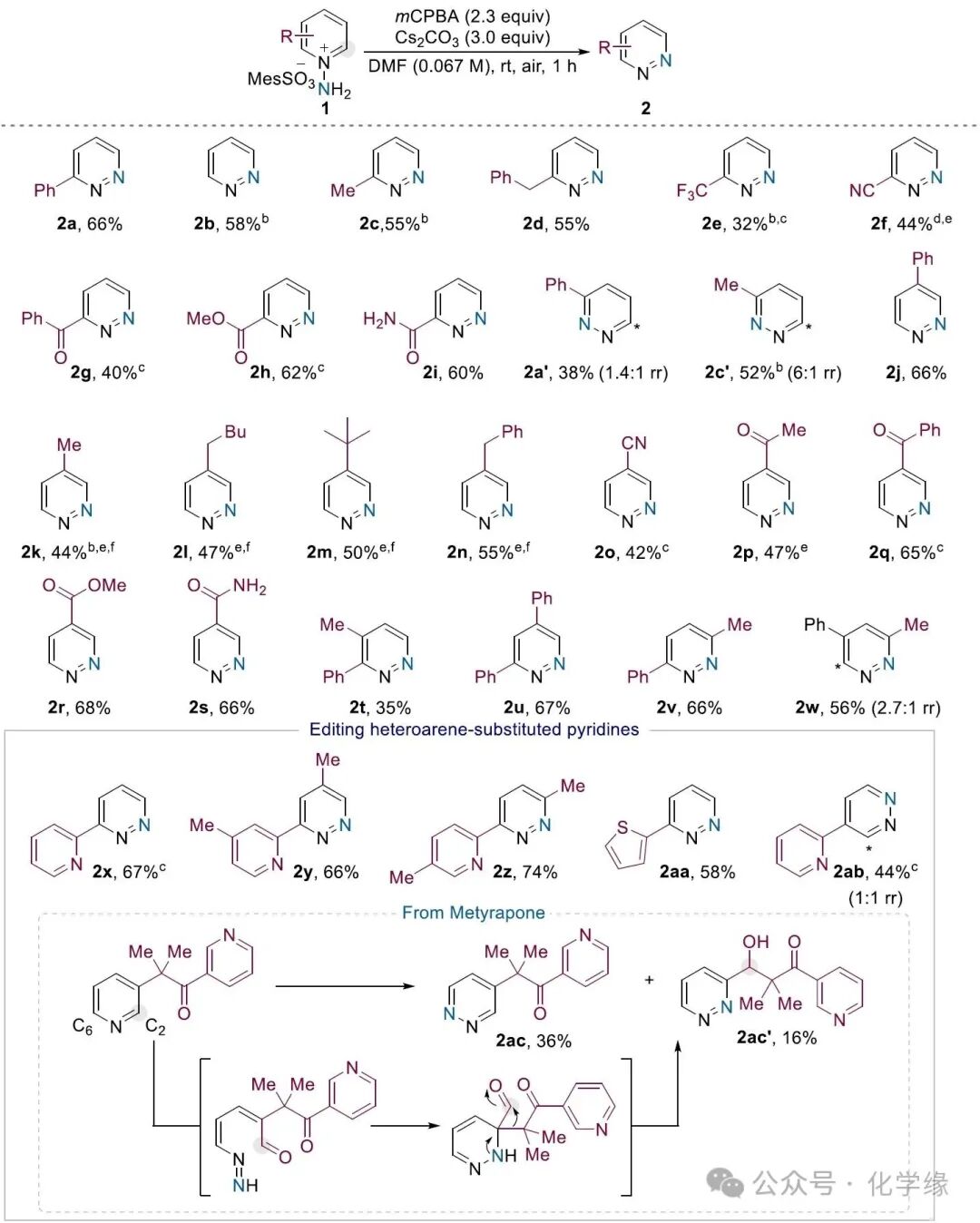
Figure 3 Substrate scope
General reaction condition: 1 (0.1 mmol), mCPBA (2.3 equiv), Cs2CO3 (3.0 equiv) in DMF (1.5 mL), at room temperature under air for 1 h.
To validate the universality and functional group tolerance of this method, various pyridine substrates were examined. This transformation process is applicable to both electron-rich and electron-poor substrates and exhibits broad tolerance towards ketones, thiophenes, pyridine derivatives, and free alcohols. Most substrates can complete the reaction within 1 hour. C2-substituted substrates, regardless of the substituent (aromatic 2a, unsubstituted 2b, aliphatic 2c, 2d), can be smoothly converted, all achieving high yields. The method also tolerated electron-withdrawing groups (such as trifluoromethyl 2e and cyano 2f) as well as carbonyl functional groups (including benzoyl 2g, ester 2h, and amide 2i), while maintaining high chemical selectivity. For C3-methyl-substituted pyridinium salts (2c′), the C2 product is more readily generated compared to the C6 isomer (6:1). As the volume of the C3 substituent increases (e.g., phenyl), the steric effect diminishes the intrinsic electronic preference, reducing regioselectivity to about 1.4:1 (2a′). C4-substituted pyridines (2j–2s) also exhibited smooth conversion similar to C2-substituted substrates, accommodating long alkyl chains (2l) and bulky substituents such as tert-butyl (2m). Multi-substituted substrates at different positions (2t–2w) also achieved successful conversion, generating structurally diverse products. Even pyridines containing easily oxidizable heteroaromatic groups can be converted with high chemical selectivity, yielding heteroaromatic compounds.
At the C6 position, the reaction follows the expected carbon expulsion pathway to generate the corresponding diazine (2ac); whereas at the C2 position, the substituent undergoes a migration reaction, producing a diazine with an alcohol functional group (2ac′). This divergent outcome supports the reaction mechanism involving the generation of an aldehyde intermediate through 6π electrocyclization.
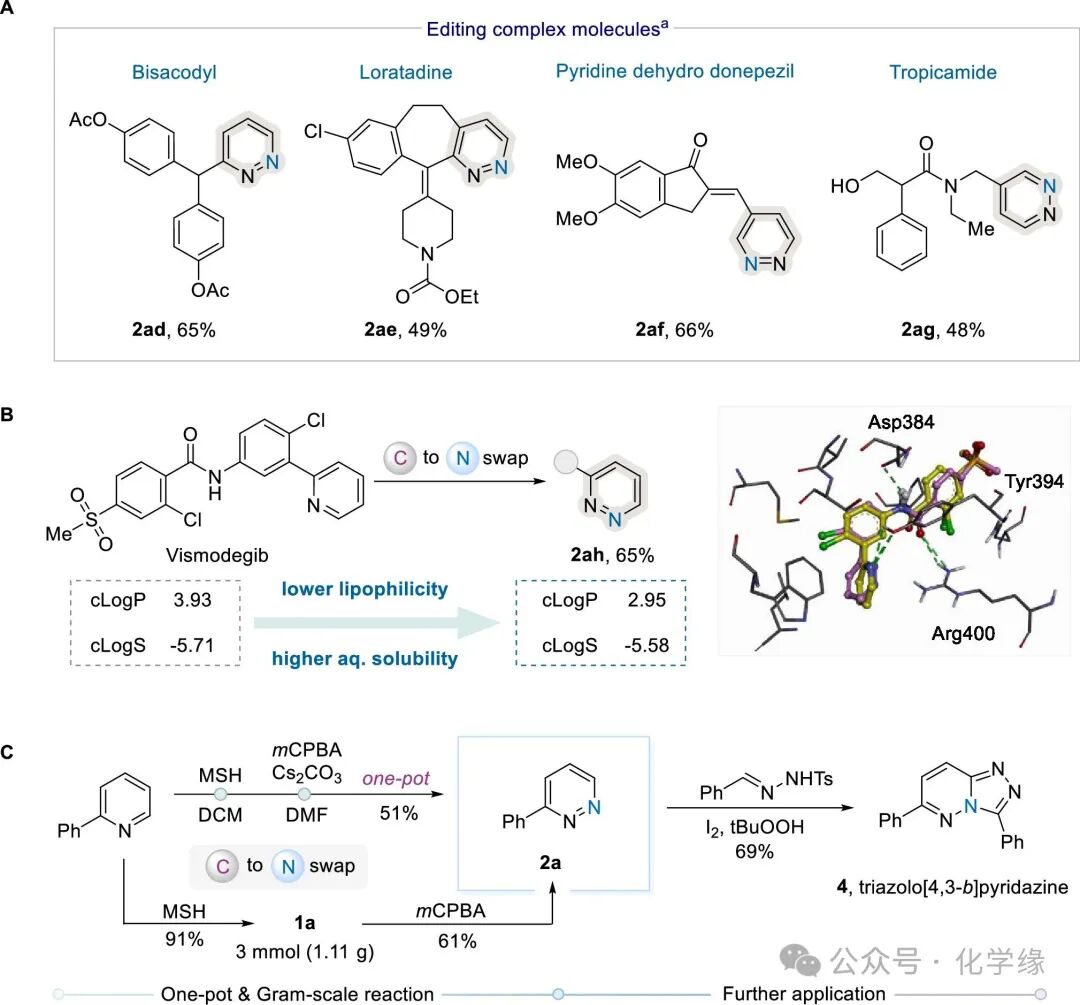
Figure 4 Synthetic applications of skeletal editing from pyridine to pyridazine
This compatibility extends to late-stage editing of complex drug molecules, directly demonstrating the practicality of this method. Bisacodyl was converted into pyridazine analogs (2ad), while the tricyclic antihistamine loratadine underwent reconstruction to introduce the pyridazine core structure (2ae). Other drug substrates (such as olefin-containing donepezil derivatives 2af and alcohol-containing anticholinergic drug tropicamide 2ag) also achieved smooth conversion. These cases collectively demonstrate that the pyridine-to-pyridazine skeletal editing technology can bridge simple building blocks and marketed drugs, overcoming key substrate limitations and facilitating rapid exploration of chemical space in drug discovery. To assess the impact of this transformation on physicochemical and biological properties, we applied it to the FDA-approved drug vismodegib—a SMO receptor antagonist used for treating basal cell carcinoma. Although vismodegib effectively binds to its target, its high lipophilicity leads to low bioavailability and long half-life, potentially causing adverse side effects. We investigated whether the C-N skeletal editing technology could mitigate these drawbacks in later stages. When processed using this method, the N-aminopyridine salt of vismodegib was smoothly converted into its piperazine analog (2ah). These results highlight C-N skeletal editing as a powerful scaffold-hopping strategy that can finely tune drug properties without compromising target binding affinity and potentially alleviate side effects. Ultimately, we validated the scalability of this method through gram-scale reactions, with only minor yield decreases, demonstrating its practical application potential. Notably, by directly achieving the conversion from pyridine to pyridazine without isolating the N-aminopyridine salt intermediate (after evaporation of volatile solvents), this one-pot two-step process was also effective, ultimately yielding pyridazine compounds 2a with a 51% yield. The synthetic value of this method is further reflected in the direct conversion of the pyridazine core into biologically promising triazole and [4,3-b]diazine scaffolds, establishing this method as a versatile platform for constructing diverse heteroaromatic scaffolds.
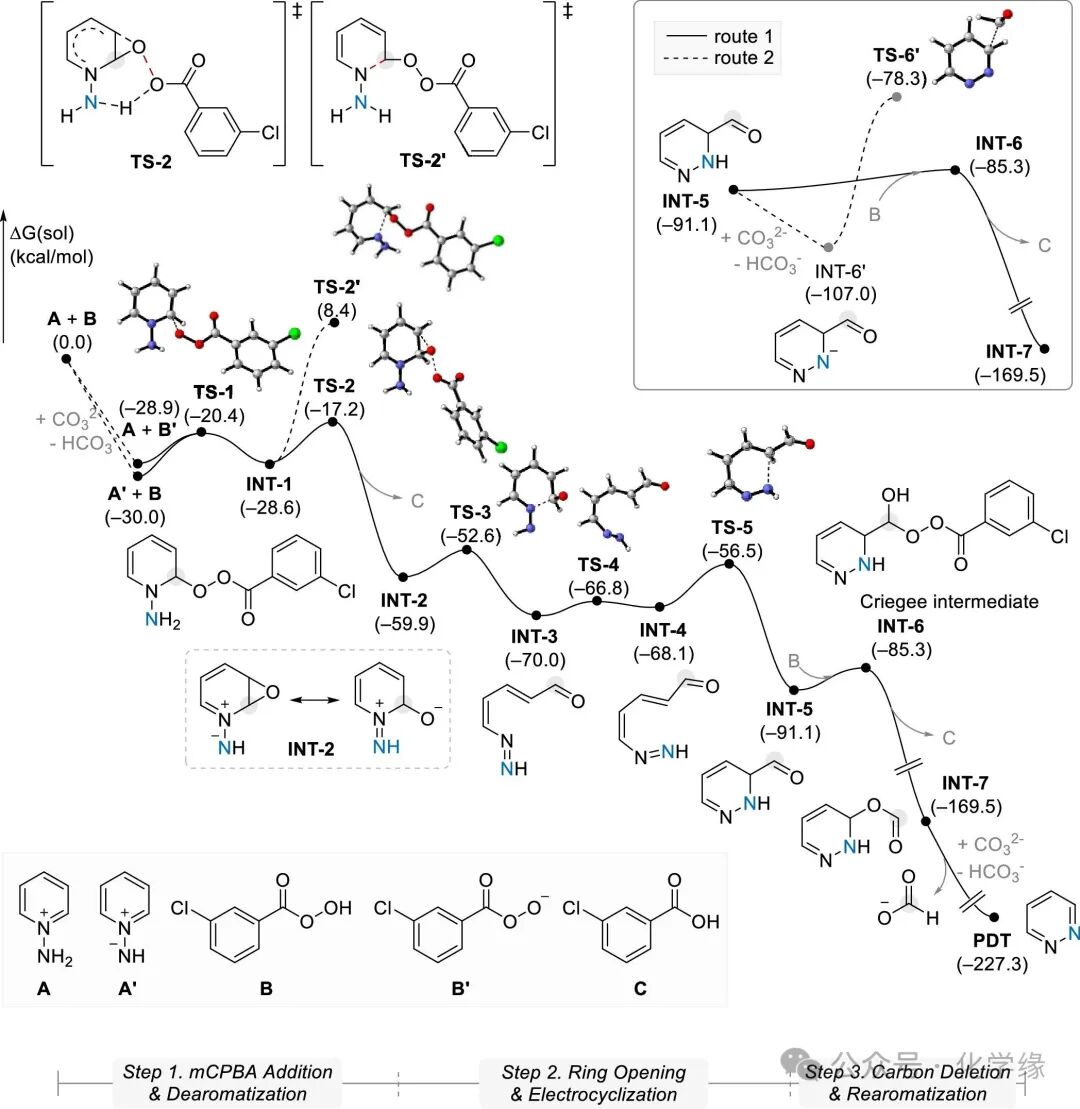
Figure 5 DFT computational analysis
DFT calculations support the following mechanistic pathway: mCPBA first adds to the pyridine ring to form a de-aromatized adduct, which is then subjected to ring-opening, 6π electrocyclization, and carbon atom expulsion to restore aromaticity. Under basic conditions, two feasible starting pathways exist, depending on the protonation state of the N-aminopyridine salt and mCPBA. The enthalpy changes for these two pathways are nearly identical (ΔG = 1.1 kcal mol-1); rapid proton transfer between adjacent N and O sites makes it difficult to computationally distinguish the corresponding transition states. In the subsequent ring-opening step of the de-aromatized intermediate INT-1, the lone pair electrons of the internal nitrogen contribute to forming an epoxide-like transition state TS-2, while releasing carboxylic acid (ΔG = –31.3 kcal mol-1), ultimately generating INT-2 in an exothermic manner. Another pathway resembling the Zincke reaction—nucleophilic attack followed by ring-opening to form an internal C-N bond—was excluded due to the high energy barrier of the corresponding transition state TS-2′ (ΔG‡ = 37.0 kcal mol-1). Subsequently, INT-2 undergoes electronic rearrangement to promote ring-opening, generating the 1,2-diazatriene intermediate INT-3. This species can form conformers INT-4, which tend to undergo a 6π electrocyclization reaction, yielding the 2,3-dihydrodiazine intermediate INT-5. Re-aromatization can occur via two pathways: one is direct aldehyde expulsion (this pathway is unfavorable, ΔG‡ = 28.7 kcal mol-1; pathway 2); the other is through Baeyer–Villiger oxidation to convert the aldehyde into a formate ester before expulsion. The oxidation-mediated pathway is thermodynamically favored, with a total free energy decrease of approximately 136 kcal mol-1. Capture experiments support this mechanism: no imine products were observed when using aldehyde trapping agents, while benzyl bromide trapping yielded benzyl formate. The observed consumption of 2.3 equivalents of mCPBA in the experiments aligns with this mechanism: the first equivalent initiates ring reconstruction, while the second equivalent drives the formate ester formation step.
Conclusion: A skeletal editing scheme for converting pyridine to pyridazine via carbon-nitrogen exchange has been reported. This method combines N-aminomethylation with mCPBA-promoted ring rearrangement steps. The method operates under mild conditions, has a broad applicability range and functional group tolerance, and enables skeletal editing of complex drugs.
Article Information:
Pyridine-to-Pyridazine Skeletal Editing
Wonjun Choi, Ahyoung Jang, and Sungwoo Hong*
DOI: 10.1021/jacs.5c15601
We hope this article inspires you, and let us strive together for a better future!