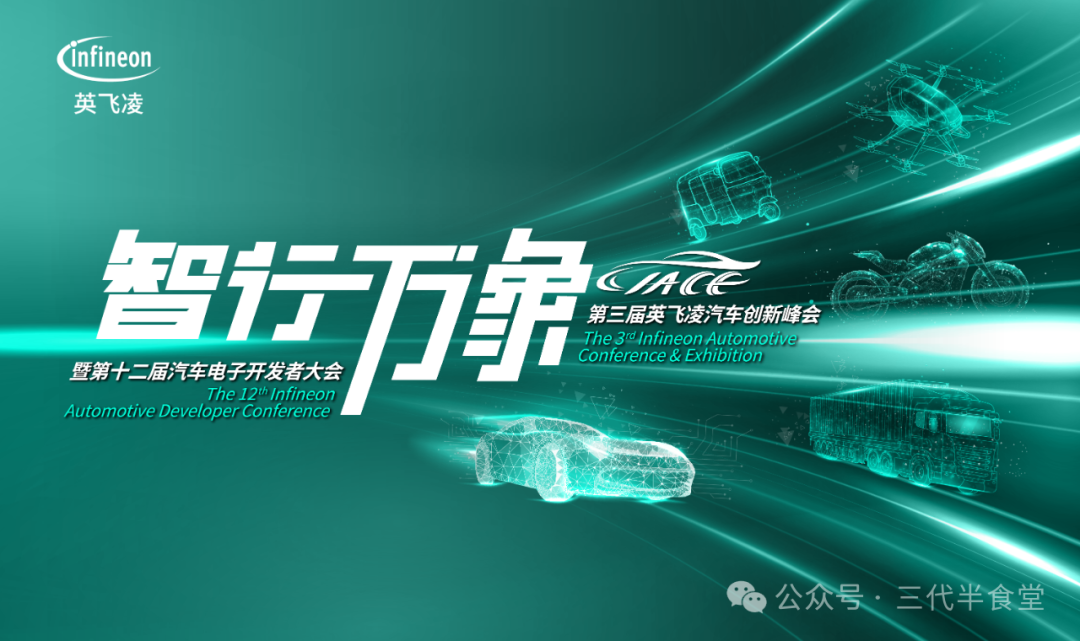
On November 13, the third Infineon Automotive Innovation Summit was held in Suzhou.
As the global leader in the automotive semiconductor market, Infineon systematically elaborated on its latest strategy in the face of industry changes. In response to the waves of electrification and software-defined vehicles, this traditional market leader is attempting to pursue two parallel paths—deepening localization in China and laying out the next-generation RISC-V architecture—as the two key focus areas of its next phase of automotive MCU strategic planning.
Conference information revealed that Infineon’s first virtual prototype of the next-generation microcontroller based on RISC-V is already in place, and the company is actively building an automotive RISC-V ecosystem. This exploration from the mature TriCore™ architecture to the open RISC-V ecosystem marks the beginning of a profound evolution in automotive electronics centered around “control and collaboration.”
Robust Performance Behind Accelerated Localization Strategy
Public data shows that in fiscal year 2025, Infineon’s automotive business revenue will account for 50% of its total revenue, maintaining its position as the world’s leading automotive semiconductor supplier with a market share of 13.5% in 2024 (with major growth driven by microcontrollers (MCUs) and power semiconductors). In this key market of China, its share has slightly increased to 13.9%, outperforming the global average.
Driven by the trend of smart electrification, Infineon’s automotive business has formed six major product lines, serving approximately 30,000 customers globally. In 2024, Infineon’s automotive MCU market share is expected to grow to 32%, once again becoming the global leader.
Building on its solid market position, Infineon’s automotive business is accelerating the implementation of the company’s localization strategy of “In China, for China.” Infineon Technology’s Vice President and Head of the Power and New Energy Systems Business Unit for Greater China, Zhong Xiaolong, stated that by 2027, most key components, including low-voltage power devices, microcontrollers, analog mixed-signal devices, and memory devices, will be manufactured locally in China, and the 28 nm critical process node has already been introduced into the local production system.
This series of initiatives indicates that Infineon is attempting to build a complete chain from local product definition to local manufacturing to address increasingly complex market demands and supply chain challenges.
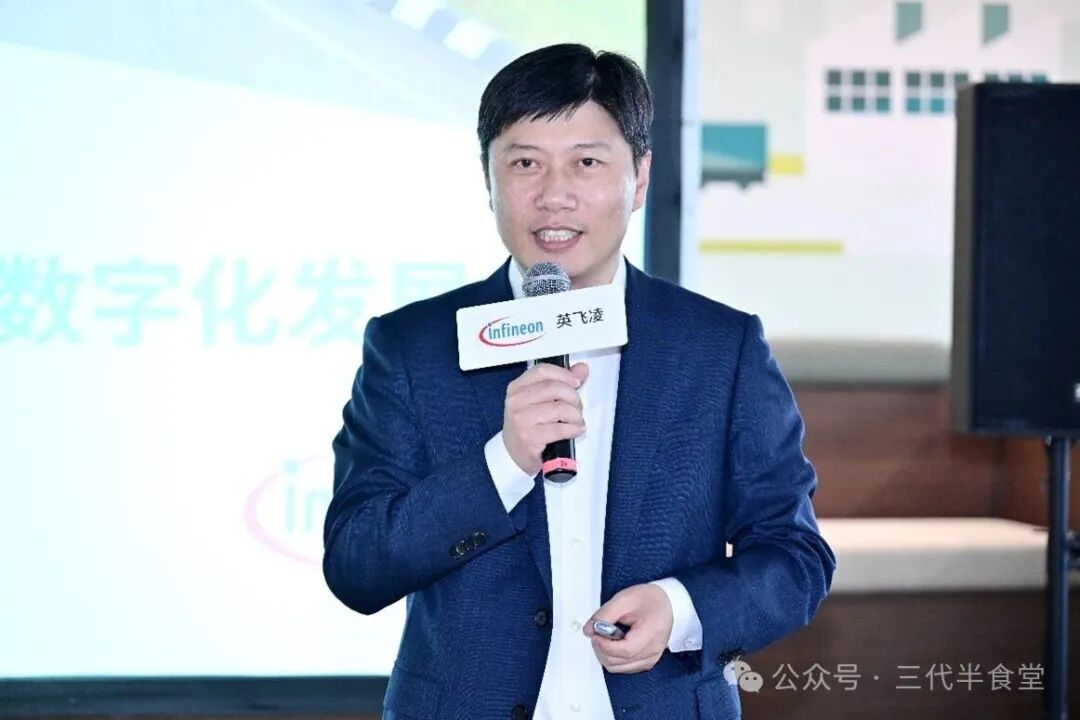
Zhong Xiaolong, Vice President of Infineon Technology and Head of the Power and New Energy Systems Business Unit for Greater China
RISC-V Layout: A Proactive Change and Exploration of the Unknown
For the past two decades, the TriCore™ architecture has been the cornerstone of automotive control due to its high reliability. However, Infineon has stated that it will adopt the open RISC-V as the unified core architecture for its next-generation MCUs.
Zhong Xiaolong of Infineon’s automotive business described this move as “proactive change as the leader.” Behind this decision are both macro considerations for leading industry technological transformation and precise layouts for the Chinese market. Market discussions focus on the belief that the future MCU choices in the Chinese market may be based on two core demands: “localization” and “open source.” Infineon’s RISC-V strategy happens to meet both points, making it not only a technical option but also a key part of deepening the localization strategy. The ultimate goal is to build a unified platform that covers all scenarios of automotive applications to meet the new requirements for cross-domain collaboration and development efficiency posed by software-defined vehicles.
At the same time, Infineon also stated that the RISC-V ecosystem is currently under construction, and there are challenges to truly establishing it as an open standard in the automotive industry. To this end, Infineon has adopted an “ecosystem-first” strategy, already working through its joint venture Quintauris and collaborating with local partners to build the toolchain and software ecosystem before the chip is launched.
It is worth noting that Infineon emphasizes that this layout aims to provide more diverse options. Infineon’s MCUs based on various architectures will continue to develop in parallel for a long time to meet different customer needs and application scenarios. This not only demonstrates its determination to explore the future but also reflects caution in the face of mature markets and technological inertia.
Addressing Architecture Centralization: From Hardware Solutions to System-Level Solution Capabilities
In response to market trends such as software-defined vehicles (SDVs), assisted driving, and artificial intelligence, Infineon showcased its adaptability as a system solution provider.
- • In terms of high-speed interconnects: The acquisition of Marvell’s automotive Ethernet business, completed in August 2025, is seen as a key step in strengthening in-vehicle network communication capabilities.
- • In supporting advanced driving sensor layers: Taking millimeter-wave radar as an example, Infineon provides two technical routes: one is the traditional edge architecture (CTRX8188F RF front-end + AURIX™ TC45 MCU), processing at the edge; the other is the future-oriented central architecture, which transmits raw data through high-speed links (such as SerDes) to the domain controller, where the SoC’s computing power enters centralized processing in the ADCU. This flexibility aims to meet the differentiated needs of different automakers and computing platforms.
- • In the AI application layer: Regarding the implementation of AI in vehicles, Infineon introduced its PPU (Parallel Processing Unit) integrated into the AURIX™ TC4x series. This lightweight AI accelerator can perform tasks such as virtual sensing while ensuring functional safety and real-time performance, seen as an attempt for MCUs to extend from pure “control” to “intelligent collaboration.”
Localization Loop: Comprehensive Implementation from “Definition” to “Manufacturing”
Infineon’s automotive business localization strategy of “In China, for China” has been accelerating from planning to implementation since it was announced at the main forum of the Electric Vehicle Hundred People Meeting (now renamed “Che Bai Hui”) at the beginning of the year. Its core is to build a complete loop covering innovation, manufacturing, and ecology.
In terms of local innovation, local teams are shifting from “adapting to the market” to “defining products.” This transition is supported by a comprehensive cooperation mechanism: Infineon is not only co-building innovation application centers with OEMs and Tier-1 suppliers but also involving over 10 mentor-level customers in product definition, and as the only automotive semiconductor manufacturer joining the China Intelligent Driving Partner System, while signing over 10 cooperation agreements with industry chain partners to explore flexible business models.
In terms of local production, Infineon’s strategy is twofold: on one hand, it fully utilizes its own backend production facility in Wuxi; on the other hand, it collaborates with existing local production partners and deepens cooperation with local partners in both frontend and backend processes. Its goal is to achieve local coverage of mainstream automotive products by 2027, covering not only key 28nm AURIX™ TC4x microcontrollers but also extending to high-voltage power devices (such as QDPAK, TO247 packages) and various sensors, to comprehensively enhance the resilience and responsiveness of the supply chain.
In terms of ecological collaboration, Infineon has jointly launched university programs, dandelion clubs, and other projects with local partners. More importantly, in building the automotive RISC-V ecosystem, Infineon is promoting the standardization of automotive RISC-V through its joint venture Quintauris and working with ecosystem partners to accelerate the co-construction of the automotive RISC-V toolchain and software. With the delivery of Infineon’s first virtual prototype of the next-generation microcontroller based on RISC-V, its ecosystem validation has entered a substantial phase.
Overall, Infineon’s localization is not just about manufacturing migration but also a systematic reconstruction of supply chain structure and innovation mechanisms. The detailed planning showcased at the Suzhou summit marks that this strategy has entered a measurable and verifiable execution phase.
Ecological Building and Social Responsibility
Infineon’s strategic layout goes beyond the products themselves, extending to broader ecosystem building and social responsibility commitments.
In terms of talent and technology ecology, the company has long invested in the cultivation of future talents. Its long-term support for the National College Student Intelligent Vehicle Competition has covered over 500 universities and more than 100,000 students. At the same time, it has maintained a 22-year university program and established cooperation with over 1,000 professors. Additionally, Infineon’s Automotive Innovation Summit (IACE) has become a leading communication platform in the industry, with this year’s summit exposure exceeding 5 million, demonstrating its influence in the industry.
In terms of industry recognition, Infineon’s technological strength has received authoritative recognition. At the World New Energy Vehicle Conference held in Haikou in September, its AURIX™ TC4x series was awarded “Global New Energy Vehicle Innovative Technology,” and the embedded wide bandgap power module integration technology for automotive inverters was awarded “Global New Energy Vehicle Cutting-Edge Technology,” with certificates personally presented by Chairman Wan Gang.
In terms of sustainable development, Infineon not only commits to achieving carbon neutrality by 2030, but is also one of the first semiconductor companies to commit to adhering to the United Nations Global Compact’s “Ten Principles,” demonstrating its social responsibility as an industry leader.
Trends: Systemic Transformation from “Control” to “Collaboration”
From the high reliability control of TriCore™ to the open ecological collaboration of RISC-V;
From decentralized ECUs to cross-domain integration under central computing;
From traditional MCUs to intelligent edge nodes integrated with PPUs—
Infineon’s strategic evolution in the automotive business clearly outlines that the core of automotive electronics is shifting from the performance of individual components to system-level collaborative efficiency.
As vehicles become mobile intelligent terminals, what determines their value is no longer just the stacking of chips, but how to enable different processing units to work together efficiently and safely. Through a series of initiatives such as acquiring Ethernet business, laying out central radar architecture, and promoting RISC-V, Infineon is providing its customers with the “toolbox” to build this collaborative capability.
This transformation ultimately points to a clear future:
A “new automotive electronics system” based on open architecture, supported by localized manufacturing, and aimed at intelligent collaboration is emerging, and Infineon is attempting to play a key role as a shaper in the formation of this system through its comprehensive strategic layout.