 Key Points:・An illuminance sensor is a device that perceives environmental brightness, working by outputting current based on the amount of light received by its photodetector.
・A proximity sensor is a device that detects the distance to a target object by measuring the reflection of emitted waves, sound, or light to determine the presence of the target and measure the distance to it.
・There are also sensors that combine illuminance, proximity, and infrared LED functions to enhance convenience.
・These sensors are widely used in various applications ranging from consumer electronics to industrial fields.
In recent years, the application of illuminance sensors and proximity sensors in various devices around us has become increasingly common. In addition to using illuminance sensors and proximity sensors separately, the combination of these sensors is also on the rise, which is why this article will introduce both types of sensors.
1What is an Illuminance Sensor?
An illuminance sensor is a device used to sense environmental brightness. In recent years, the term “brightness sensor” has become more common among general consumers, indicating its widespread use. For example, in battery-powered portable devices with larger displays, such as smartphones, tablets, and laptops, the screen brightness is automatically adjusted based on the ambient light. This adjustment is not only for visibility but primarily to reduce power consumption and extend battery life. In addition to portable devices, products like televisions and car navigation systems are also equipped with automatic adjustment features that can change screen brightness and display colors (such as night mode in car navigation systems) based on ambient light, aiming to optimize visibility and reduce eye strain.
The sensing element of an illuminance sensor typically uses phototransistors or photodiodes, which convert the received light into current and output a current corresponding to the illuminance. Since the current signal from photodiodes is usually weak, it needs to be amplified by an amplifier before signal processing. The mainstream illuminance sensors using photodiodes are mainly divided into two types: one is a simple analog output type that directly outputs the amplified current signal through a current amplifier; the other is a digital output type that integrates current-to-voltage conversion, analog-to-digital conversion, digital control, and external interfaces (as shown in the figure below).
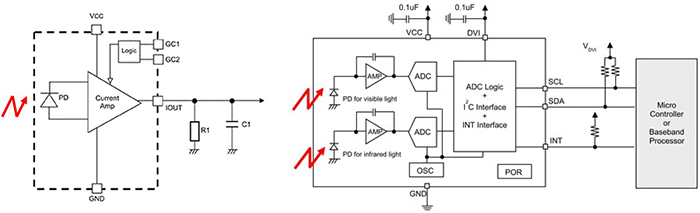
Important characteristics of illuminance sensors include spectral sensitivity characteristics, which require visual sensitivity, meaning they must maintain uniform sensitivity even when the type of light source (such as bulbs) varies, which is crucial.
2What is a Proximity Sensor?
A proximity sensor is a device that detects the presence of objects or people without contact. In applications such as security lights or outdoor parking lots, devices that automatically light up when a person or vehicle approaches typically use proximity sensors. There are various types of proximity sensors, including infrared, inductive, capacitive, ultrasonic, and radio wave types.
To detect whether a target has entered the detection range (i.e., is nearby) and the degree of proximity, the sensor emits electromagnetic waves, light, ultrasonic waves, or other energy and senses the proximity by detecting changes in the material or energy reflected from the target.
Some proximity sensors can not only detect the presence of a target but also measure the distance to the object. For example, the obstacle detection warning system and adaptive cruise control system equipped in cars utilize proximity sensors such as ultrasonic sensors, microwave, or millimeter-wave radar to achieve distance measurement.
In recent years, infrared proximity sensors have become common in smartphones and tablets. These sensors consist of infrared emitting elements (such as infrared LEDs) and photodetectors like photodiodes. The infrared light emitted from the emitting element reflects off the target object, and the photodiode receives this reflected light and converts it into current. A threshold is set based on the relationship between the conversion amount and the distance to the target object, and when this threshold is exceeded, it is determined that the target is within the set distance.
For example, in smartphones, when a call is made, the proximity of a face to the LCD screen is detected, which turns off the touch screen function to prevent accidental touches and also turns off the screen backlight to save power.
3Combined Sensors of Illuminance and Proximity
The application of using both illuminance sensors and proximity sensors to enhance convenience has become quite common. Taking the previously mentioned security lights and outdoor parking lots as examples, the lighting conditions need to meet the dual conditions of “dim environment and presence of a person or vehicle.” The brightness of the environment is detected by the illuminance sensor, while the proximity of the object is sensed by the proximity sensor. Additionally, in applications like smartphones, the brightness adjustment requires an illuminance sensor, while preventing accidental touches and turning off the backlight during calls requires a proximity sensor. Although these are not AND conditions, both sensors are essential. For applications that require dual functionality, sensors that integrate illuminance sensors, proximity sensors, and infrared LEDs into a single package have been developed. An example of such a product is the RPR-0521RS.
The advantage of this integrated sensor lies not only in the simple integration of two functions but also in the miniaturization brought about by integration, as well as the fixed positional relationship between the infrared LED as the emitting element and the photodiode as the receiving element, which eliminates the need for complex adjustments, thereby shortening design time. This miniaturization of components is a rigid requirement, especially in small devices like smartphones. For instance, the RPR-0521RS has a package size of only 3.94×2.36×1.35mm.
4Conclusion
This article introduced illuminance sensors, proximity sensors, and the integrated sensor combining illuminance, proximity, and infrared LED functions, which have a wide range of applications. Although examples were provided using everyday devices like smartphones, their uses can be further expanded to security and safety management in factories, as well as serving as triggering devices for data collection in IoT applications, among various other scenarios.
Source:ROHM Semiconductor Group, thank you.
Disclaimer: This article is a reprint, and the purpose of reprinting is to convey more information. The copyright belongs to the original author. If there are any copyright issues with the videos, images, or text used in this article, please contact the editor for resolution.