Recently, Professor Wang Yang’s research group at the National Digital Fishery Innovation Center of China Agricultural University published a research paper titled “Real-time rapid visual fish disease detection system based on tiny machine learning” in the journal Aquaculture International.
Article Overview
Aquaculture International is an international academic journal focused on the field of aquaculture. The journal accepted the paper by Wang Jiayi, Yin Yihan, Yang Jinqi, Zhu Feiyu, Li Daoliang, and Wang Yang (supervisor) from the National Digital Fishery Innovation Center of China Agricultural University—”Real-time rapid visual fish disease detection system based on tiny machine learning” (DOI: https://doi.org/10.1007/s10499-025-02256-6).
This research was funded by the National Key Research and Development Program (Fund Numbers: 2024YFD2400200; 2024YFD2400204), the National Natural Science Foundation (Fund Number: 32373185), and other projects.
Figure 1: Paper Cover
Research Background
Aquaculture plays an increasingly important role in ensuring global food security and promoting economic growth, but fish diseases during aquaculture can lead to high mortality rates and economic losses. Traditional target detection and laboratory diagnostic methods have shortcomings in timeliness and cost, failing to meet the rapid diagnostic and prevention needs in frontline scenarios. This research focuses on a new paradigm represented by machine vision and lightweight intelligence, which completes diagnosis on-site: in aquaculture environments with limited network bandwidth, computing power, and energy consumption, conventional large models are difficult to implement, necessitating the shift of inference to low-power edge devices to achieve real-time, low-cost, and more secure disease detection. The rise of TinyML provides a feasible path—by running efficient lightweight models on resource-constrained devices such as microcontrollers, on-site perception inference can be achieved without relying on the cloud, making it particularly suitable for continuous health monitoring in offshore or small aquaculture scenarios.
Innovations
The main innovations of this research are as follows:
(1) For the first time, a lightweight target detection model YOLO11n is deeply coupled with RISC-V microcontrollers to complete the closed loop of “acquisition—inference—display/feedback,” achieving non-capture, non-contact real-time detection for both underwater and transparent observation box operational modes.
(2) The device integrates solar/lithium hybrid power supply and Wi-Fi/BLE communication, enabling off-grid autonomous operation, reducing manual intervention and network dependence; the entire machine adopts a waterproof casing to adapt to complex aquaculture environments.
(3) The system introduces depthwise separable convolutions, CIoU regression, and FP16 perceptual quantization training in YOLO11n, significantly compressing parameters and computational overhead while maintaining the ability to locate and classify small-scale, irregular disease symptoms.
(4) End-to-end testing was completed on a self-built dataset and actual edge platform, achieving a balance between model size, latency, and accuracy, validating the usability of the TinyML solution in frontline aquaculture production.
Research Introduction
This research constructed a rapid detection device for fish diseases that operates in a closed loop on the edge, centered around the SG2002 RISC-V microcontroller, integrating a 1 TOPS neural network processing unit, dual C906 cores, and 256MB DDR3 memory; equipped with a 4-megapixel GC4653 color camera and a 2.3-inch capacitive touch screen, achieving an integrated process of “acquisition—inference—display—local storage/wireless feedback.” The system is housed in a waterproof casing to adapt to humid, corrosive environments, and supports both “underwater deployment” and “transparent observation box” operational modes as shown in Figure 2, with onboard Wi-Fi/BLE completing remote data transmission and monitoring, while a TF card is used for local data management and offline export.
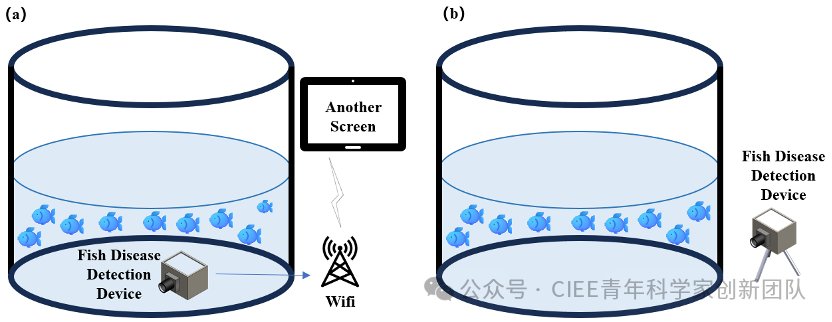 Figure 2: Operational Modes
The case data was sourced from 914 images of large mouth bass (Nocardia disease) collected and annotated at the Huangdao base, divided into training/validation/testing sets at a ratio of 70%/15%/15%, with categories of “normal/diseased” binary classification, including 300 healthy samples and 614 diseased samples.
The algorithm and software process can be referenced in Figure 3. When the system starts, the camera and microcontroller initialize in coordination, and images are input in RGB565 format with a resolution of 640×640 into a pre-allocated DMA buffer; if the network is available, it automatically associates with the preset access point to enable remote monitoring. Subsequently, under the management of a real-time operating system, threads for image acquisition, preprocessing, neural network inference, result rendering, and network communication run in parallel: each detection cycle completes frame acquisition—bilinear interpolation resampling—YOLO11n inference—overlaying target boxes and labels—local display of results/remote feedback. The deployed model employs pruning and FP16 quantization strategies to reduce latency and memory usage; during the training phase, input of 640×640 is optimized for 100 epochs, using SGD (with mAP50-95 as the main metric), and introducing L2 regularization and dropout in the detection head to enhance generalization; meanwhile, depthwise separable convolutions and CIoU regression are systematically introduced within the YOLO11n framework to balance the localization and robustness of small-scale disease symptoms under resource constraints.
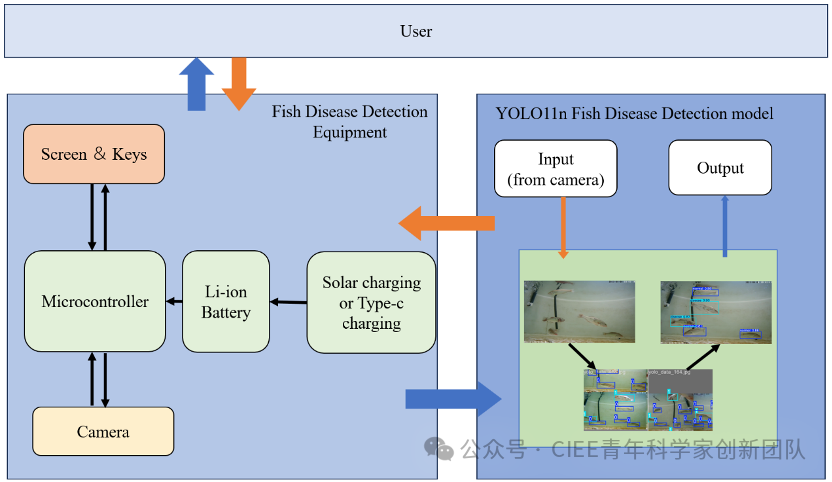 Figure 3: System Operation Process
On the device side, the single-frame inference latency is approximately 40.7 ms, with Flash usage at 5,332 KB; compared to YOLO11s, YOLOv8n, and YOLOv5n on the same platform, YOLO11n shows advantages in resource usage and latency while achieving a mAP50-95 of 0.736, realizing a good trade-off between “accuracy and efficiency.” Additionally, power consumption assessments indicate that the device’s typical power consumption under inference/idle/mixed conditions is approximately 1.82 W/0.67 W/1.05 W, supporting long-term autonomous operation in off-grid scenarios.
Research Conclusion
This research proposes and validates a rapid detection system for fish diseases based on “TinyML + microcontroller + machine vision”: under the resource constraints of 256 MB memory and dual-core RISC-V, through structured lightweight and quantization training, achieving millisecond-level edge inference and stable detection accuracy (mAP50-95=0.736), significantly reducing dependence on network and laboratory conditions, suitable for continuous monitoring and early warning in small and offshore aquaculture. The total cost of the system is less than $100, equipped with display and wireless feedback capabilities, showing potential for low-cost large-scale application.
In the future, the team will expand datasets for multiple species, pathogens, and environments, and introduce multimodal sensing and optical supplementation to further enhance robustness and generalizability, promoting the evolution of aquaculture towards intelligence and sustainability.
Congratulations to Wang Jiayi, Yin Yihan, Yang Jinqi, Zhu Feiyu, and others for their achievements, and thanks to Professor Wang Yang for his careful guidance. The Youth Scientist Innovation Team of China Agricultural University (Green Energy and Smart Agriculture/Fisheries, CIEE) will continue to support and encourage students to publish high-level research papers, promote innovative spirit, and strive for progress in scientific research, showcasing the youthful spirit of agricultural university students.
Author, Images | Wang JiayiEditor | Ge QuanwuReviewer | Wang Yang