Imagine a material that is as soft as a sponge, fits like skin, yet can sensitively perceive a gentle breath, a whisper, and even ‘see’ every angle of your finger’s bend.
This is no longer a scene from a science fiction movie. Recently, a three-dimensional, highly sensitive flexible pressure sensor has been developed, showcasing the limitless possibilities of ‘electronic skin’, which is set to bring revolutionary changes to fields such as health monitoring and human-computer interaction.
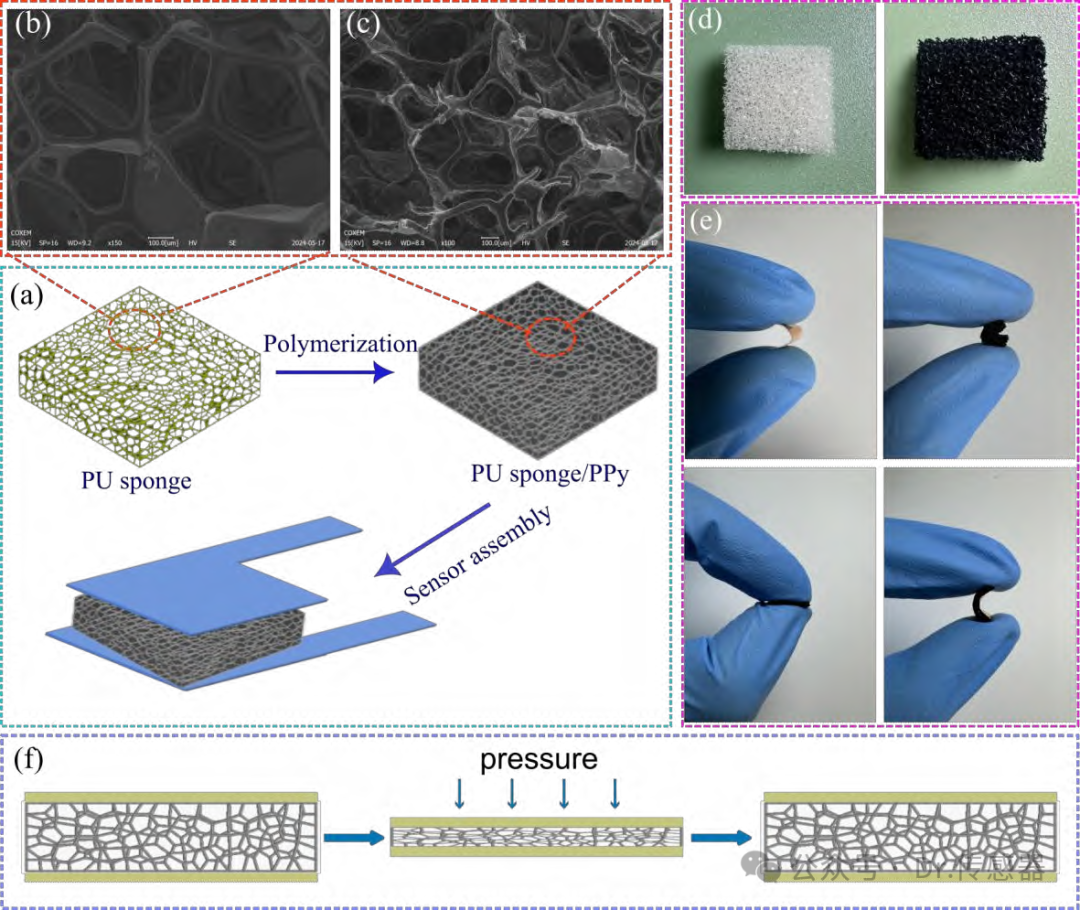
Inspiration: When Sponge ‘Learns’ to Conduct Electricity
Traditional pressure sensors are often rigid, unable to bend or stretch, making it difficult to perfectly conform to the soft, dynamic surfaces of the human body. So, how can we create a sensing system that is both soft and sensitive?
The research team’s solution is both clever and efficient:
Core Framework: They selected a common polyurethane sponge. This sponge is filled with interconnected micropores, forming a three-dimensional network. It is like a skyscraper with countless rooms, lightweight and capable of significant compression.
Giving it ‘Nerves’: Through a special ‘one-step’ gas-phase polymerization process, conductive polymer material—polypyrrole—is uniformly attached to the sponge’s framework. This process is akin to coating the entire three-dimensional skeleton of the sponge with a conductive layer, transforming it from an insulator into a conductor.
The final product is a black, soft, and conductive elastic sponge. When sandwiched between two thin copper foil electrodes, a highly sensitive flexible pressure sensor is born.
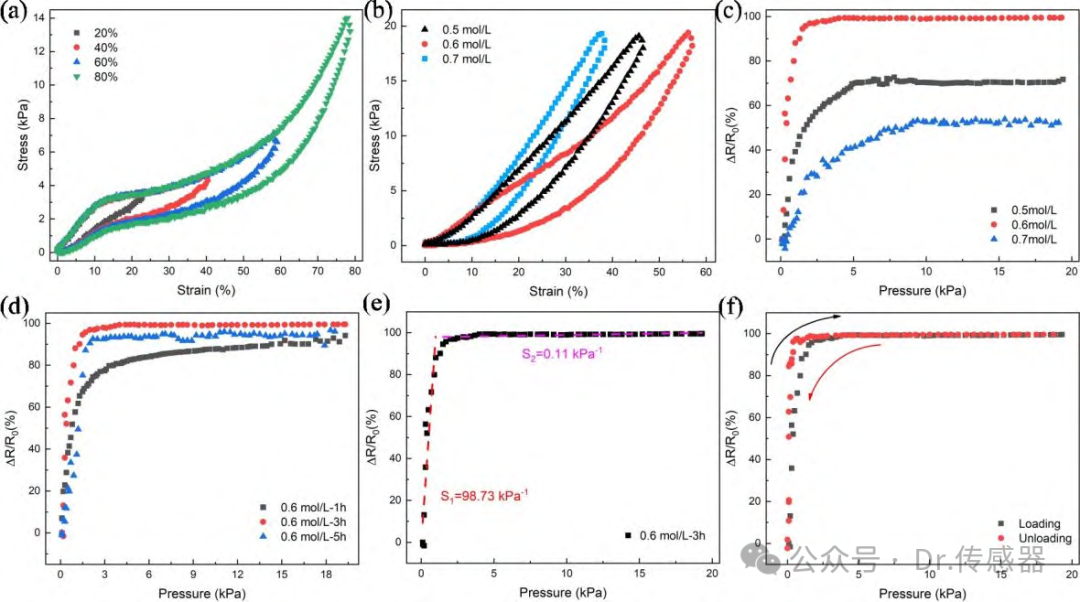
Exceptional Performance: Why Can It ‘Perceive with Precision’?
This unique ‘Sponge + Conductive Coating’ structure endows it with astonishing performance:
Ultra-high Sensitivity: At extremely low pressures (≤1.3kPa, approximately the weight of a feather), its sensitivity reaches 98.73kPa. This means that even the slightest pressure can be accurately captured and converted into a strong electrical signal.
Fast Response: Its response speed is extremely quick, with loading and unloading response times of about 460 milliseconds, allowing it to track dynamic changes in real-time.
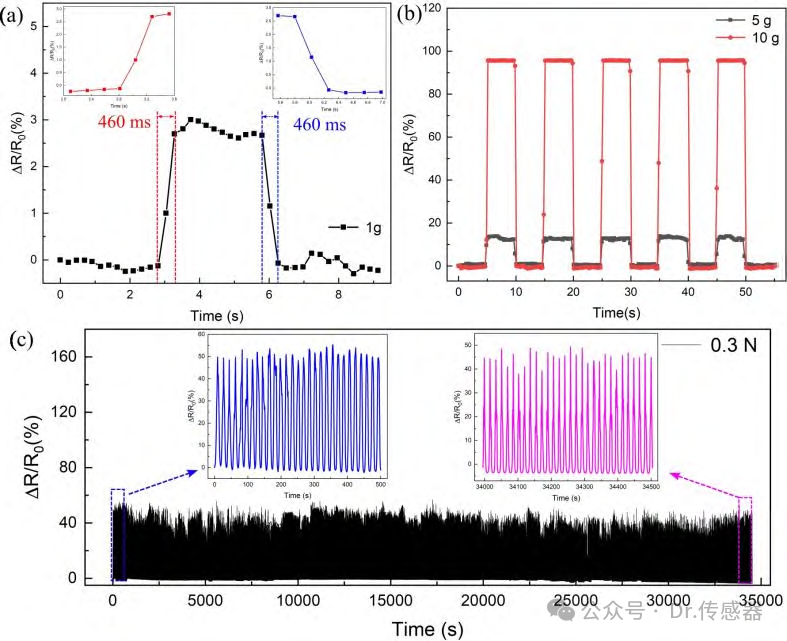
Superb Durability: After 2000 cycles of repeated compression, its performance remains stable with almost no degradation, demonstrating exceptional reliability.
Its working principle is straightforward: when the sponge is compressed, the internal conductive network is squeezed, making contact more closely, increasing the conductive pathways, and reducing resistance; when pressure is released, the sponge rebounds, and resistance returns to its original state. By measuring the change in resistance, the pressure magnitude can be accurately inferred.
Future Applications: From Health Monitoring to ‘Understanding’ Your Gestures
This skin-like sensor can be attached to various parts of the body, opening up infinite application scenarios:
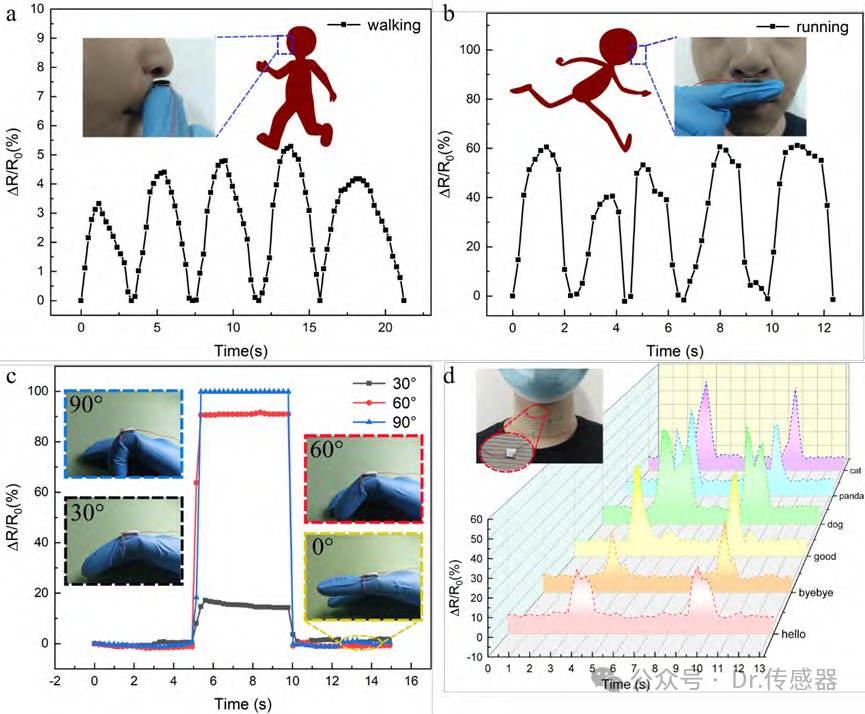
Real-time Health Monitoring: When placed on the chest or under the nose, it can clearly monitor the frequency and intensity of breathing, distinguishing between different breathing states during calm walking and intense running.
Sports Rehabilitation Tracking: When attached to fingers or joints, it can accurately capture the bending angles of joints, providing precise data for athlete training and post-operative rehabilitation.
Silent Voice Recognition: When applied like a band-aid on the throat, it can recognize different words through the subtle vibrations of throat muscles, potentially aiding those who have lost their voice in communication in the future.
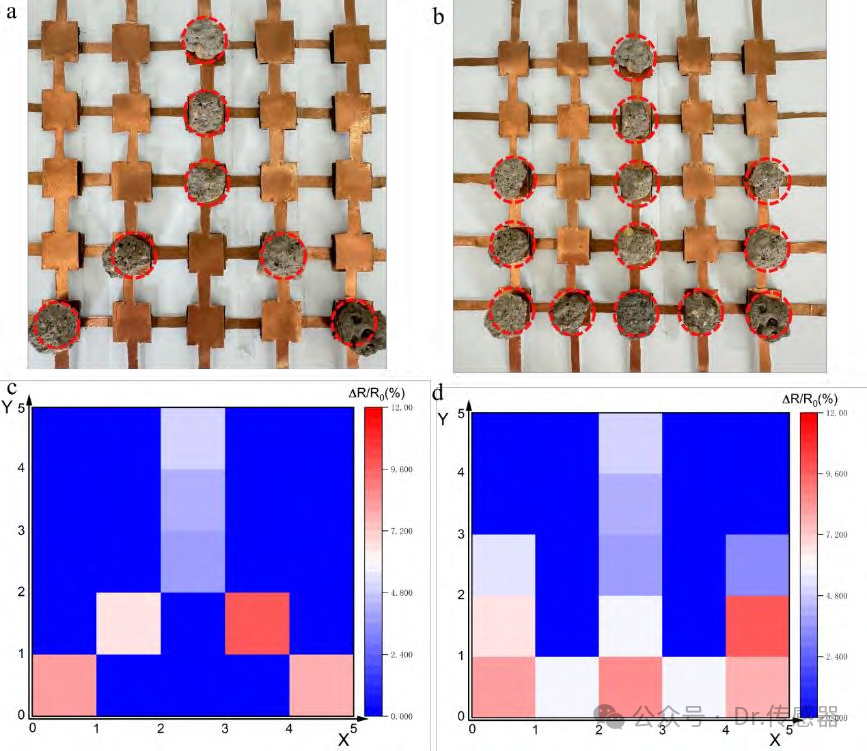
Smart Pressure Map: By combining multiple sensors into a 5×5 sensor array, it can not only sense ‘touch’ like our skin but also clearly ‘see’ the location and intensity of the touch. In experiments, it successfully mapped the pressure distribution of the characters ‘person’ and ‘mountain’.
Soft Technology, Hard-core Future, the most fascinating aspect of this research is that it creates a powerful soft sensing system using a simple and economical method. It reveals to us that future technology does not have to be cold and hard; it can also be soft, fitting, and omnipresent.
When our clothes can sense our heartbeat, when our homes can understand our gestures, and when human-computer interaction becomes as natural as breathing— this ‘perception revolution’ driven by flexible sensors is quietly approaching.
For more information on pressure sensors, flexible electronics, and cutting-edge smart sensing, please contact Dr. Wang!