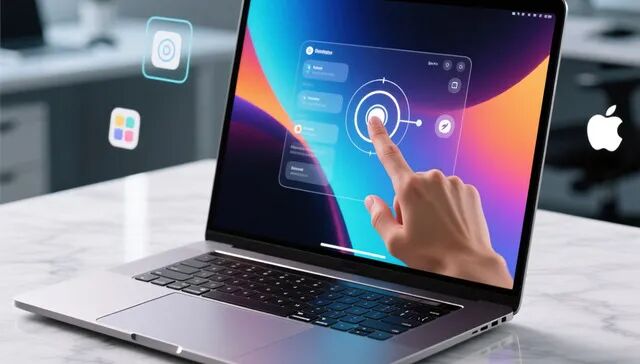
On September 18, TF International Securities analyst Ming-Chi Kuo stated in a recent report that Apple plans to integrate a touchscreen panel into its first OLED MacBook Pro, with mass production expected in 2026. This marks the first time in 19 years that the MacBook will break the interaction boundary of “only supporting keyboard and mouse”.
Kuo noted in the report that data from the past five years of iPad Pro users with the Magic Keyboard shows that about 38% of users utilize both touch and keyboard/mouse during creative tasks (such as drawing and note-taking), especially in educational and design scenarios, where touch operations can improve task efficiency by 22%. This “tablet-like” usage habit has prompted Apple to reassess the interaction logic of the MacBook.
It is reported that the touchscreen MacBook Pro’s touch solution is not a simple transplant of iPad technology, but rather employs On-Cell technology, which embeds the sensors directly into the screen. This technology integrates the touch sensors into the top layer of the display rather than relying on a separate touch layer, effectively reducing panel thickness while improving screen response speed. Additionally, the screen will use the same dual-layer series OLED technology as the iPad Pro. According to earlier reports, Samsung will provide the OLED display for the touchscreen MacBook Pro.
Furthermore, Kuo also revealed information about a budget version of the MacBook, stating that Apple aims to reduce costs through the energy efficiency of the A-series chips. A 13-inch MacBook is expected to enter mass production in Q4 2025, featuring the same A18 Pro chip as the iPhone 16 Pro, with a starting price potentially as low as $599, targeting the youth market. The second generation of the budget MacBook (2027) has also reserved a touchscreen interface.
Previously, it was reported that a MacBook Pro model equipped with the M5 chip might be launched by the end of 2025. However, in July of this year, well-known tech journalist Mark Gurman indicated that Apple is considering delaying it until early 2026. This timeline aligns with Kuo’s prediction of Apple launching the touchscreen MacBook Pro next year.
Looking back at history, Apple’s attitude towards touchscreen technology can be described as a “ten-year reversal”. In 2012, Steve Jobs explicitly stated at a press conference: “Touchscreens are not suitable for vertically oriented computers; human arms are not windshield wipers.” Since then, the MacBook has consistently maintained its positioning as a “professional tool”. It wasn’t until 2016 that Apple introduced the MacBook with the Touch Bar, but it was discontinued due to lack of practicality. With the cross-device collaboration between iPadOS and macOS maturing, and the M-series chips bridging the ARM architecture in 2023, the time may finally be right for Apple to introduce a touchscreen MacBook.
Unauthorized reproduction is prohibited