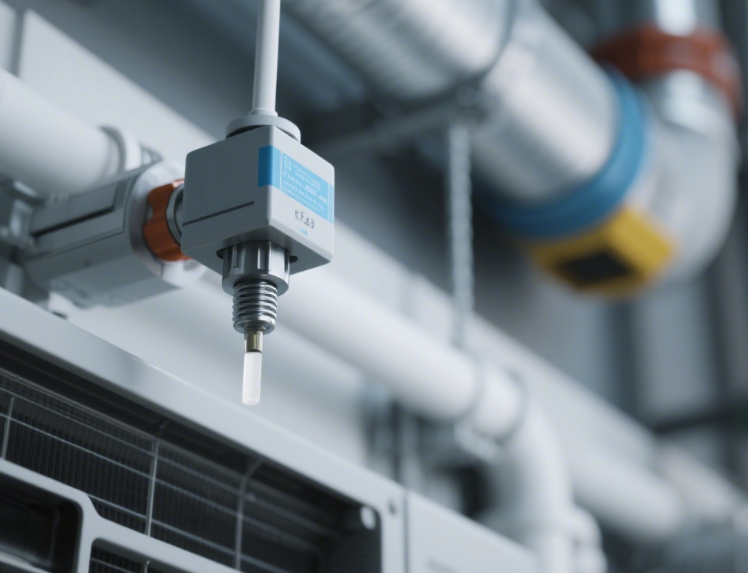
The importance of sensors in Heating, Ventilation, and Air Conditioning (HVAC) systems is irreplaceable. They act as the “sensory nerves” of the system, responsible for real-time monitoring of environmental parameters and equipment status, providing a solid data foundation for intelligent control. Their core value is mainly reflected in the following aspects:
1. Precise Monitoring of Environmental Parameters: Achieving Demand-Based Control
Temperature Sensors: Monitor indoor and outdoor temperatures, controlling the start and stop of cooling/heating equipment and output, avoiding energy waste (such as preventing “overcooling” or “overheating”).
Humidity Sensors: In places requiring precise humidity control (such as hospitals, data centers, museums), they work in conjunction with humidification/dehumidification equipment to prevent mold growth or static electricity hazards.
CO₂ Sensors: Detect air quality in densely populated areas, dynamically adjusting fresh air volume (such as in conference rooms and classrooms), balancing energy savings and health.
PM2.5/VOC Sensors: Trigger air purification devices or increase fresh air to ensure health (especially in areas prone to smog or industrial environments).
2. Monitoring Equipment Operating Status: Ensuring System Reliability
Pressure Sensors: Monitor pressure in air ducts/water pipes, promptly detecting blockages or leaks (such as clogged filters or ruptured pipes), protecting fans/pumps from overload.
Flow Sensors: Detect the flow of hot and cold water or refrigerants, preventing heat exchange efficiency decline due to insufficient flow (a key parameter for energy-saving operation in refrigeration stations).
Current/Voltage Sensors: Monitor the load of motors and compressors, preventing electrical faults (such as three-phase imbalance or overload).
Vibration Sensors: Early identification of wear in fan and pump bearings, enabling predictive maintenance.
3. The Core Support for Energy Efficiency Optimization
Demand Response: Dynamically adjust system operation strategies based on real-time data (such as indoor/outdoor temperature and humidity, personnel density) (e.g., reducing fresh air volume at night).
Fault Detection and Diagnosis (FDD): Abnormal sensor data can pinpoint energy efficiency vulnerabilities (such as refrigerant leaks leading to a decrease in COP).
Time-Based and Zone Control: Combine occupancy sensors to turn off air conditioning terminals in unoccupied areas.
4. The Foundation for Intelligence and Automation
IoT Integration: Sensor data is uploaded to the cloud for remote monitoring, big data analysis, and AI optimization (such as predicting loads based on historical data).
Adaptive Control: For example, light sensors work with shading systems + air conditioning to reduce cooling loads caused by solar radiation.
Digital Twin: High-precision sensors provide real-time input for virtual system models, enabling simulation optimization.
5. Key Assurance for Special Scenarios
Clean Rooms/Laboratories: Differential pressure sensors ensure positive and negative pressure gradients to prevent contaminant spread.
Data Centers: Rack microenvironment temperature sensors prevent localized overheating and downtime.
Hospital Operating Rooms: Real-time monitoring of suspended particle counts to meet medical-grade cleanliness standards.
Challenges in Sensor Selection and Application
Accuracy and Drift: Low-quality sensors can lead to control failures (e.g., humidity sensor drift causing erroneous dehumidification).
Placement: Improper sensor installation (e.g., direct sunlight or airflow dead zones) can cause data distortion.
Redundant Design: Critical parameters (e.g., data center temperature) require multi-point monitoring to avoid single-point failure risks.
Future Trends
Wireless and Self-Powered Sensors: Reduce installation complexity (e.g., energy harvesting technology).
Multi-Parameter Fusion Sensors: Single devices integrate temperature, humidity, CO₂, and PM2.5 detection.
Edge Computing: Sensors preprocess data locally, reducing cloud transmission delays.
In summary, sensors are the cornerstone for HVAC systems to achieve “perception-analysis-execution” closed-loop control. Without accurate sensor data, even the most advanced algorithms cannot function effectively. As building intelligence and carbon neutrality goals advance, highly reliable, low-maintenance sensor technology will become the core pillar for the efficient, comfortable, and safe operation of HVAC systems.