(This is a series of articles, click the blue text above to follow our public account for the full series) ,关注公众号查看全系列内容)
In the heart of smart factories, there are two crucial types of equipment that act like the nervous system, receiving information from all directions and issuing precise commands to drive every aspect of the production line efficiently. They are the Programmable Logic Controller(PLC) and the Distributed Control System(DCS).
For us programmers, understanding PLC and DCS is not just about knowing the hardware, but also understanding the logic, data flow, and system architecture of industrial control. They are the key bridges that transform our software logic into physical actions.
PLC (Programmable Logic Controller):The Core of Discrete Control
Imagine the devices in a factory that require precise sequences, logical judgments, and rapid responses, such as robotic arms on an assembly line, packaging machines, and feeding systems. The control of these scenarios is precisely what PLC excels at.
What is PLC?PLC is an electronic system designed for digital operation in industrial environments. It uses programmable memory to store instructions for executing logical operations, sequential control, timing, counting, and arithmetic operations, and controls various types of machinery or production processes through digital or analog inputs/outputs. In simple terms, PLC is the “microcomputer” of the industrial field, but it is more robust, reliable, and specifically designed for real-time control.
Core Features of PLC:
- Strong Real-time Performance: Fast response speed, suitable for discrete control tasks with strict time requirements.
- High Reliability: Designed for harsh industrial environments, strong anti-interference capability, and long mean time between failures.
- Flexible Programming: Supports multiple programming languages, easy to modify and debug control logic.
- Modular Design: Typically consists of CPU modules, power supply modules, input/output modules, etc., facilitating expansion and maintenance.
- Cost-effective: Compared to DCS, PLC is more cost-effective in small to medium-sized control systems.
Mainstream PLC Brands:
- Siemens(Siemens) SIMATIC S7 Series: Undoubtedly, Siemens is a giant in the global industrial automation field. Its SIMATIC S7 series PLCs (such as S7-1200, S7-1500, S7-300, S7-400) are known for their powerful functions, stable performance, and wide applications. Siemens’ TIA Portal software platform integrates PLC, HMI, and drives into a single development environment, greatly enhancing development efficiency.
- Rockwell Automation(Rockwell Automation) Allen-Bradley Series: Dominates the North American market. Its Logix series controllers (such as CompactLogix, ControlLogix) are favored for their flexible architecture and strong network communication capabilities. Rockwell’s Studio 5000 software is its main development environment.
- Mitsubishi Electric: Has a high market share in Asia, and its MELSEC series PLCs are reliable and have a rich product line.
- Schneider Electric: Modicon series PLCs are also significant players in the market.
Introduction to PLC Programming Languages:
The International Electrotechnical Commission(IEC) has established the IEC 61131-3 standard, which defines five programming languages for PLCs, the most commonly used of which are:
- Ladder Diagram (LD):
- Features: The earliest and most intuitive programming language, mimicking relay control circuit diagrams, making it easy to understand.
- Applicable Scenarios: Discrete logic control, such as start-stop control, interlocking, and sequential control.
- Programmer’s Perspective: Very friendly for those with an electrical background, but inadequate for complex algorithms or data processing.
- Function Block Diagram (FBD):
- Features: Graphical programming that encapsulates common functions (such as timers, counters, mathematical operations, etc.) into function blocks, transmitting data flow and control flow through connecting lines.
- Applicable Scenarios: Process control, data processing, algorithm implementation.
- Programmer’s Perspective: Similar to the modular concept in object-oriented programming, improving code reusability and readability.
- Structured Text (ST):
- Features: High-level text language, similar to Pascal or C, supporting loops, conditional statements, functions, and other advanced programming structures.
- Applicable Scenarios: Complex algorithms, data processing, mathematical operations, string manipulation, etc.
- Programmer’s Perspective: Most accessible for programmers with traditional programming experience, allowing for more complex control logic and data processing.
In addition to these three, there are Instruction List (IL) and Sequential Function Chart (SFC), each with its own characteristics, collectively forming a powerful toolkit for PLC programming.
DCS (Distributed Control System):A Tool for Large, Complex Continuous Processes
When the control object is no longer a single machine or production line, but an entire factory or large continuous production processes (such as refining, chemical, power, pharmaceuticals, etc.), and requires high integration, redundancy, reliability, and centralized management, DCS comes into play.
What is DCS?DCS is a distributed control system that decentralizes control functions across multiple independent controllers, which are connected via high-speed communication networks and monitored and managed by one or more operator stations. Each controller is responsible for controlling a part of the process, while operators can view the entire system’s operational status in real-time through a Human-Machine Interface (HMI).
Core Features of DCS:
- Distributed Architecture: Decentralized control functions improve system reliability and scalability. Even if a controller fails, it does not affect the entire system.
- Centralized Monitoring: Operators monitor the entire complex production process through a unified operator station, achieving a “comprehensive overview”.
- Redundancy: Critical components (such as controllers, networks, power supplies) are typically configured with redundancy to ensure the system continues to operate without interruption in the event of a failure.
- Powerful Process Control Capability: Excels at handling complex analog control, PID regulation, batch control, etc.
- Historical Data Management: Built-in powerful historical database (Historian) functionality facilitates data storage, analysis, and traceability.
- Openness: Modern DCS tends toward open architecture, supporting integration with upper-level systems such as MES and ERP.
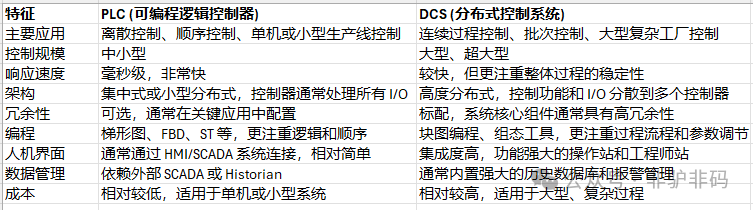
Contact: Although they have significant differences, PLC and DCS are not completely independent. In modern industry, they often work together:
- DCS can integrate PLC: In large DCS systems, certain discrete control subsystems (such as packaging lines) may be controlled by PLC and then exchange and coordinate data with DCS through communication interfaces.
- PLC takes on some functions of DCS: As PLC performance improves and functionalities enhance, some high-end PLCs can also undertake certain control tasks of small DCS, especially in batch control.
How to Choose the Right Controller Based on Control Needs
Choosing between PLC and DCS mainly depends on your control needs, project scale, and budget:
- Control Type:
- Primarily Discrete Control(On/Off control, sequential control, logical judgment): PLC is the preferred choice. For example, robotic arm gripping, conveyor belt start-stop, valve switching, etc.
- Primarily Continuous Process Control(Analog regulation, PID control, batch control): DCS has more advantages. For example, precise control of temperature, pressure, flow, and complex chemical reaction processes.
- System Scale and Complexity:
- Single machine, small production line, fewer I/O points: PLC is the cost-effective choice.
- Large factories, hundreds or thousands of I/O points, multiple devices working together, complex process flows: DCS provides a better overall solution, including centralized monitoring, data management, and redundancy.
- Reliability and Redundancy Requirements:
- High tolerance for downtime, small impact range of failures: PLC is sufficient.
- Significant losses from downtime, extremely high safety requirements, need for uninterrupted operation: DCS’s high redundancy architecture is the preferred choice.
- Integration and Scalability:
- Future needs for deep integration with MES, ERP, or frequent expansions: Modern DCS and high-end PLCs both provide good integration interfaces, but DCS typically has stronger integration capabilities at the system level.
- Budget:
- Limited budget: PLC is usually lower in cost.
- Large projects with long-term ROI considerations: DCS, while requiring a higher initial investment, may yield greater returns in efficiency, reliability, and management in the long run.
As developers of IIoT platforms, we ultimately deal with these controllers, whether through OPC UA, Modbus , or other industrial protocols, obtaining data from them or sending commands to them. Therefore, understanding their “language” and “way of thinking” is the foundation for building efficient, intelligent industrial solutions.