Click the blue text
PLC Automation Hub
Follow us
In the field of industrial automation, PLCs (Programmable Logic Controllers) are known as the “industrial brain,” responsible for controlling various mechanical devices. But did you know that PLCs are divided into safety PLCs and standard PLCs? What are the differences between the two? Let’s explore today.
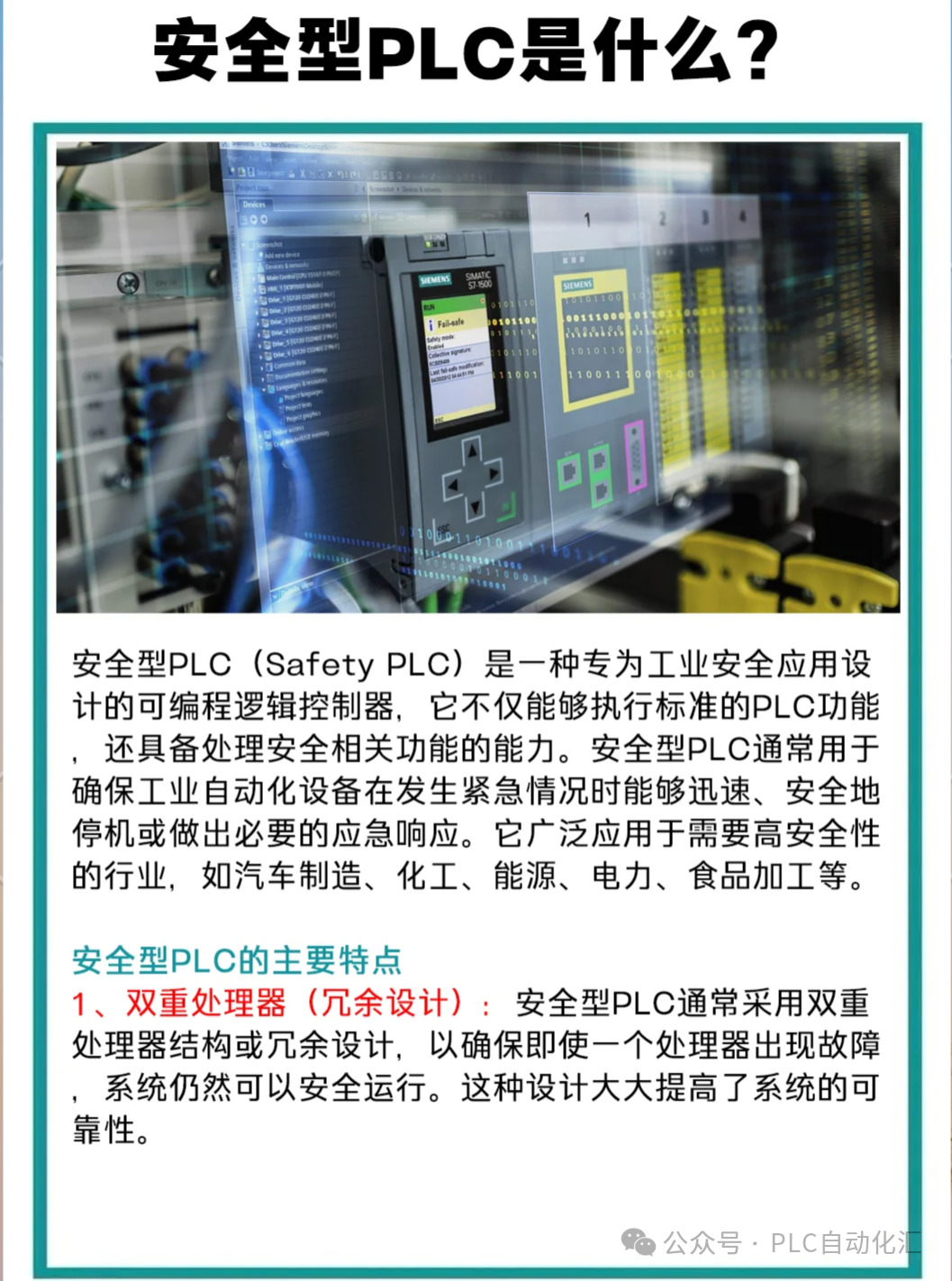
Essential Differences: Safety Design PhilosophyStandard PLCs focus on control functions, primarily executing logical operations and sequential control according to preset programs, pursuing efficiency and stability. Safety PLCs, on the other hand, emphasize safety functions, specifically designed to monitor equipment status and achieve safe shutdown in hazardous situations, ensuring the safety of personnel and equipment. They adhere to the “fail-safe” principle, ensuring that even in the event of a fault, the system can enter a safe state.
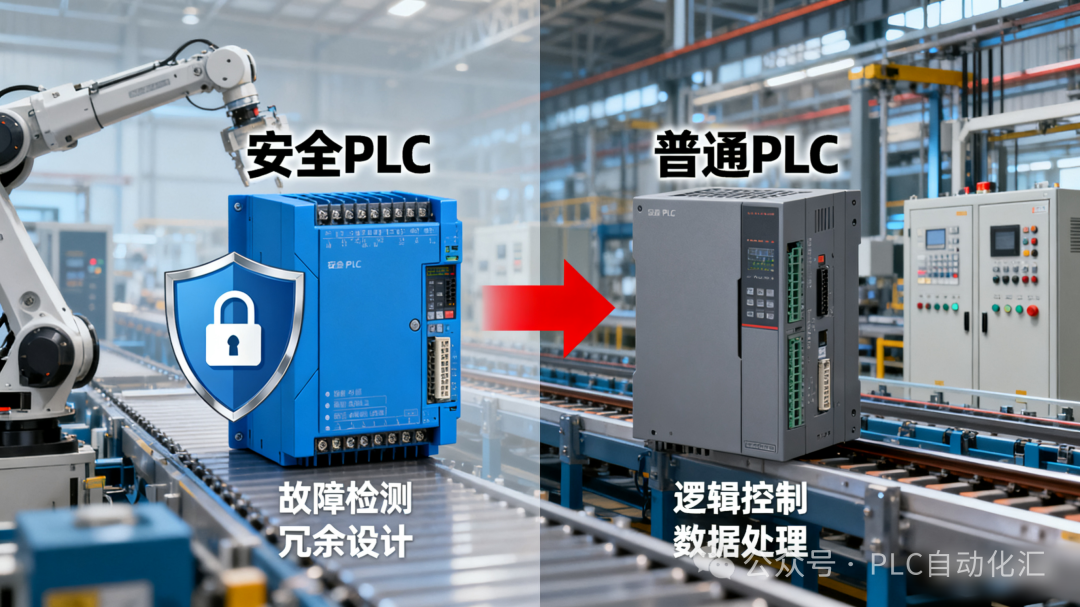
Detailed Comparison: Six Core Differences1. Different Hardware Architectures Standard PLCs use a single-processor structure, while Safety PLCs typically employ a multi-processor redundant design (dual-core or even triple-core), ensuring reliability through mutual monitoring. 2. Different Diagnostic CapabilitiesSafety PLCs have comprehensive self-diagnostic functions, capable of detecting internal and external faults, including processor failures, memory errors, and I/O module faults. 3. Different Software StandardsSafety PLCs use certified safety function blocks, which are written according to safety standards, avoiding errors that may occur in standard programming. 4. Different Communication ProtocolsSafety PLCs adopt safety communication protocols (such as CIP Safety, Profisafe, etc.), featuring data verification, timeout detection, and other functions to prevent communication errors or failures. 5. Different Certification RequirementsSafety PLCs must pass international safety certifications (such as TÜV, SIL, PL, etc.), ensuring compliance with relevant safety standards. 6. Different Application Scenarios Standard PLCs are suitable for general control situations, while safety PLCs are used in scenarios involving personal safety, such as emergency stop systems, safety door monitoring, and light curtain control.
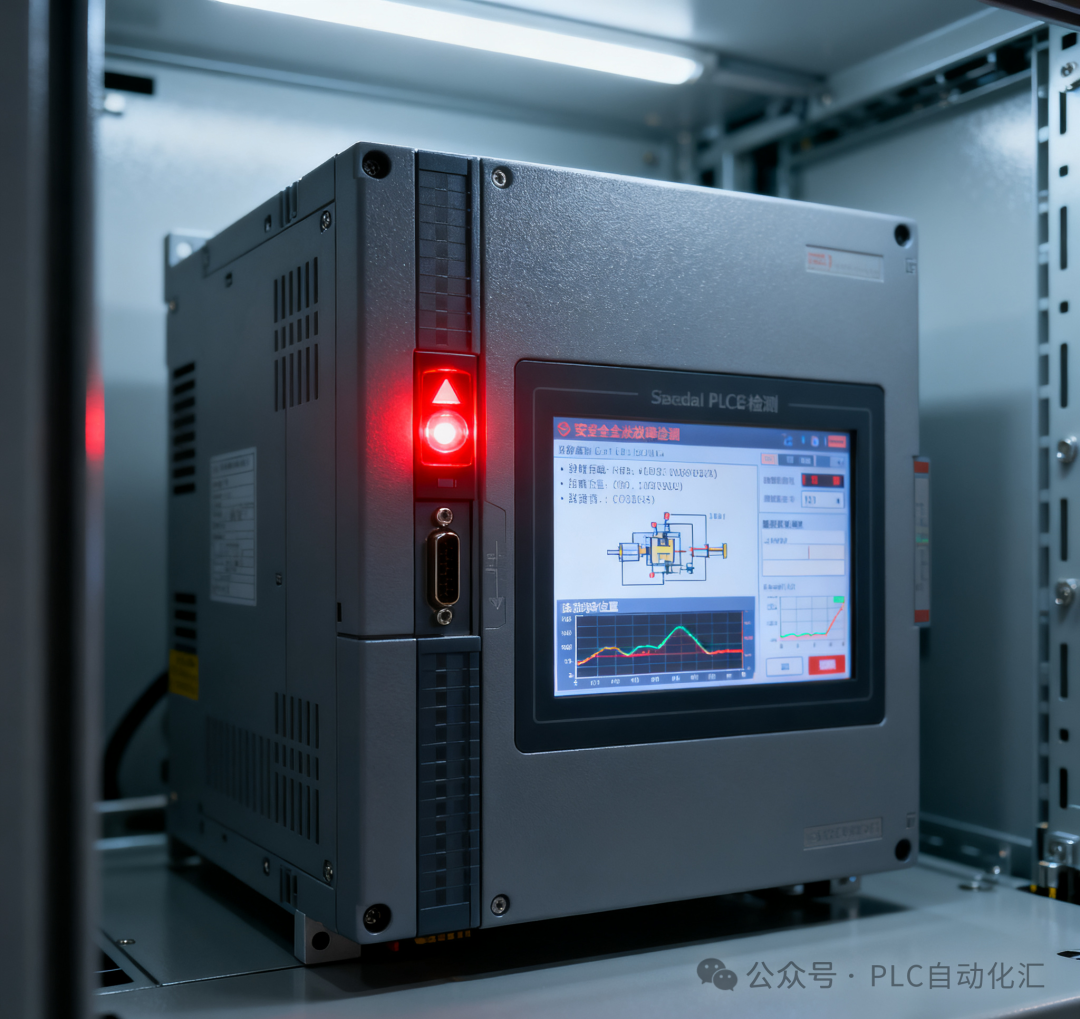
What Key Signals Should Safety PLCs Connect To?Personnel Protection Signals· Emergency Stop Button Signals: All emergency stop switches in the area · Safety Door Lock Signals: Monitoring the status of protective doors and covers · Light Curtain Signals: Detecting personnel entering hazardous areas · Safety Mat Signals: Detecting personnel presence in specific areas · Two-Hand Operation Button Signals: Dangerous equipment requiring simultaneous operation of both hands Equipment Status Monitoring Signals· Speed Monitoring Signals: Detecting overspeed or low speed of rotating equipment · Position Monitoring Signals: Detecting moving parts exceeding safe ranges · Pressure Monitoring Signals: Abnormal pressure in hydraulic/pneumatic systems · Temperature Monitoring Signals: Overheating detection for motors, bearings, etc. · Liquid Level Monitoring Signals: Abnormal levels of coolant or lubricating oil Environmental Monitoring Signals· Gas Detection Signals: Detecting leaks of flammable or toxic gases · Flame Detection Signals: Early warning of fire · Smoke Detection Signals: Fire alarm What Safety Functions Should Safety PLCs Control?Motion Control Safety Functions· Servo Drive STO (Safe Torque Off): Immediately cuts off the power supply to the servo motor · Safe Stop (SS1/SS2): A controllable safe stopping process · Safe Speed (SLS): Limits speed to a safe range · Safe Direction (SDI): Prevents dangerous reverse motion · Safe Brake Control (SBC): Controls the safe release of the brake device
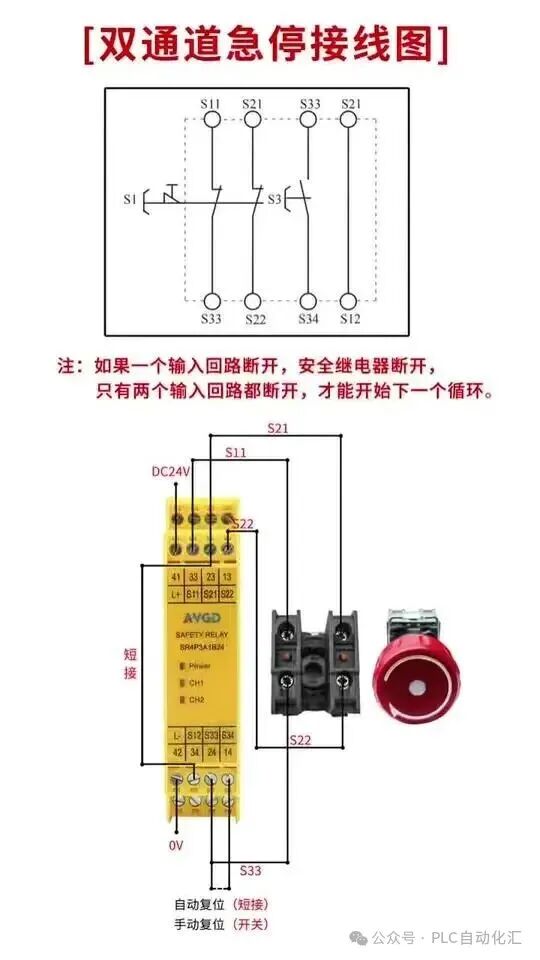
Robot Safety Control· Robot Emergency Stop: Immediately stops all robot movements · Robot Work Area Limitation: Restricts the robot’s activity range · Robot Speed Monitoring: Reduces teaching speed or limits automatic running speed · Robot Load Monitoring: Detects abnormal load conditions Process Control Safety Functions· Safety Valve Control: Cuts off fluid pathways in emergencies · Safety Contactor Control: Cuts off the main power supply · Safety Relay Control: Controls various safety devices · Safety Interlock Control: Ensures equipment operates in a safe sequence Status Indication and Alarms· Safety Status Indicator Lights: Display the safety status of the equipment · Sound and Light Alarms: Emit safety warning signals · HMI Safety Display: Display safety information on the human-machine interface Analysis of Safety PLC Advantages and DisadvantagesAdvantages:1. High Reliability: Redundant design and self-diagnostic functions greatly enhance system reliability 2. Safety Certification: International certification ensures compliance with safety standards 3. Risk Reduction: Effectively reduces the risk of personal injury and equipment damage 4. Legal Responsibility: Using safety PLCs can help companies fulfill safety legal obligations 5. Comprehensive Cost: Although initial investment is high, it may lower overall safety costs Disadvantages:1. Higher Cost: Prices are typically 2-3 times that of standard PLCs 2. Complex Programming: Requires specialized knowledge and training 3. Limited Selection: Relatively few brands and models available in the market 4. Over-Design: May be overly complex for low-risk applications Cost-Effectiveness Consideration: Is It Worth the Investment?The initial investment in safety PLCs is indeed higher than that of standard PLCs, but cost-effectiveness assessments cannot focus solely on procurement costs:1. Accident Cost Avoidance: The potential costs of accidents, including personal injury, equipment damage, and production downtime, far exceed the price difference of safety PLCs 2. Reduced Insurance Costs: Many insurance companies offer premium discounts for businesses using safety equipment 3. Compliance Value: Avoid fines and legal liabilities due to non-compliance with safety regulations 4. Production Efficiency: Modern safety PLCs can balance safety and production, reducing unnecessary downtime without sacrificing safety. Generally, in medium to high-risk applications, safety PLCs offer excellent cost-effectiveness. For low-risk applications, actual needs may need to be weighed. How to Design a Safety Control System?1. Conduct a Risk Assessment: Identify all potential hazards and risk levels 2. Determine Required Safety Levels: Establish PLr or SIL levels according to ISO 13849 or IEC 62061 3. Select Appropriate Safety Components: Include sensors, controllers, and actuators 4. Design Safety Circuits: Ensure all safety signals are correctly connected to the safety PLC 5. Verification and Validation: Confirm that the system meets the designed safety level requirements ConclusionSafety PLCs are not a simple upgrade from standard PLCs, but a fundamentally different design philosophy. By correctly connecting various safety signals and implementing corresponding safety control functions, safety PLCs can build a complete safety protection system, ensuring timely and reliable protective measures in the event of danger. Investing in safety is not a cost, but a value investment. Proper selection and use of safety PLCs is a responsibility to employees and a commitment to the sustainable development of the enterprise. Remember: Safety is no small matter; prevention is better than cure! Please indicate the source when reprinting, and feel free to share your thoughts and experiences!
If you want to learn Siemens SCL programming, you can purchase the first book below; if you want to learn ladder diagrams, you can purchase the second book, which includes detailed examples from basics to entry level.
Your support is the motivation for my writing. Thank you all, and I wish you success and happiness in your work!
Recommended Reading:
- Using All Your Strength! Nine Steps to Ensure Stable Operation of Siemens PLCs
- Siemens S7-1500 PLC Troubleshooting: Transforming into an Industrial “Doctor” to Quickly “Cure” Production Line Downtime!
- [10-Year Siemens PLC Veteran Upgrade Journey] From Screwing Modules to Mastering Communication Architecture: My Hard-Won Technical Guide
- The “Three Weapons” of Servo Motors: Detailed Explanation of Position/Speed/Torque Control (Including Practical Siemens SCL Code)
- Core Secrets of Siemens PLC Programming: What Are FB, FC, DB, OB? You Will Understand After Reading This!
- Why Can’t PLC Engineers with a Monthly Salary of 20,000 Retain Employees? The “Occupational Burnout” Behind High Salaries is Devouring This Industry!
- Siemens PLC Programming: Ladder Diagram vs. SCL, Which One is Right for You? A Comprehensive Beginner’s Guide + Practical Code!
- Say Goodbye to “Spaghetti Code”! The “Three-Step Method” for Siemens PLC Sequential Programming Doubles Efficiency Without Pitfalls!
- Siemens SCL Communication Heartbeat Monitoring: A Practical Guide to Industrial Heartbeat Programs
- Siemens 1200 and Weintek Tag Communication: Say Goodbye to Manual Address Filling; This “Smart Translator” Makes Debugging Three Times Faster!
- Siemens SCL Practical: Step-by-Step Guide to Writing Station Control Function Blocks
- Siemens S7-1200 Mixed Programming Practice: The Golden Combination Rules of SCL and LAD
- Electrical Automation Encirclement: Ten Years of Hard Work Resulting in This Heartfelt Industry Experience Summary
- Siemens SCL Workstation Control Program: Start/Stop Control + Three-Color Light + Buzzer Alarm
- Mitsubishi FX3U PLC Dual Pump Constant Pressure Water Supply Explained: Frequency + Industrial Frequency Intelligent Switching + Safety Emergency Stop System
- Electrical Automation Major Graduation Guide:
- Employment Directions and Salary Prospects Fully Analyzed
- Electrical Automation Associate Graduates: Starting Salaries Comparable to Bachelor’s Degrees? Full Disclosure of Technical Reversal Roadmap!
- Siemens S7-200 SMART Free Port Communication Explained: Introduction to Flexible Serial Communication Solutions
- Siemens SCL Full-Function Servo Control Ultimate Solution: 8 Motion Modes + 5 Safety Protections
- Let Data Speak! A Scientific Guide for Choosing Majors for Science vs. Humanities Students (Including Employment Salary & Trend Analysis)
Share to Let More People See

Like
Collect
Share