Welcome FPGA engineers to join the official WeChat technical group.
Overview of Xilinx 7 Series FPGAs
Table of Contents
-
Overview of Xilinx 7 Series FPGAs
-
1. Four Process Levels of Xilinx
-
2. Virtex, Kintex, Artix, and Spartan
-
3. Features of the 7 Series
-
4. Naming Convention of the 7 Series
-
5. Summary of 7 Series Resources
In November 2015, Xilinx launched the Spartan®-7 FPGA series, marking a new generation of products. The previous two articles: FPGA Mainstream Chip Selection Guide and Naming Rules (Part 1) and FPGA Mainstream Chip Selection Guide and Naming Rules (Part 2) introduced older generations of FPGAs, and only recently have similar news begun to attract attention. This article mainly introduces the Xilinx 7 Series FPGAs. Reference: link, link
No document download available…
1. Four Process Levels of Xilinx
Xilinx currently has four main product process levels. Generally, each process will have four families: Spartan, Artix, Kintex, and Virtex, as shown in the following figure. The 45nm process product Spartan6 is still widely used in China, possibly because Xilinx’s high-end chips are unavailable domestically. The other products have been “delisted.” With Xilinx officially announcing the mass production phase of Spartan7 on May 11, 2017, Spartan7 may gradually replace Spartan6 and become the new representative of Xilinx products in China.
The 28nm process 7 series chips are currently Xilinx’s main products. Additionally, although Xilinx announced over a year ago, on October 13, 2016, that 16nm FPGAs had entered mass production, 20nm and 16nm process FPGAs still only exist in “legend.”
2. Virtex, Kintex, Artix, and Spartan
Next, let’s briefly introduce the main features of these series. The Virtex series devices not only represent Xilinx’s highest standards but are often also the best devices in the entire FPGA industry. These devices are generally used in high-speed networking (10G~100G), portable radar, and ASIC prototype verification, where high resource quantity and performance are required, but power consumption and cost are less sensitive.
Kintex series devices make certain concessions in terms of cost and power consumption compared to Virtex series devices, achieving a relatively good balance among cost, performance, and power consumption, but costs remain high. Kintex devices are generally used in 3G/4G wireless communication, display, and Video IO Over fields.
Artix series devices significantly reduce device costs while striving to maintain performance and resource quantity. This series is widely used in domestic medical equipment and military industries.
Spartan series devices have far inferior performance and resource quantity compared to the previous three series, but they are favored for their low price, making them widely used in consumer electronics, automotive electronics, and industrial fields. It is worth mentioning that the performance of Spartan series devices is notably higher than that of the Altera Cyclone series (which competes with Spartan). For example, Spartan6 supports DDR3, but the Cyclone10 series, which was released much later, does not support DDR3.
3. Features of the 7 Series
PS: This section is likely to have little reference value.
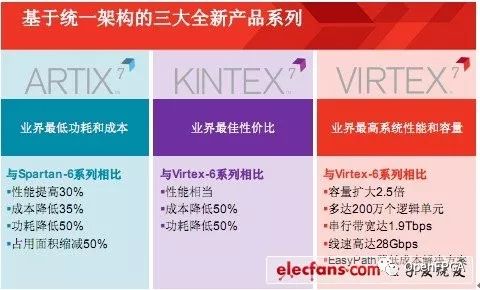
Feature 1: The industry’s cost-performance king In 2012, Xilinx’s latest 7 Series FPGA chips include three sub-series: Artix-7, Kintex-7, and Virtex-7. Before introducing the chips, let’s take a look at the introduction table for the three sub-series chips, as shown in Table 1 below:
(1) Artix-7 FPGA Series – Industry’s Lowest Power Consumption and Cost
Through Table 1, we can easily conclude that compared to the previous generation of FPGAs, its power consumption has decreased by 50%, costs have been cut by 35%, performance has increased by 30%, and area has been reduced by 50%. Xilinx FPGA chips have achieved a very good balance between power consumption and performance during upgrades.
(2) Kintex-7 FPGA Series – Industry’s Best Cost-Performance Ratio
The Kintex-7 FPGA series, known as the “king of cost-performance ratio,” can achieve the performance of the Virtex-6 series FPGA at less than half the price, doubling the cost-performance ratio while reducing power consumption by half, providing a balanced optimization for high-end functions.
(3) Virtex-7 FPGA Series – Industry’s Highest System Performance and Capacity
Compared to Virtex-6 FPGAs, the system performance of the Virtex-7 series has doubled, power consumption has been halved, speed has improved by 30%, focusing on expanding capacity by 2.5 times, with up to 2 million logic units, serial bandwidth reaching 1.9 Tbps, and line speed up to 28 Gbps. Its EasyPath cost reduction solution has brought this industry-leading FPGA architecture to a new height.
Feature 2: Comprehensive Analysis of the Advantages of the New Xilinx 7 Series FPGA Chips
(1) Overall Advantage Analysis
The new Xilinx 7 Series FPGA chips not only achieve breakthroughs in helping customers reduce power consumption and costs but also possess advantages such as high capacity, high performance, and strong portability. The following diagram illustrates the importance of reducing power consumption for FPGAs. The following table also shows that Xilinx 7 Series FPGAs have high scalability, capable of achieving different system performance levels.
Table 2: Xilinx 7 Series FPGAs have high scalability, capable of achieving different system performance levels.
All three sub-series are developed using TSMC and Samsung HKMG (High-K Metal Gate) high-performance low-power processes, with significant improvements in performance, power consumption, and cost compared to previous products. The new Xilinx 7 Series FPGA chips have made significant progress in power consumption, performance, and design portability. The new series products adopt a carefully optimized 28nm process technology for low power and high performance, achieving excellent productivity and solving the issues of excessive costs, complexity, and inflexibility in developing other methods like ASIC and ASSP, thus enabling the FPGA platform to meet the increasingly diverse needs of design communities. The 28nm process and design innovations have dramatically reduced power consumption by 50%. The unified architecture preserves IP investment and accelerates design portability. These FPGA series form the foundation of Xilinx’s new generation of domain-optimized and market-specific design platforms. The following charts illustrate how reducing power consumption can improve capacity and functionality: the table shows that halving power consumption can enhance usable performance and capacity; optimized hard modules can reduce power consumption by more than 25%.
Moreover, another significant feature of the new Xilinx 7 Series FPGA chips is that the architectures of the three sub-series are completely unified. This unified architecture is actually based on Virtex-6, allowing easy transfer of development between any of the three sub-series. The conversion between high, mid, and low-end can be done at any time, and design solutions can be adjusted as needed. The following diagram shows the current focus on three aspects: all optimized for reducing power consumption and improving cost-performance ratio; common logic units, BRAM, and interfaces; easy design expansion.
For example, using the same IP, one can develop high-end vending machines and then switch to developing low-end handheld devices. This feature greatly helps manufacturers improve production efficiency, allowing them to quickly expand products to meet adjacent market demands without the need for expensive IP and design rework for each generation of products. Of course, for customers looking to further achieve energy savings or enhance system performance and capacity with the latest 7 Series FPGAs, they can start with designs using Virtex-6 and Spartan-6 FPGAs, and when the timing is right, migrate their design solutions.
(2) Chip Advantage Analysis(1) Artix-7 Series
-
a. Characterized by low power consumption and low cost, it is 30% faster than Spartan-6, with half the power consumption and a 35% price reduction;
-
b. Using Virtex series architecture-based FPGAs can meet the performance requirements of cost-sensitive, high-volume markets;
-
c. Achieving 3.75Gbps serial connection functionality through built-in Gen1x4 PCI Express® technology;
-
d. Achieving miniaturization and low cost through ball grid array (BGA) packaging;
Can meet the low power and high performance requirements of battery-powered portable ultrasound devices.
Can meet the small and low power requirements for commercial digital camera lens control.
Can meet the strict SWAP-C (Size, Weight, Power, and Cost) requirements of military avionics and communication equipment.
-
e. The size, weight, and power characteristics are particularly suitable for handheld applications such as portable ultrasound, digital camera control, and software-defined radio.
(2) Kintex-7 Series
-
a. Boasting the industry’s highest system performance and capacity, with a density of 2 million logic units, surpassing all previous and existing FPGAs by 2.5 times.
-
b. The system performance of Virtex-7 has doubled compared to Virtex-6, power consumption has been halved, and speed has increased by 30%, making it the highest-end sub-series of the 7 series;
-
c. Can provide high-performance 10.3Gbps or low-cost optimized 6.5Gbps serial connectivity, memory, and logic performance required for applications such as large-volume 10G optical wired communication equipment;
-
d. Achieving the best balance of signal processing performance, power consumption, and cost, supporting Long-Term Evolution (LTE) wireless network deployment, meeting the strict power consumption and cost requirements of the new generation of high-definition 3D flat panel displays;
-
e. Providing the performance and bandwidth required for new generation broadcast video on demand systems;
-
f. 10.3125Gbps serial connection functionality and built-in Gen2x8 PCI Express technology;
-
g. Rich block memory and DSP resources make it an ideal choice for wireless LTE infrastructure equipment, LED backlighting, and 3D digital video display, medical imaging, and avionics imaging systems. (3) Virtex-7 Series
-
a. Setting a new industry performance benchmark;
-
b. Compared to Virtex-6 devices, system performance has doubled, power consumption has halved, signal processing capacity has increased by 1.8 times, I/O bandwidth has increased by 1.6 times, and memory bandwidth has increased by 2 times;
-
c. The highest density FPGA in the industry, with up to 2 million logic units achieving breakthrough capacity;
-
d. Using EasyPath-7 devices ensures a 35% cost reduction without any design conversion;
-
e. Supporting 400G bridging and switching structure wired communication systems, core of global wired infrastructure;
-
f. Supporting advanced radar systems and high-performance computer systems, meeting the logic density, performance, and I/O bandwidth requirements of single-chip TeraMACC signal processing capabilities and next-generation test measurement equipment;
-
h. Achieving next-generation 100GE line cards, 300G bridges, terabit-level switching structures, 100G OTN wavelength converters, radar, and ASIC emulation.
In summary, the 7 Series FPGA chips, which have made groundbreaking progress in the industry, possess the advantages shown in the following table:
(3) Industry Advantages
Aerospace and Military Products The 7 Series FPGAs significantly lower power consumption through higher integration and signal processing capabilities, providing SWAP-C advantages for radar, military communication, and advanced imaging systems.
-
a. Avionics
Kintex-7 FPGAs enhance the SWAP-C advantages of aircraft video data bus systems due to their high cost-performance ratio.
-
b. Radar
Virtex-7 FPGAs reduce SWAP-C for portable radar systems.
-
c. Broadcasting
Kintex-7 FPGAs provide 10Gbps serial connectivity for mainstream designs, achieving new generation digital video distribution systems.
-
d. Video-over-IP Gateway
Kintex-7 FPGAs provide cost-effective, low-power bridging for serial digital interface (SDI) protocols and IP technologies for long-distance WAN transmission, enabling standard IP networks to connect local studios/live events, broadcasting facilities, and satellite uplinks. Consumer Electronics
Artix-7 and Kintex-7 FPGAs support mainstream and emerging serial protocols, achieving power consumption and cost advantages, making them attractive alternatives to ASIC and ASSP. Their reprogrammability enables rapid application of advanced image enhancement algorithms and differentiation of characteristics across various end product prices.
-
a. LED Backlit Flat Displays and 3D TVs
Artix-7 and Kintex-7 FPGAs provide capabilities that enable flat panel display manufacturers to improve image quality, reduce power consumption, and cut costs. They implement complex local dimming and lighting compensation algorithms for LED backlight controllers, producing direct-lit displays with varying numbers of LED areas and layouts while adjusting lighting to match the physical characteristics of panels produced by different vendors. They also add 3D functionality to displays.
-
b. High-End Consumer Digital Cameras
Artix-7 and Kintex-7 FPGAs achieve low power consumption, low cost, and miniaturization, allowing high-end consumer digital camera manufacturers to implement control functions within autofocus lenses and rapidly deploy enhancements within camera body controllers/image processing ASICs. Medical
Kintex FPGAs achieve high performance, low power consumption, and miniaturization for various medical devices. Through the unified architecture of the 7 Series, engineers can quickly adjust designs to meet different market and application requirements.
-
a. Portable Ultrasound
High I/O bandwidth and 144GMACS DSP processing performance achieved within chip-level packaging make Kintex-7 70T FPGAs ideal for frontend and backend ultrasound processing. Designers can adopt fully programmable 128-channel ultrasound designs, which can scale up to 196 or 256 channels for high-end handheld solutions or scale down to 64 or 32 channels for portable sizes. Wired Communication
The 7 Series FPGAs are designed for the highest bandwidth and lowest power consumption, capable of meeting the ever-increasing bandwidth demands of network devices. They enable hardware upgrades to enhance capacity without exceeding existing power consumption and cooling areas.
-
a. 100GE Line Cards
Virtex-7 FPGAs provide the appropriate I/O, memory, and logic combinations, achieving single FPGA designs for new line cards, increasing bandwidth.
-
b. 300G Interlaken Bridging
The extended capabilities of Virtex-7 XT FPGAs help achieve infrastructure upgrades, providing up to 1.9Tbps bandwidth for bridging between MAC-NPU, NPU-switch, and NPU-TCAM. Wireless Communication
Kintex-7 FPGAs are designed for the lowest power consumption and economical signal processing, providing the functional combinations required for DSP-intensive wireless infrastructure, achieving low-cost solutions through cost-optimized packaging and integrating multiple functions within a single FPGA.
-
a. Multi-Mode Radio
Kintex-7 FPGAs help reduce costs and power consumption, providing an upgradeable platform that supports multiple air interface standards.
-
b. LTE Baseband
Kintex-7 FPGAs offer the highest cost-performance ratio, enabling designers to meet stringent latency requirements for LTE baseband processing within general platforms.
Feature 3: Excellent Applications of the New Xilinx 7 Series FPGA Chips
As mentioned above, due to the various advantages of the new Xilinx 7 Series FPGA chips, they can further expand the application fields of FPGAs. Their core markets include portable ultrasound devices, wireless infrastructure, and new generation wired switching devices, while new markets include digital single-lens reflex cameras, 3D TV flat panel displays, and high-performance computing, among others. Specific applications are detailed in the following introduction:
(1) Digital Single-Lens Reflex Cameras – Artix-7 Series FPGAs
As we all know, advanced digital cameras are becoming increasingly popular. Statistics show that by the end of 2010, sales of digital cameras reached 150 million units; among them, digital single-lens reflex cameras accounted for 10% of the total. Undoubtedly, this situation will bring a huge business opportunity worth hundreds of millions of dollars to FPGAs. However, there are also requirements during application, such as avoiding IC obsolescence; high precision motor control must be implemented inside the camera; pursuing low power consumption and low cost, etc. Before the emergence of Artix-7 FPGAs, multiple ASSP chips were required in digital single-lens reflex cameras. However, the introduction of Xilinx Artix-7 FPGAs has been a boon for digital single-lens reflex cameras. A single Artix-7 FPGA can replace nine ASSPs, significantly reducing costs, power consumption, and size. The specific implementation scheme comparison is shown in the following figure. The cost, power consumption, and size specifications of the two schemes are as follows:
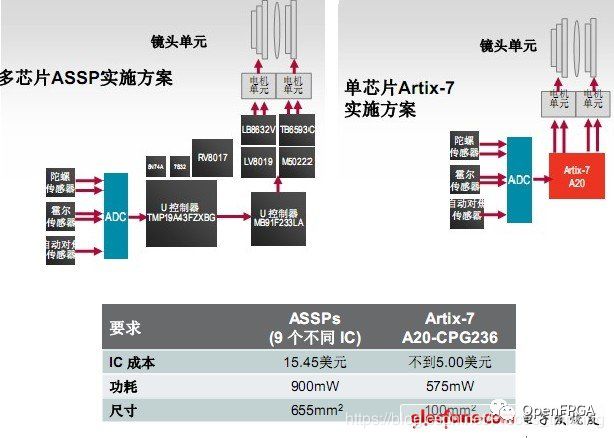
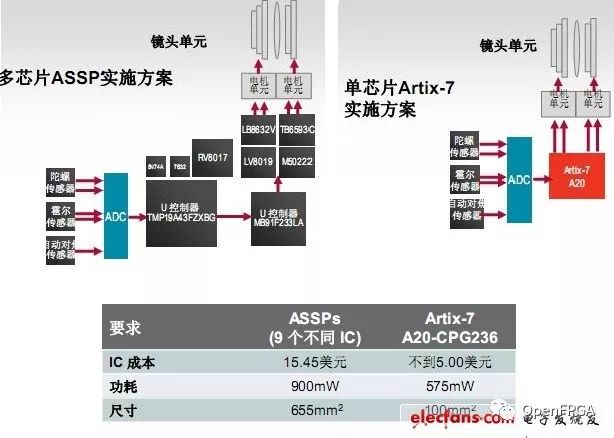
Clearly, as shown in the table comparison, using Artix-7 series FPGA chips reduces costs by 66%, power consumption by 37%, and size by 85% compared to using ASSPs.
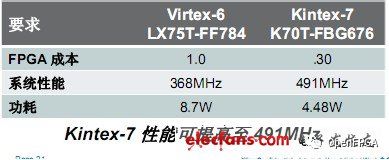
(2) New Generation Wireless Multi-Mode Radio – Kintex-7 Series FPGAs The new generation wireless multi-mode radio requires portability. Specifically, it must economically and efficiently meet the increasing data rate demands; adapt to new standards; and support mixed use of multiple air interface standards (MC-GSM+LTE). In addition, application requirements include supporting CPRI/OBSAI interface standards; performance can be improved to 491MHz; reducing capital and operational expenditures; lowering system costs by 15%; and achieving five nines availability (i.e., 99.999% availability). Due to the existence of the above requirements, a problem arises: existing FPGAs must be expandable to meet strict cost, performance, and power consumption requirements. At this time, Xilinx Kintex-7 series FPGAs emerged to solve this problem. The following diagram illustrates the application advantages of Xilinx Kintex-7 series FPGAs in the new generation wireless multi-mode radio compared to the previous Virtex-6 series chips. It is no exaggeration to say that after adopting Xilinx Kintex-7 series FPGAs, the cost-performance ratio of this solution improved threefold, and power consumption was reduced by 18%.
In terms of system performance, the following table provides a clearer view:
 (3) Core of Wired Communication Architecture – Virtex-7 Series FPGAs
Today, more than 4 million “smart” devices have been deployed in wired communication architectures; video on demand is ubiquitous; moreover, internet traffic is growing at a rate of over 70% per year. Therefore, the construction of wired communication architectures has an endless demand for bandwidth. In terms of applications, it is required to meet current and future standard requirements, connect with numerous endpoint devices, enhance performance threefold while maintaining low power and small footprint. Moreover, it should support the “Interlaken” protocol. Due to the high capacity and connectivity requirements, wired communication architectures most commonly adopt ASIC solutions. The structure diagram of NPU or switching using ASIC solutions is shown in the lower left diagram.
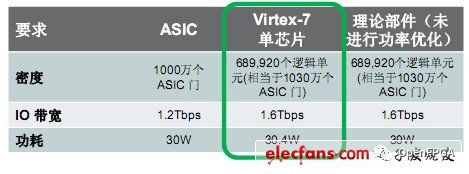
However, with the emergence of the ultra-high-end FPGA Virtex-7 (the world’s first single-chip 300G programmable bridge), the Virtex-7 chip can match ASICs in performance, bandwidth, and power consumption, and can reduce power consumption by 28% compared to devices that have not undergone power optimization. Therefore, the application of Virtex-7 series chips in the construction of wired communication architectures is increasing. The structure diagram of NPU or switching using Virtex-7 series solutions is shown in the upper right diagram. The following table compares the two solutions. It is evident from the table that the Virtex-7 series chips have advantages.
In addition to their extensive applications in digital single-lens reflex cameras, new generation wireless multi-mode radios, and wired communication architectures, the new Xilinx 7 Series FPGA chips can also meet the performance requirements for portable ultrasound devices and large-volume 10G wired communication devices; support LTE wireless network deployment; meet the power consumption and cost requirements of 3D displays; provide the performance and bandwidth required for next-generation broadcast video on demand systems; and support new generation wired access devices, advanced radar systems, and high-performance computer systems, among others.
Outlook: A Bright Future for the New Xilinx 7 Series FPGA Chips Since the launch of the new Xilinx 7 Series FPGA chips, programmable logic technology has shown an unstoppable trend. With this chip series continuously entering the market for application, the demand for bandwidth and flexibility is steadily increasing, and power consumption and costs have been reduced by at least half; performance and capacity have doubled; the target design platforms adopted have significantly improved productivity; and fewer and fewer designers are choosing to use ASSPs; ASICs are also facing difficulties. In summary, the future is indeed “bright.”
Of course, to maintain this “brightness,” Xilinx must continue to keep pace with the times and remain vigilant. Based on existing technology, continuous innovation is required, striving to achieve the following five points: pursue higher system performance; achieve higher cost-performance ratios; strive for greater capacity; achieve lower power consumption and better service. If these goals can be achieved, more engineers will “fall in love” with Xilinx FPGA chips.
4. Naming Convention of the 7 Series
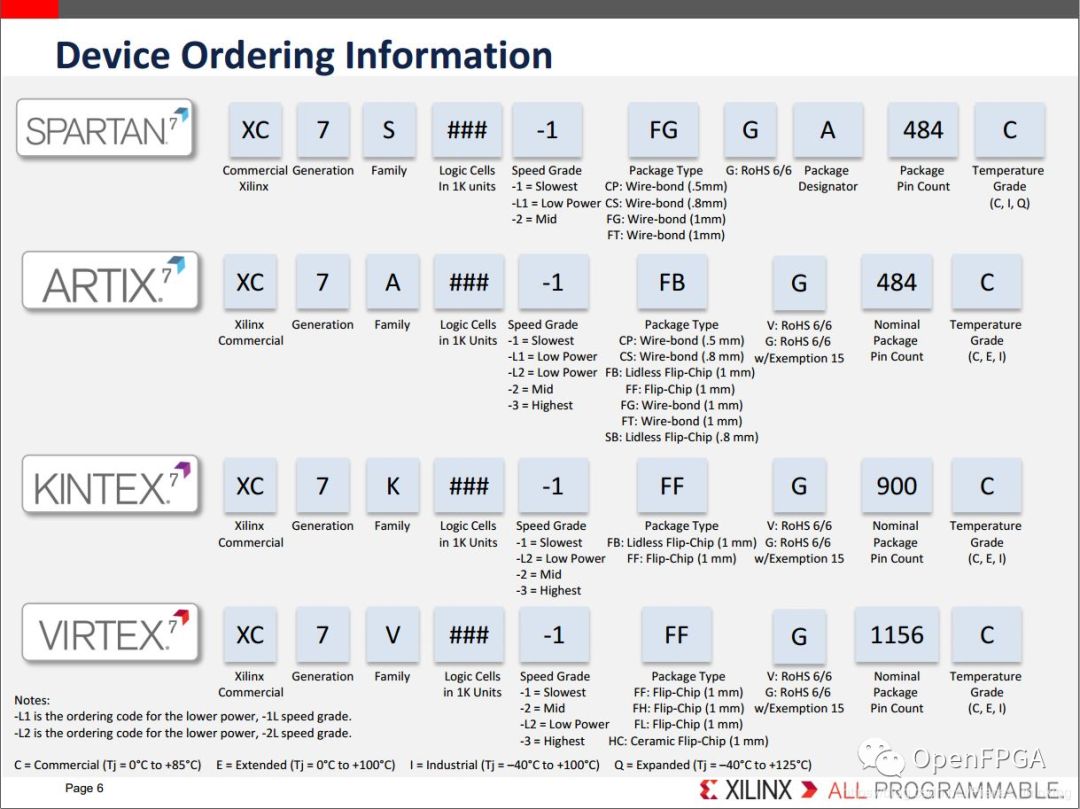 From the above figure, it can be seen that apart from the Spartan series devices whose vendor number consists of ten fields, the vendor numbers of the remaining three series consist of nine fields.
The first segment of the vendor number for all four series of devices is “XC,” which indicates that the device is a commercial-grade device produced by Xilinx. Additionally, there are military-grade and aerospace-grade devices, but these two grades are unlikely to be purchased through regular channels in China;
The second field from the left represents the generation of the device produced by Xilinx, with this field being 7 for the 7 series;
The third field from the left represents the family to which the device belongs, with S representing Spartan, A representing Artix, K representing Kintex, and V representing Virtex;
The fourth field from the left, which is printed on the actual device, is one or more Arabic numerals. This number multiplied by 1000 represents the approximate resource quantity of the device, but it is only an approximation and not accurate;
The fifth field is used to indicate the speed grade of the device, with -3 being the highest and -1 the lowest. The letter L indicates that the device is low power (the supply voltage of low power devices is lower than that of ordinary devices). This parameter is a value printed on the chip after vendor testing and screening, and it is an empirical value. The higher this value, the higher the maximum clock for resources such as Block RAM and high-speed IO. Therefore, careful consideration is required when designing with this value.
Next, the sixth to ninth fields of Spartan devices and the sixth to eighth fields of the other three families represent the packaging information of the device. The last number in these fields represents the total number of pins of the device (which differs from the number of user pins), while the meanings of the other two or three fields are not very clear.
The final field indicates the temperature grade of the device, with C and I being the most common in China; C represents commercial grade (Commercial), which can operate normally at 0℃ to 85℃; I represents industrial grade (Industrial), which can operate normally at -40℃ to 100℃. The other two grades, to my knowledge, only exist in “legend.”
5. Summary of 7 Series Resources
A simple comparison of the resources of the 7 series FPGAs across families. 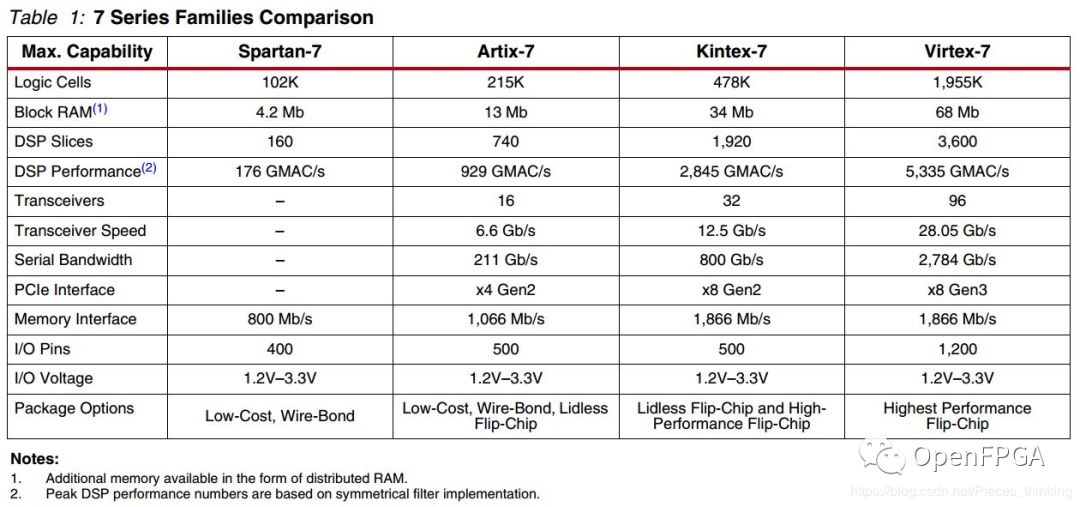 The following series of images provide an overview of the resources of each FPGA family, where the IO resources are marked according to the maximum package.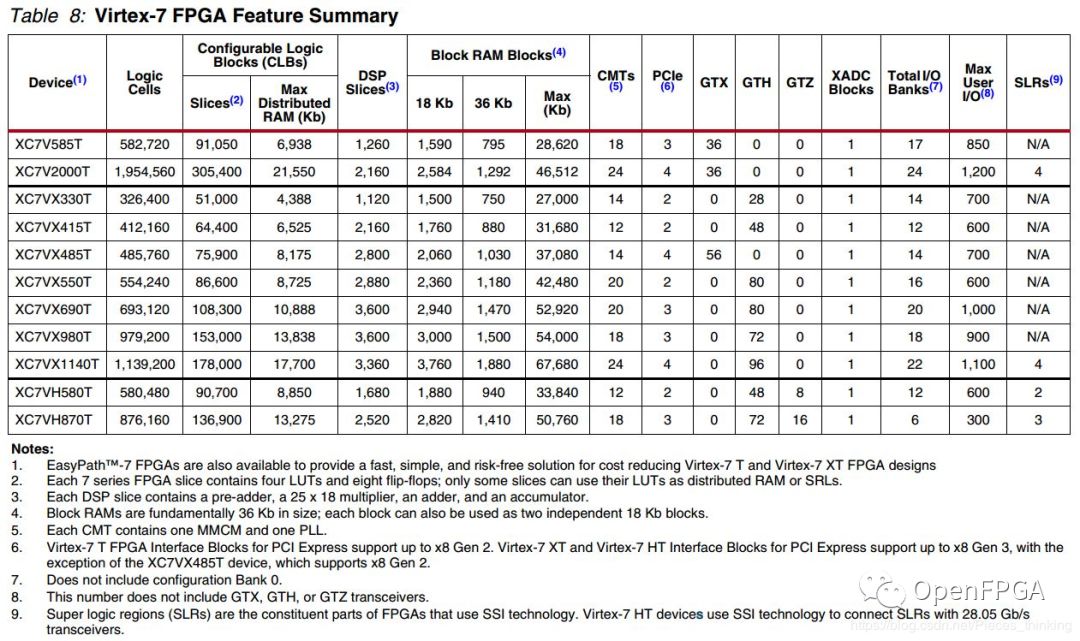
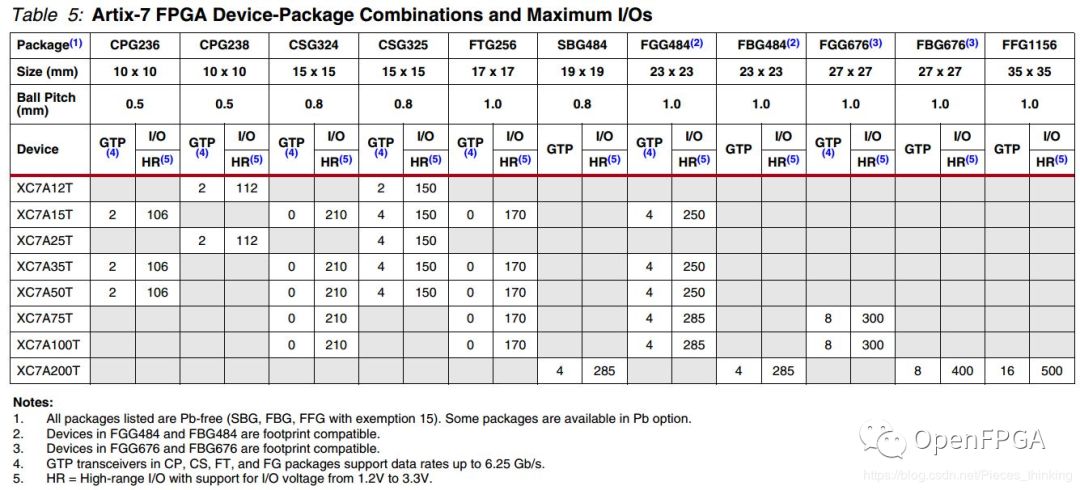
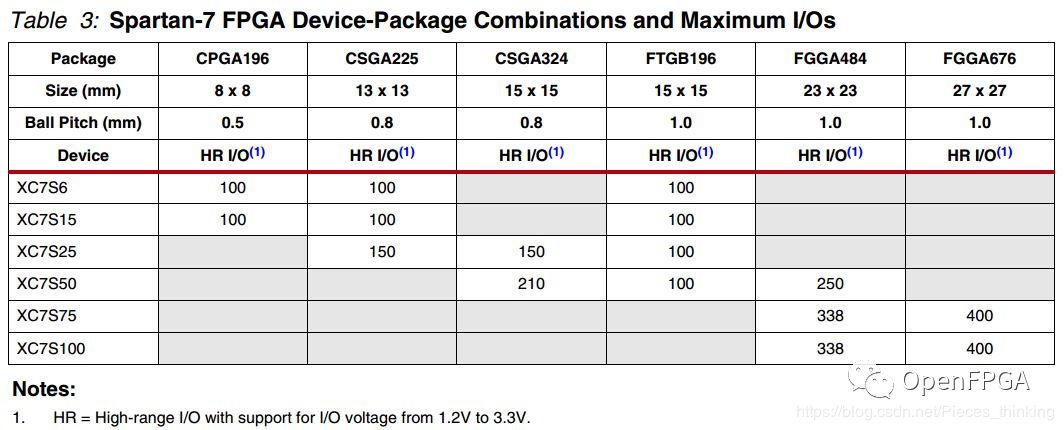
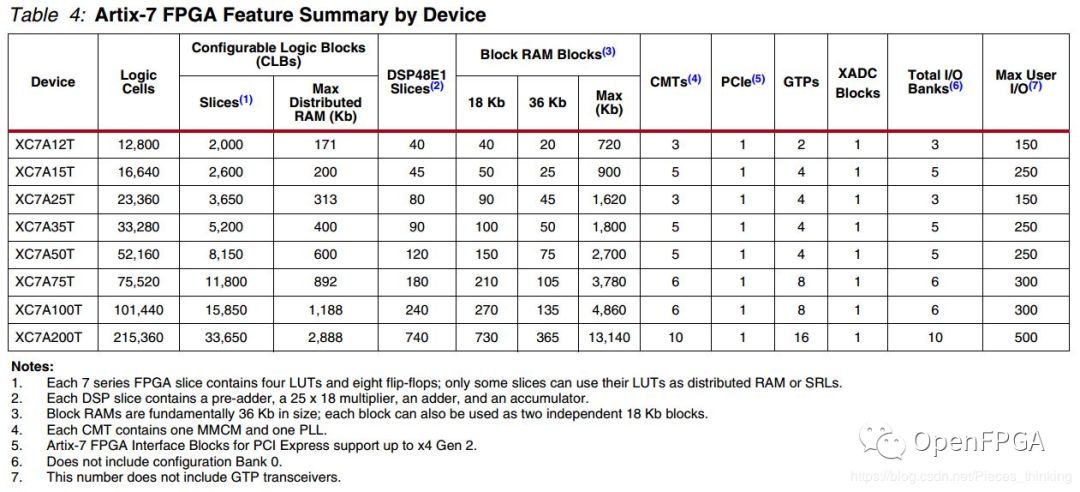 It is worth mentioning that the 7 series FPGAs integrate an ADC module, known as “XADC Blocks,” which can not only collect voltage values from pins but also monitor the power supply itself. Although this is not a new feature on CPUs and MCUs, it is quite novel on FPGAs, at least for me.
Note that in the Virtex7 image, the first and sixth notes indicate that Virtex7 is further divided into Virtex7T, Virtex7XT, and Virtex7HT. The following series of images show the IO resources and high-speed transceiver resource tables of different packaged FPGAs: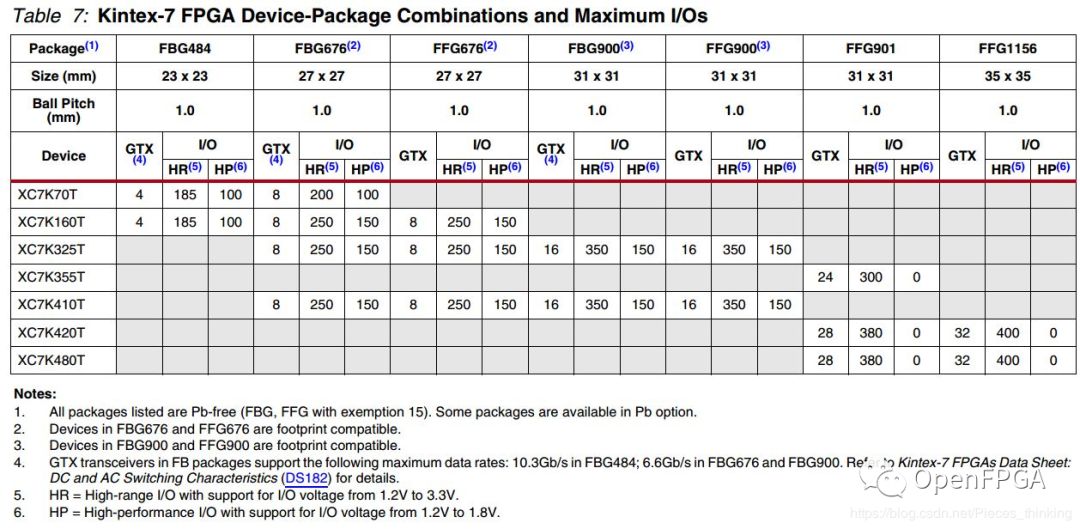
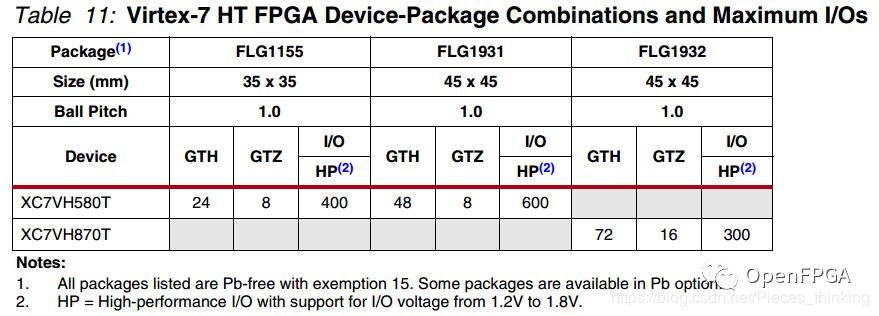
From the above images, it can be seen that the IO resources of the 7 series FPGAs have two specifications: HR and HP. HP supports voltage from 1.2V to 1.8V, while HR supports voltage from 1.2V to 3.3V. The former has a higher maximum transmission rate, but its usage range is narrower, so it requires self-judgment based on demand.
In terms of quality, Kintex7 actually has a slight edge over Virtex7, as all Kintex7 models support GTX, while all models have HR IO, and most models also have both HP and HR specifications of IO.
The performance of the three types of high-speed serial transceivers in the 7 series is as follows:
-
GTH: 500Mb/s~13.1Gb/s
-
GTP: 500Mb/s~12.5Gb/s
-
GTP: 500Mb/s~6.6Gb/s
For each device, the maximum transmission rate is also affected by the speed grade mentioned earlier. Additionally, Xilinx has IP cores for configuring high-speed serial transceivers, where specific transmission rates and encoding/decoding attributes can be set.

Welcome communication engineers and FPGA engineers to follow our public account.

FPGA WeChat Technical Group
We welcome everyone to join the national FPGA WeChat technical group, where there is a group of engineers who love technology, and you can discuss and exchange technology together!

Press and hold to join the national FPGA technical group.
FPGA IP Core Services: Various high-quality IP core service providers, with guaranteed service! If you have needs, you can contact the group owner directly!
FPGA Technical Group Platform Self-Operated:Xilinx Altera Micron, Samsung, Hynix, ADI TI ST NXP, and other brand advantage agents and distributors are welcome to send model lists anytime. We will provide you with the most competitive quotes at the first time!Prices are more than 5% lower than your original supplier! Welcome to inquire – just send your needs to the group owner!
FPGA Technical Group Official Thanks to Brands: Xilinx, Intel (Altera), Microsemi (Actel), Lattice, Vantis, Quicklogic, Lucent, etc.