[Header]
Sensors are a topic in the college entrance examination syllabus and are covered in Chapter 6 of the People’s Education Press elective textbook 3-2.
What is a sensor? In modern technology, a sensor refers to a type of component that can sense physical quantities such as force, temperature, light, sound, and chemical composition, and convert them into another physical quantity that is easier to transmit and process (usually electrical quantities like voltage or current), or convert them into an on/off state for circuits. By converting non-electrical quantities into electrical quantities, it becomes very convenient for measurement, transmission, processing, and control. For students, analyzing sensor problems requires a lot of previously learned knowledge, which demands a higher level of comprehensive ability and can seem somewhat difficult. Below, we will analyze the principle of speed measurement using sensors in conjunction with the textbook.
[Textbook Reference 1]
People’s Education Press compulsory textbook 1, p23
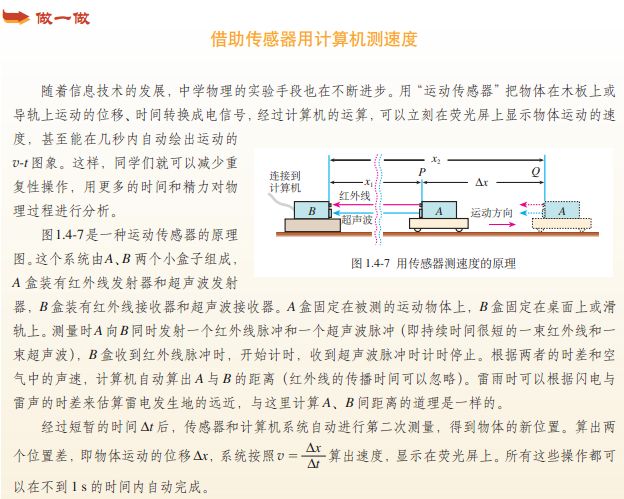
Through careful reading of the materials, we can easily find that measuring speed with sensors requires several steps:
1. The sensor A on the moving object simultaneously emits an infrared pulse and an ultrasonic pulse, while sensor B connected to the computer is responsible for recording the time difference of receiving the two pulses. The computer automatically calculates the distance between the two sensors based on the time difference and the speed of sound x1.
2. After a brief time interval ∆t, repeat step one to measure the distance between the two sensors x2.
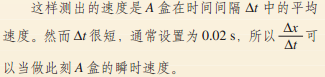
3. Calculate the position difference between the two, which is the displacement of the moving object ∆x. The system calculates the average speed of the object based on displacement over time; since the time interval is very short, the average speed can be used to replace the instantaneous speed of the object.
In step one, the textbook only mentions the principle of automatically calculating the distance between A and B using the computer, which is similar to estimating the distance of a lightning strike based on the time difference between lightning and thunder during a thunderstorm, without specific explanation. Below, we will clarify how to estimate the distance of a lightning strike through an example, thus mastering the principle of distance measurement using ultrasonic waves by the computer.
[Example 1]
In 2005, the Beijing college entrance examination physics question 19
A person sees lightning 12.3s later hears thunder. Given that the speed of sound in air is about 330m/s to 340m/s, the speed of light is 3×10⁸m/s, he quickly estimates that the distance from the lightning strike to him is 4.1km. Based on your physics knowledge, you can determine:
A. This estimation method is incorrect and should not be used
B. This estimation method can accurately estimate the distance from the lightning strike to the observer C. This estimation method does not consider the propagation time of light, resulting in a large error
D. Even if the speed of sound doubles, the estimation result remains correct
[Analysis]
Since the speed of light is much greater than the speed of sound, the propagation time of light can be ignored, thus the distance from the sound source to the observer is

Therefore, this estimation method can accurately estimate the distance from the lightning strike to the observer, soB is correct.
Through the analysis of this problem, we can see that when calculating distance, the sensor considers that infrared rays are also electromagnetic waves, and their propagation speed is much greater than that of sound waves, so the propagation time of infrared can be ignored, thus the distance is calculated based on the speed of sound multiplied by the time difference.
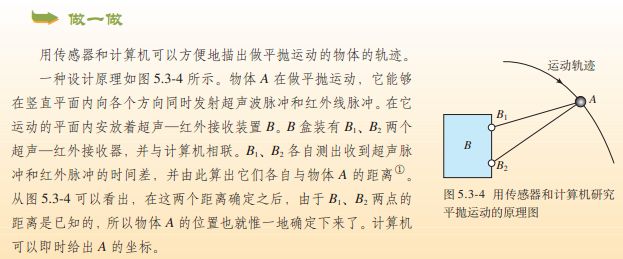
Using this method, the computer can accurately determine the position of the object through the sensor, and can also conveniently depict the trajectory of projectile motion.
[Textbook Reference]
People’s Education Press compulsory textbook 2, p14
[Analysis]
B1 and B2 each measure the time difference of receiving ultrasonic and infrared pulses, and from this calculate their respective distances to objectA. Once these two distances are determined, since the distance between B1 and B2 is known, and the direction of the ultrasonic pulse emitted by the sensor is also known, the position of objectA is uniquely determined, and the computer can instantly provide the coordinates ofA.
[Example 2]
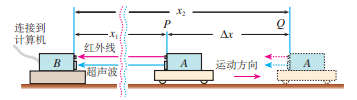
The diagram shows a schematic of using motion sensors to measure the speed of a small car. This system consists of boxes A and B, box A contains an infrared emitter and an ultrasonic emitter, while box B contains an infrared receiver and an ultrasonic receiver. Box A is fixed on the small car moving to the right. During measurement, A simultaneously emits an infrared pulse and an ultrasonic pulse to B, and box B starts timing when it receives the infrared pulse and stops timing when it receives the ultrasonic pulse. If the time difference between the two is t1, and the speed of sound in air is v0. The question is:
(1) What is the distance between A and B?
(2) After a brief time interval Δt, a second measurement is taken, with the time difference for this measurement being t2, what is the speed of the small car?
[Analysis]
(1) v0t Since the speed of infrared is much greater than that of ultrasonic, the time taken for infrared to propagate between A and B can be ignored.
According to the uniform linear motion law, the distance between A and B is x1=v0t1
(2) 
Similarly, when the second measurement is taken, the distance between A and B is x2=v0t2
The time interval between the two ultrasonic pulses emitted is Δt, which is the time taken for the small car to move Δx=x2–x1.
Based on the definition of speed, the speed of the small car is given by:

[Textbook Reference 3]
People’s Education Press compulsory textbook 1, p23
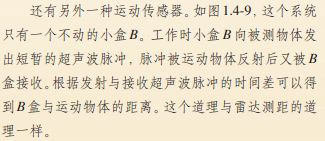
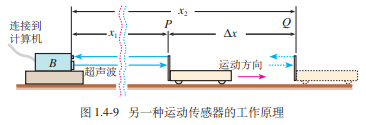
Students can read related materials, think about how this sensor measures distance, and consider the example questions below.
[Example 3]
In 2016, the Zhejiang college entrance examination question
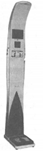
The diagram shows a common height and weight measurement device. The device emits ultrasonic waves with a speed of v downwards, which are reflected back and received by the measuring device, which records the time interval of emission and reception. A weighing platform with mass M0 is placed on a pressure sensor, and the output voltage of the sensor is proportional to the pressure applied to it. When no one is standing on the weighing platform, the recorded time interval is t0, and the output voltage is U0. When a student stands on the weighing platform, the recorded time interval is t, and the output voltage is U, then the height and weight of the student are respectively:
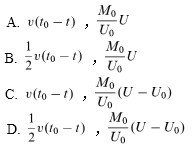
[Answer] D
[Analysis]
When no one is standing on the weighing platform, then 2x=vt0
When someone is standing: 2(x–h)=vt
Solving gives:
When no one is standing: U0=kM0g
When someone is standing: U=k(M0g+mg)
Solving gives: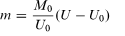
Therefore, the answer isD.
Welcome to submit articles
Email: [email protected] (Physics Learning Research submission initials)
For specific requirements, please check the “Physics Learning Research” official account under “Exchange Cooperation” in “About Us” or reply directly to the official account with the word “submission”, and we will reply with specific requirements!


Reviewed by: Zhang Chunli, Shi Yapoo
Edited by: Wang Chunmei