
Dr. Katharina Zeissler, editor of the prestigious international journal Nature Electronics, highlights:
Published in Nature Electronics (2025, Vol. 8, Page 879)
Sub-millimeter robots with autonomous capabilities show great potential in environmental monitoring and biomedical applications.
However, these robots need to possess multiple functions, including perception, motion control, and wireless communication with other robots. Due to the extremely limited surface area available at the sub-millimeter scale, integrating all the communication components required for collective collaboration remains a challenge.

Researchers from Chemnitz University of Technology and the European Center for Life Technology in Venice, including Vineeth Bandari, John McCaskill, and Oliver Schmidt, reported a self-folding modular microrobot capable of moving in aquatic environments and communicating optically.
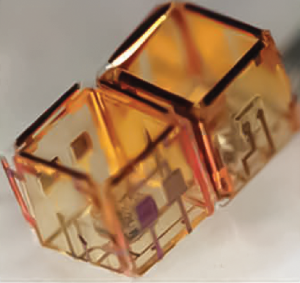
The researchers designed a self-folding “origami” membrane structure that can fold into cubic-shaped microrobots and can further self-assemble into larger, more complex structures.
On the inner surfaces of the robots, the researchers integrated rigid micro-components—such as silicon chiplets for information processing and micro light-emitting diodes (μLEDs) for communication; while curled organic solar cells were arranged on the edges to achieve omnidirectional energy harvesting, with a maximum output power of 37.5 μW.
The research team optimized the flip-chip bonding process of rigid components on various thin film and hydrogel surfaces, enabling heterogeneous integration through automatic photolithography and microchip bump bonding processes, thus providing advantages for scalable production and cost control.
The generated energy is sufficient to propel the microrobots through water electrolysis and achieve optical communication via green μLEDs, with a data transmission rate of up to 1,000 Hz and a communication distance of up to 4 mm.
Link: https://www.science.org/doi/10.1126/scirobotics.adu6007