
In 2025, Linux operations will no longer be as simple as “writing scripts and installing services”. With the development of cloud-native, automation, security, and intelligence, it will enter a whole new stage.This article will analyze the major transformations happening in Linux operations from five dimensions, illustrated with case examples to help you understand intuitively.
1️⃣ From Manual to Automation:
Say goodbye to manual labor ⚡
In the past, Linux operations relied heavily on Shell scripts and manual operations: configuring services, batch releases, log cleaning… all executed step by step by humans.Today, the rise of automation tools has ushered operations into a new era of “fewer commands, more code”.
📊 Comparison of Automation Tools:
📌 Comparing the features and applicable scenarios of Shell, Ansible, Terraform, and Puppet
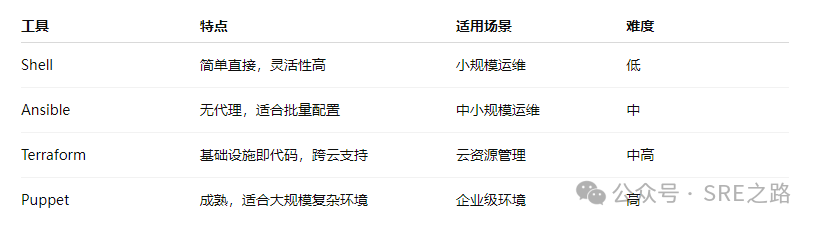
👉 As we can see:
Shell is suitable for small-scale, temporary tasks.
Ansible is simple and efficient, with zero-agent batch configuration, favored by small to medium teams.
Terraform provides Infrastructure as Code (IaC), suitable for multi-cloud and resource orchestration.
Puppet is stable and mature, still common in enterprise environments.
From “manual commands” to automation platforms, this is the first major step in Linux operations.
2️⃣ From Servers to Containerization:
Deployment efficiency significantly improved 🐳
In early Linux operation environments, application deployment mostly relied on physical or virtual machines, with high costs for scaling and migration, and difficulty ensuring environmental consistency.
With the popularity of Docker, containerization has become standard in Linux operations:
Build once, run anywhere
Environment isolation reduces dependency conflicts
Lightweight, higher resource utilization
Containers are not the end, but a springboard leading Linux operations into the cloud-native era.
📌 Timeline of Operations Development:📌 Showcasing the evolution path from Shell → Automation → Containerization → Cloud-native → Intelligence
3️⃣ From Operations to DevSecOps:
Security shifts left 🔒
In the traditional model, operations often occupy the last link: development completed → deployment online → operations responsible for stability and security.However, this model cannot cope with the complexity and security challenges of cloud-native.
Now, DevOps has upgraded to DevSecOps, where security and compliance are no longer “patches after going live”, but integrated into the entire process from the development stage.
📌 DevSecOps Lifecycle:📌 Showcasing the full process of development, testing, security, deployment, and monitoring
This means Linux operations need to master:
Automated security scanning
Compliance checks
Container security hardening
Implementation of zero-trust architecture
4️⃣ From Traditional Architecture to Cloud-native Architecture:
Architectural paradigm shift
One of the most significant changes in Linux operations is the comprehensive evolution of architecture.
Past IT systems were mostly three-tier architectures: load balancing → application → database.But in the cloud-native era, Kubernetes, Service Mesh, and microservices architecture have become mainstream.
📌 Architectural Evolution Comparison:📌 Comparing three-tier architecture and K8s+Service Mesh architecture
👉 The differences are clear:
Traditional architecture: stable but limited in scalability, relying on manual operations.
Cloud-native architecture: loosely coupled services, automatic scaling, container orchestration, traffic governance.
This requires Linux operations to not just “guard the servers”, but to understand the complex ecosystem of distributed systems, microservices, and cloud platforms.
5️⃣ From Passive Response to Intelligence:
The rise of AIOps 🤖
In the past, the operations model often was:system failure → receive alert → manual investigation → manual recovery.
This “firefighting mode” is completely inadequate in large-scale distributed environments.Therefore, AIOps (Artificial Intelligence for IT Operations) is becoming a necessary course for Linux operations.
📌 AIOps Intelligent Operations Closed Loop:📌 Showcasing the closed loop of data collection → analysis → anomaly detection → automated decision-making → execution → optimization
It brings three major capabilities:
Intelligent alert deduplication → avoiding being overwhelmed by alert storms
Anomaly detection and prediction → identifying risks instead of waiting for downtime
Automated closed-loop processing → from data → analysis → decision-making → execution → optimization
Linux operations are gradually shifting from “human-driven” to data-driven + AI-driven.
🔝 Evolution of Linux Operations Roles: From Technician to SRE
These transformations have also led to the evolution of operations roles.
📌 Growth Path of Operations Roles:
Technician: only knows commands and basic operations
Automation Engineer: masters Ansible, Terraform
Cloud-native Engineer: proficient in Docker, Kubernetes
Platform Engineer: builds DevOps/Observability platforms
Architect/SRE: oversees the entire system, driving stability and efficiency
🏁 Summary
The five major transformations happening in Linux operations are:
From manual operations → automated operations
From server operations → containerized operations
From operations as an afterthought → DevSecOps full-process security
From traditional three-tier architecture → cloud-native architecture
From passive response → intelligent operations
This is not just an upgrade of tools and methods, but a reshaping of operations thinking and roles.
In the future, Linux operations will move towards platformization, intelligence, and security, with SRE becoming the ultimate destination.

END

Long press to scan the code and follow us
Public Account | The Path of SRE
Rushing towards the mountains and fields
Putting down the pursuit of footsteps
Persisting in sharing technical documents
For more technical content, click below【Read the original text】