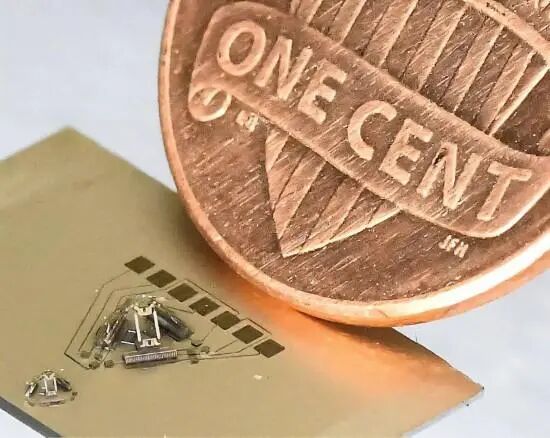
Two different sizes of miniature robots placed next to a coin. Image source: Carnegie Mellon University, USA.
Scientists at Carnegie Mellon University have developed a new 3D printing process that successfully manufactures miniature delta robots known as microDeltas. These robots are expected to play significant roles in fields such as micro-manipulation, micro-assembly, minimally invasive surgery, and wearable haptic devices. The related paper was published in the latest issue of Science Robotics.
A delta robot, also known as a parallel robot or parallel kinematic robot, is a high-speed, lightweight parallel robot. It consists of three parallel support arms that form the mechanical arm, utilizing a parallelogram structure, and is widely used in food packaging, pharmaceutical sorting, electronic assembly, and new energy vehicle die-casting processing.
As early as the 1980s, when micro-electromechanical systems emerged, engineers envisioned their use in the manufacture of miniature robots. The laws of physical scaling also suggest that miniaturized robots could achieve breakthroughs in speed and precision. However, at that time, the limitations of micro 3D manufacturing technology made it challenging to scale down robots to microscopic sizes.
In this instance, the team developed a 3D printing process based on two-photon polymerization. This is an advanced nano-manufacturing technology that creates complex 3D structures and actuators with electrical functions by precisely curing photosensitive materials with focused lasers and then depositing a thin layer of metal, without the need for manual folding or assembly.
Using this technology, the team manufactured miniature delta robots with heights of only 1.4 millimeters and 0.7 millimeters. Compared to similar robots, they are the smallest and fastest to date. Experiments confirmed that reducing the size not only improved the robots’ precision to sub-micron levels but also allowed their operating frequency to exceed 1 kilohertz, even enabling them to launch salt particles equivalent to 7.4% of their own mass.
The team stated that with the help of 3D design and printing technology, they completed eight iterations of robot design in a very short time, whereas traditional methods could take weeks or even months. In the future, by adjusting design parameters, constructing large-scale arrays, or introducing sensory feedback, they can further enhance the robots’ bandwidth, precision, and operational range.


Disclaimer
Article source: Science and Technology Daily
Any information sourced from other media is reprinted from those sources and does not represent our website’s endorsement of their views, nor does it imply our responsibility for their authenticity. For reprints and business cooperation, please contact Teacher Mu at 159 0176 7989 (WeChat same number).