
This Issue Highlights
2024 Issue 8
Micro-Nano Energy Harvesting Technology for Self-Powered Sensing in Power EquipmentHe Hailong, Li Yi, Chen She, Yang Aijun, Xiao Song, Rong MingzheDOI: 10.13336/j.1003-6520.hve.20240674(Full Text Reading)01Research BackgroundThe complex operating conditions of new power systems impose higher requirements for the state perception and operational maintenance of power equipment. Building a power IoT based on a large number of distributed micro-nano sensors to enhance the depth and breadth of state perception is key to achieving panoramic information perception and fault monitoring and early warning of equipment. Meanwhile, stable and reliable power supply for sensors is fundamental to ensure their normal operation. Achieving low power consumption and self-powering of sensors can not only enhance the robustness of monitoring devices and systems but also effectively reduce the operational and maintenance costs of equipment. In recent years, micro-nano energy technology has gained widespread attention due to its strong environmental adaptability, high energy harvesting efficiency, and wide range of application scenarios, showing potential to support self-powered sensing in power equipment.
02Key Content
1) Micro Energy Distribution Characteristics of Power Equipment
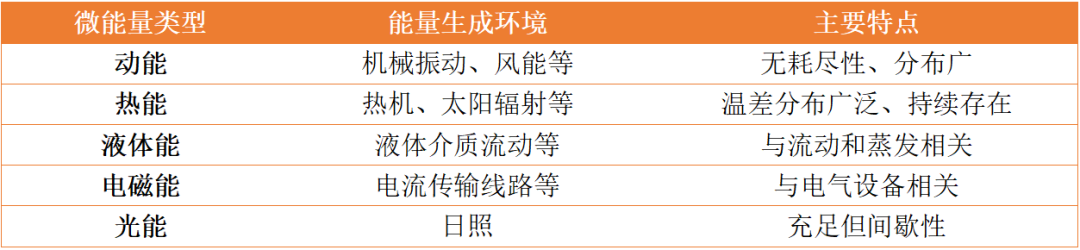
There are rich forms of micro energy in the operating environment of power equipment (as shown in Table 1), including mechanical energy, thermal energy, electromagnetic energy, fluid energy, light energy, etc. Specifically, mechanical energy such as high-frequency vibrations from transformers and GIS, and wind-induced vibrations from transmission lines; thermal energy contained in the heat generated by transformers and motors during operation; electromagnetic energy from static and magnetic fields generated during the operation of power equipment; fluid energy from insulating oil and other liquid media; and light, wind, and raindrop energy from the operating environment of power equipment. These forms of micro energy are unevenly distributed in different parts and operating environments of power equipment, exhibiting high spatial variability, which provides a broad development space for the application of micro-nano energy devices and offers opportunities to solve the challenges of real-time monitoring of power equipment.
Table 1 Micro Energy Distribution Characteristics of Power Equipment
2) Micro-Nano Energy Devices and Self-Powered Sensing
Figure 1 presents a self-powered state sensing framework based on micro-nano energy harvesting. Essentially, by designing micro-nano energy harvesting converters that match the micro energy distribution characteristics of specific power equipment scenarios, waste energy can be reused to achieve self-powered sensing.
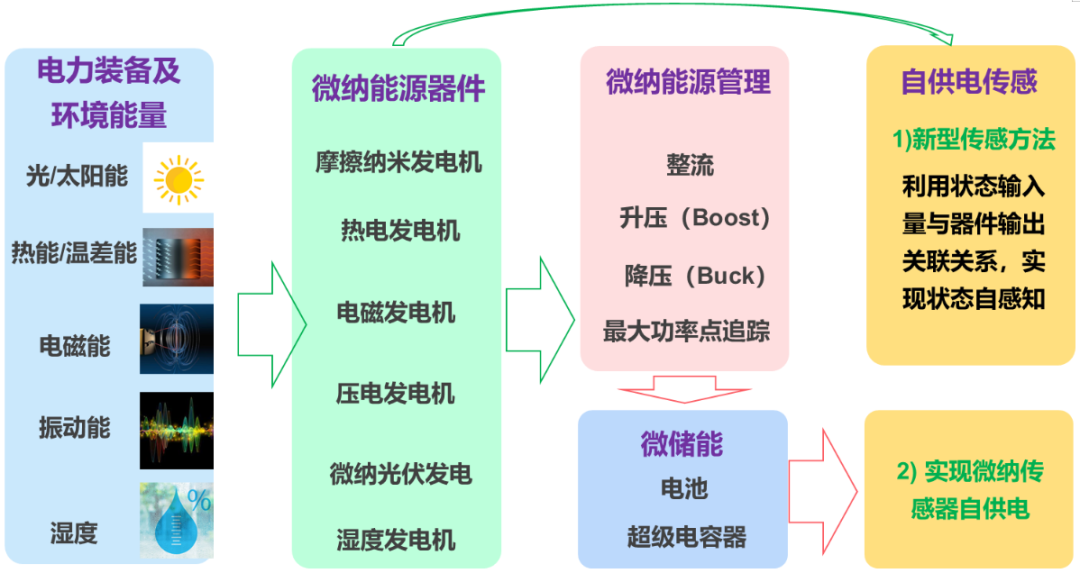
Figure 1 Self-Powered State Sensing Framework Based on Micro-Nano Energy Harvesting
Currently, micro-nano energy harvesting methods and devices include piezoelectric nanogenerators (PENG), triboelectric nanogenerators (TENG), thermoelectric generators (TEG), hydrovoltaic nanogenerators (HNG), as well as micro-nano electromagnetic generators (EMG) and magnetic field energy harvesting devices. On one hand, these devices can convert energy from power equipment and the environment into electrical energy for use, combined with micro-nano energy management strategies and low-power micro-nano sensors to achieve self-powered sensing; on the other hand, by utilizing the correlation between external state input and the device’s electrical output characteristics, the devices themselves can also achieve self-powered sensing of physical and chemical quantities, providing new sensing principles and methods for the perception of state parameters. Additionally, by combining multiple micro energy harvesting strategies, sensors with diverse energy harvesting capabilities and wide environmental applicability can be developed to achieve high-reliability self-powered sensing in all weather conditions.03Conclusion
Micro-nano energy devices exhibit unique advantages in high-entropy energy harvesting and self-powered sensing, meeting the demands for self-powering and distributed integration of micro-nano sensors in state perception of power equipment in new power systems. Although scholars at home and abroad have made significant progress in device principles, material selection and modification, structural design optimization, and device applications, there are still certain technical difficulties and challenges in improving output efficiency, optimizing energy management strategies, ensuring device stability and durability, and integrating and scaling applications. Overall, research in this emerging field of micro-nano energy harvesting methods and devices for power equipment is expected to promote self-powered state monitoring and the intelligent development of equipment.
Reference Information:
He Hailong, Li Yi, Chen She, et al. {{custom_author.name_cn}} Micro-Nano Energy Harvesting Technology for Self-Powered Sensing in Power Equipment [J]. High Voltage Technology. 2024, 50(8): 3387-3402
Author and Team Introduction

He Hailong, Associate Researcher at Xi’an Jiaotong University, has conducted in-depth research on fault current limiting and equipment sensing technology for ship DC systems in recent years, leading 15 projects funded by the National Natural Science Foundation, the Navy Equipment Department, the Ministry of Industry and Information Technology, and the Ministry of Education; has published 46 SCI/EI papers, including 23 SCI papers as the first/corresponding author in the past five years (8 papers with IF > 10), received 3 conference best paper awards; holds 19 authorized invention patents (including 2 US patents); has given 7 invited talks at international conferences/industries; received 3 provincial and ministerial scientific research awards; selected as a top young talent in Shaanxi Province and supported by the Shaanxi Provincial Youth Talent Support Program.

Chen She, Associate Professor and Doctoral Supervisor at Hunan University, Deputy Director of the Department of Electrical Engineering. Engaged in research in advanced sensing of electrical equipment and high voltage discharge. Published over 60 SCI journal papers, led 3 National Natural Science Foundation projects, Hunan Province Excellent Youth projects, and multiple research projects from enterprises and institutions. Received the Young Scientist Award at the International High Voltage Conference (ISH), two provincial and ministerial second prizes for scientific and technological progress, and the top ten disruptive technology innovation award at the Hunan Province Innovation and Entrepreneurship Competition. Serves as a youth member of the China Electrotechnical Society, a youth member of the Plasma and Applications Committee of the China Electrotechnical Society, and a youth member of the High Voltage Committee of the China Electrotechnical Society.
Li Yi, Distinguished Associate Researcher at Wuhan University, mainly engaged in research on environmentally friendly power transmission and distribution equipment and their state perception. In recent years, as the first/corresponding author, published over 30 papers in journals such as Nat. Commun., Adv. Mater., Adv. Sci., Nano Energy, High Volt. IEEE Trans., with 7 papers selected as cover papers; co-authored one Chinese monograph; holds over 20 authorized/accepted invention patents; led projects funded by the National Natural Science Foundation Youth Program, China Postdoctoral Science Foundation, and the China Association for Science and Technology High-end Technology Innovation Think Tank Youth Program. Selected for the sixth batch of the Postdoctoral Innovation Talent Support Program, the Hubei Province Youth Science and Technology Talent Morning Light Lifting Project, and listed among the top 2% of scholars in the “Annual Scientific Impact Ranking” by Stanford University (World’s Top 2% Scientists).
Editor: Wei Lijing
– 【 END 】 –
Disseminating Knowledge · Sharing Achievements · Exchanging Experiences
Statement: This article is an original work, and all text and image copyrights belong to the editorial department of “High Voltage Technology”. According to the latest regulations of the National Copyright Administration, for reprinting or excerpting our editorial department’s works in paper media, websites, or WeChat public accounts, please contact our editorial department in advance. Individuals may forward and share according to the original text of this WeChat article.
Hot Search Collection
#Hot Articles, #Hot Reports, #Call for Papers, #Conference Information, #Online First Release, #Selected Papers
Official Website
http://hve.epri.sgcc.com.cn/
Video Account

“High Voltage Technology” Video Account
Contact Us