On June 20, 2025, the smartphone processor rankings were updated again, incorporating the latest smartphone SoCs. This adjustment reflects the proportion of single-core and multi-core benchmark scores, as well as adjustments to CPU and GPU performance scores. Some smartphone SoC rankings have been appropriately adjusted, continuing to optimize the rankings. Thank you for your feedback!
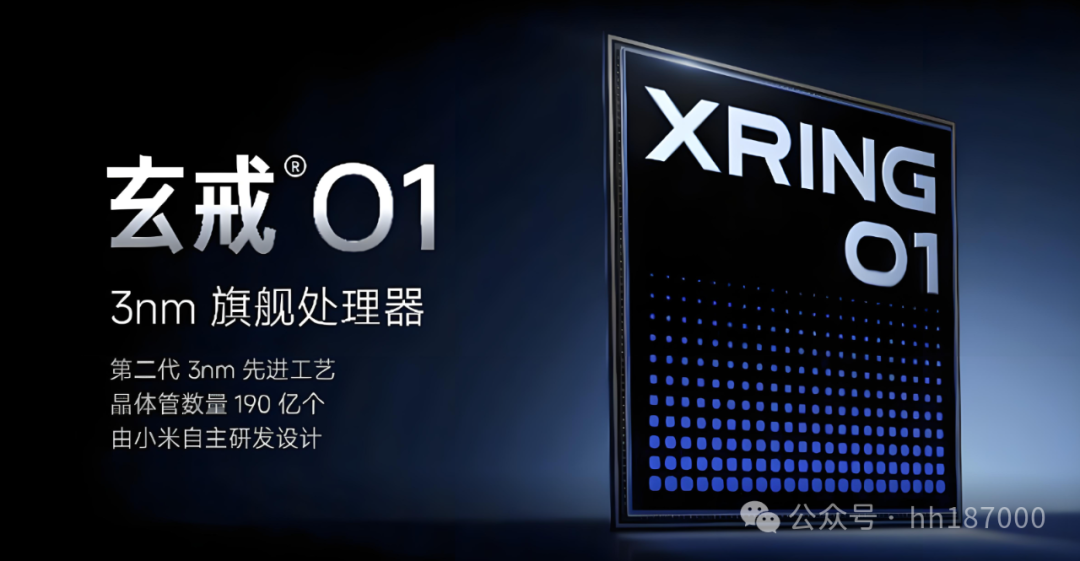
On May 22, 2025, Xiaomi released its first flagship self-developed chip Xuanjie O1, which is first equipped in the Xiaomi 15S Pro smartphone, based on TSMC’s second-generation 3nm process (N3E), featuring a four-cluster ten-core architecture (2 super-large cores at 3.9GHz X925 + 4 large cores at 3.4GHz A725 + 2 low-frequency large cores + 2 small cores), balancing high-load and low-power scenarios through a dynamic scheduling mechanism.
In the GeekBench 6 performance test, it scored 2985 points in single-core and 9253 points in multi-core, with AnTuTu scores exceeding 3 million (approximately 3004137 points). The GPU is equipped with a 16-core Immortalis-G925 GPU, leading Apple’s A18 Pro by about 43% in the Manhattan 3.1 test, but limited by the reference architecture and lack of system-level cache (SLC), the power consumption in heavy gaming scenarios is relatively high (about 6.2W), requiring continuous optimization. Overall performance ranks in the first tier of Android, second only to Snapdragon 8 Gen 2 and Dimensity 9400. Unlike previous Surge chips, this one directly reaches flagship level, and we look forward to continuous updates to achieve further breakthroughs.
In April 2025, Honor GT Pro debuted with the Qualcomm Snapdragon 8 Gen 2 chip, which has two main improvements over the Snapdragon 8 Gen 1: the frequency of the 2 Oryon super-large cores increased from 4.32GHz to 4.47GHz, and the GPU frequency increased from 1100MHz to 1200MHz. In GeekBench 6 performance scores, the Snapdragon 8 Gen 2 CPU scored 3135 points in single-core and 9567 points in multi-core, with an overall performance improvement of about 5%.
In April 2025, the Snapdragon 8s Gen 4 was updated, using TSMC’s second-generation 4nm process (N4P), adopting a “1 super + 7 large” full-large core CPU architecture, significantly improving CPU performance. Single-core performance is slightly inferior to Snapdragon 8 Gen 3, but significantly ahead of Dimensity 8400 and 8s Gen 3. Multi-core performance is close to 8 Gen 3, showing significant progress compared to the previous generation 8s Gen 3. In Geekbench 6 tests, single-core scores reached 2232 points, and multi-core scores were 7308 points. In terms of GPU, the Adreno 825 performed excellently in the Aztec 1440P off-screen test, with significant peak performance improvements and energy efficiency far exceeding the previous generation 8s Gen 3.
Snapdragon 8s Gen 4 can be seen as an optimized version of the small 8 Gen 3! The differences are minimal, with performance parameters slightly inferior to 8 Gen 3, but leading in low-load energy efficiency! Redmi Turbo 4 Pro and iQOO Z10 Turbo Pro are the first to feature 8s Gen 4.
Below is the latest mainstream consumer-grade smartphone processor ladder chart for 2025; for your reference when choosing a smartphone; data source: Geekbench single-threaded, multi-threaded scores and GFXBench Manhattan graphics frame rate rankings, as well as game frame rates, energy consumption, and daily experience comprehensive rankings.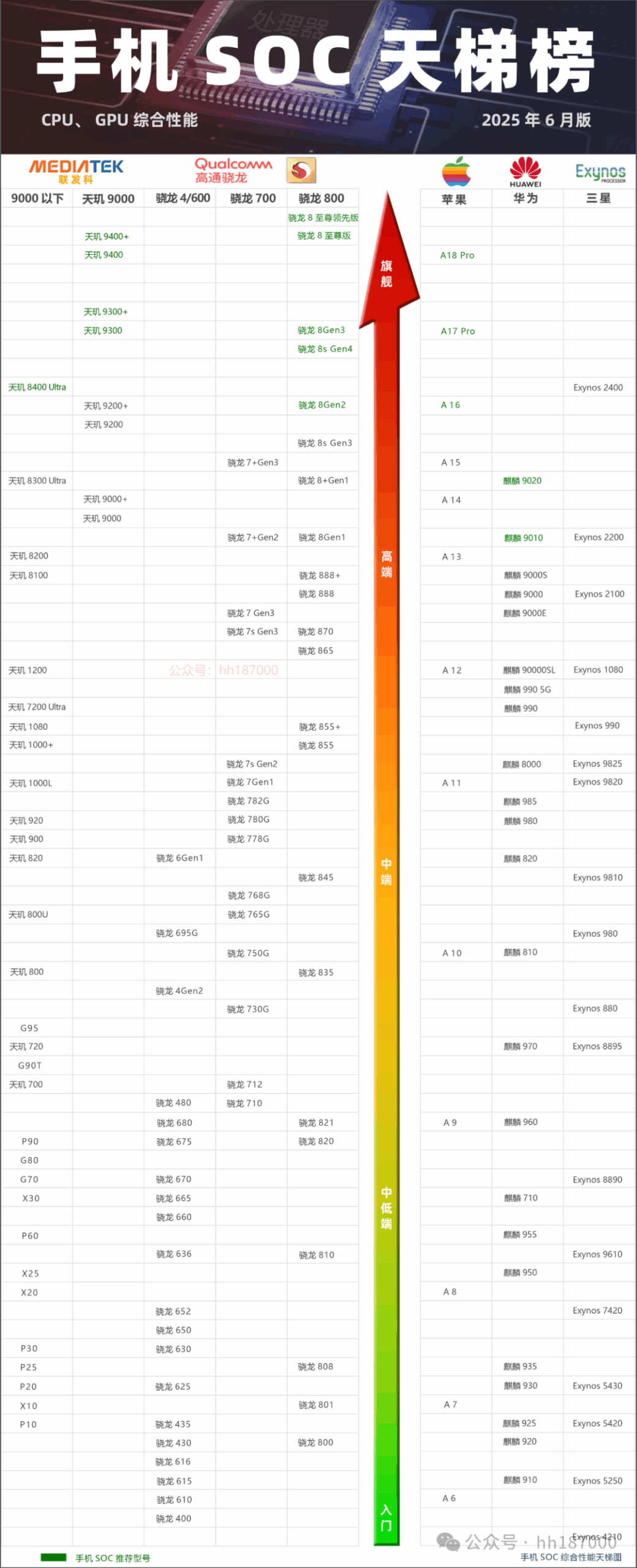 We have tested and compiled statistics on mainstream smartphone processors and continue to optimize the ladder rankings.Here is a brief introduction to smartphone processors: Smartphone processors (System on Chip, abbreviated SoC, translated as system-level chip, commonly referred to as CPU) are the core components that consumers pay the most attention to when purchasing a smartphone. It is the control center of the entire phone and the control hub of the logical part. The microprocessor achieves control by running software stored in memory and calling databases stored in memory. All data that needs to be processed must go through the SoC, and the management of various parts of the phone cannot be separated from the unified coordination and command of the microprocessor.
 Strictly speaking, computer CPUs and smartphone CPUs are completely different, the correct term for smartphone CPUs is SoC. Smartphone SoCs integrate a series of functional modules including CPU, GPU, RAM, modem, navigation positioning, and mobile baseband. With the continuous improvement of integrated circuit production technology and process levels, the functions of microprocessors in smartphones have become increasingly powerful, such as integrating advanced digital signal processors (DSP) within the microprocessor. Therefore, the performance of smartphone processors determines the performance of the entire phone. In contrast, computer CPUs are not as complex; they are simply central processing units without integrating other functional modules, and the memory, graphics processors (GPUs), and network interfaces in computers are independent.
Key components integrated into smartphone SoC chips include:
1. CPU: Responsible for processing computational tasks. The most important part of the smartphone processor, responsible for task computation and control, its strength directly relates to smartphone performance. It is easy to understand that all instructions are processed and issued by it.2. GPU: Responsible for image rendering. The graphics processor, equivalent to the graphics card in a laptop. The GPU is crucial for gaming experience; generally, the stronger the performance, the higher the game frame rate.3. Baseband: A circuit in the smartphone, primarily responsible for demodulating, deinterleaving, despreading, and decoding wireless signals in mobile networks. It is responsible for communication capabilities, and the quality of mobile signals is directly related to this.4. ISP: Image Signal Processor, mainly used for image processing in smartphone imaging systems. Mainstream smartphone SoC chips from Qualcomm, MediaTek, and Kirin integrate ISP modules. For most people, the presence of ISP may not be highly noticeable, but it is also an indispensable part of smartphones.5. DSP: Digital Signal Processor, a chip that integrates specialized computing capabilities. DSPs are designed for embedded systems such as mobile base stations, where floating-point operations are not required, only integer operations. However, with the advent of 5G networks, the computational burden on base stations is increasing, making floating-point operations essential.6. NPU: Responsible for artificial intelligence computations. Functions such as facial recognition and portrait segmentation address the long-standing issue of poor night video quality due to insufficient computing power of ISP and general processors, as well as information loss in traditional imaging links.7. Other integrated functional components. This is why the most important factor when choosing a smartphone is the smartphone chip! Because it is not just about CPU performance!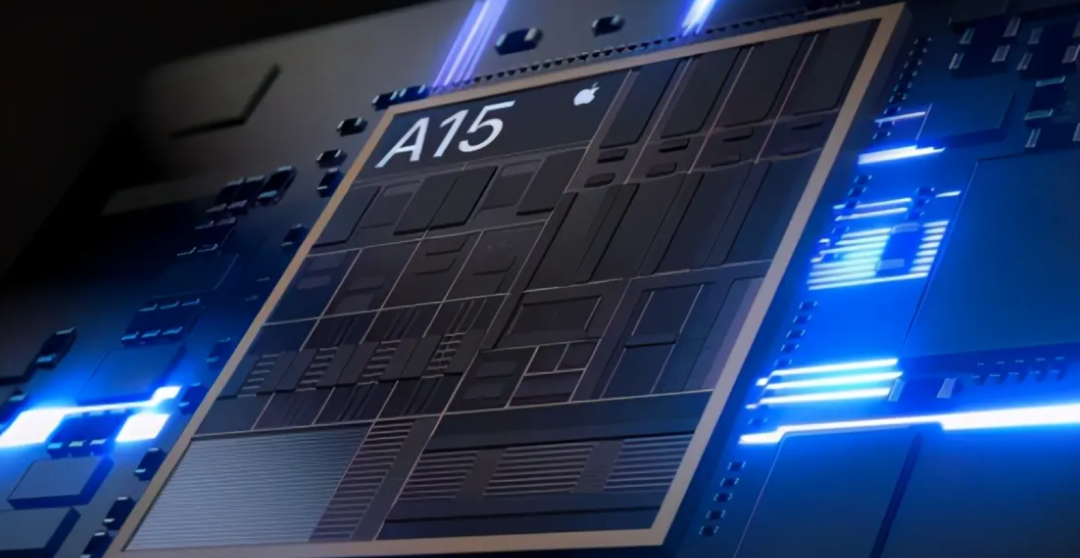 Currently, the five most well-known mainstream chip manufacturers are Qualcomm, Huawei, Samsung, MediaTek, and Apple. The flagship chips from these five companies are:
-
Qualcomm representative models: Snapdragon 8 Gen 2, Snapdragon 8 Gen 3, 8s Gen 4, Snapdragon 8 Gen 1;
-
Huawei representative models: Kirin 9020, Kirin 9010, Kirin 9000S, Kirin 9000, etc.;
-
Samsung representative models: Exynos 2400, Exynos 1580, Exynos 2200, etc.;
-
MediaTek representative models: Dimensity 9400 (+), Dimensity 9300 (+), Dimensity 9200, etc.;
-
Apple representative models: A18 Pro, A17 Pro, A16, etc.;
 Apple: In terms of CPU performance and experience, Apple A-series processors have consistently ranked in the top tier of high-end flagships over the years. Coupled with the advantages of the excellent iOS system, they have a notable advantage in smoothness compared to the Android platform, and they are more energy-efficient, making them relatively more power-saving than Android devices, with the flagship representative being A18 Pro. A new iPhone can maintain a high level of smoothness even after several years of use.Qualcomm: As the most popular in the Android camp, Qualcomm’s chip models are comprehensive, covering high, mid, and low-end series. The latest Snapdragon 8 Gen 2 is the mainstream choice for this year’s Android flagships, currently featured in flagship devices like Xiaomi 14 and OnePlus 13. In previous years, Qualcomm’s Snapdragon 8 Gen 1 and Snapdragon 888 faced criticism for power consumption and heating issues. As long as Qualcomm’s power consumption does not falter, it remains the preferred chip for major Android manufacturers.Huawei: As a well-known domestic smartphone manufacturer, it mainly uses its own Kirin processors, with the highest-end updated to the Kirin 9000 series (9020, 9010). Due to U.S. sanctions, it has fallen behind Apple and Qualcomm’s second-generation chips in performance, but it is believed that Huawei will rise again in the future.MediaTek: In recent years, it has made a strong comeback, despite being criticized in earlier years for being used in mid-range and low-end models. Since upgrading to the Dimensity series, it has been making significant progress. Last year, the Dimensity 9300 could compete head-to-head with Qualcomm’s Snapdragon 8 Gen 3, and this year’s Dimensity 9400 is also a top choice for Android flagships, fully entering the high-end flagship market.Samsung: The popularity of its processors is relatively low, mainly because Samsung smartphones have nearly exited the domestic market, and Samsung processors are primarily used in Samsung’s Korean models, while Samsung’s domestic phones are equipped with Qualcomm processors.