Operating Environment:
MATLAB 2024a
1. Algorithm Description
As large-scale multi-antenna communication gradually becomes mainstream, the cost of channel estimation is turning into an “invisible ceiling” for system efficiency. In traditional multi-antenna systems, the base station only needs to estimate the channels of a dozen antennas, and the pilot overhead is still manageable. However, when the number of antennas rises to dozens or even hundreds, if we continue to use the approach of “each antenna sends pilots and estimates one by one,” the training resources will expand dramatically, data transmission time will be squeezed, system throughput will decrease, and it will also bring additional delays and energy consumption. Especially in scenarios such as millimeter-wave, vehicular communication, and industrial wireless, where channels change rapidly over time and links are sensitive to delays, having more pilots becomes increasingly unacceptable. Therefore, how to reliably recover large-scale MIMO channels under conditions of sparse or severely limited pilots has become a critical issue that cannot be overlooked. The system described in this article is built around this pain point, establishing a complete simulation platform: it employs a strategy of “sparse pilot observation + traditional linear estimation for coarse reconstruction + deep neural network residual completion” to achieve full channel recovery and verify the effectiveness of the scheme through end-to-end bit error rate assessment.
The communication scenario corresponding to the system is a typical link model of “large-scale base station array and small-scale terminal reception.” The transmitter adopts a uniform planar array structure, which arranges antennas in a regular pattern in both horizontal and vertical directions to form a planar array. This array form is very common in existing 5G/6G base stations, millimeter-wave phased arrays, and various high-density antenna devices. A direct feature of the planar array is its high spatial dimension and clear geometric structure, where antennas are distributed regularly in two-dimensional space rather than in a scattered manner. Correspondingly, the channel will also exhibit significant structural characteristics in space: adjacent antennas see similar scattering environments, and channel responses are often highly correlated; while antennas that are farther apart become less similar due to differences in observation angles and paths. In other words, large-scale array channels do not operate independently for each antenna, but rather form a high-dimensional random field with smooth textures and spatial coherence. This spatial structure is both the source of increased difficulty in traditional estimation and the key foundation for the feasibility of sparse pilots and the involvement of deep learning.
To realistically reflect this structure at the simulation level, the system explicitly introduces the spatial correlation of the transmitter in channel modeling. The meaning of correlation is not abstract; it can be understood as follows: the more compact the array and the more concentrated the propagation angles, the more the channels between antennas resemble “different pixels on the same image” rather than independent random points. The system uses a common and practically reasonable “nearest neighbor correlation decay” model to describe the high correlation of adjacent antennas, which gradually decays with distance; at the same time, it characterizes the correlation characteristics in both horizontal and vertical directions, combining them into an overall correlation structure suitable for planar arrays. The channel samples generated in this way exhibit significant spatial continuity on the two-dimensional array, consistent with the propagation characteristics of real arrays. In terms of multipath, the system adopts a typical power delay profile to generate small-scale fading and equivalently represents it as a flat fading matrix, thereby focusing the research on the spatial domain and avoiding additional interference caused by frequency domain selectivity. The final channel obtained contains statistical fluctuations caused by random scattering and has a “interpolatable and learnable” spatial texture due to array correlation.
In terms of the sparse pilot strategy, the system does not simply reduce the number but emphasizes “few but reasonable.” Due to the spatial coherence of the channel, the layout of pilot points determines whether the entire spatial texture can be effectively captured. The system adopts a uniformly covering pilot selection method, ensuring that pilot antennas are as evenly distributed as possible on the two-dimensional planar array, avoiding the concentration of pilots in local areas that would lead to large areas of the spatial domain being completely unobserved. The intuitive effect of uniform sparse sampling is to spread the observation points like a grid: even if the number of pilots is reduced, it can still capture representative spatial information from the entire array range, laying the foundation for subsequent reconstruction and completion. The system also sets multiple levels of pilot density, controlling the number of pilots by adjusting the sparse ratio, thus systematically observing how the estimation accuracy and bit error rate change as the number of pilots decreases, as well as the effective boundaries of deep learning completion at different sparse levels.
The traditional linear estimation module serves as the “robust foundation” of the entire scheme. In large-scale MIMO, relying solely on deep learning to directly generate the full channel from sparse observations often faces issues such as strong dependence on training data, unstable generalization, and sensitivity to noise. The system chooses to first use an estimation method based on linear minimum mean square error principles, starting from partial pilot observations to infer the full array channel using known statistical correlations. This step constructs a “interpretable, conservative but reliable” coarse reconstruction result. The advantage of linear estimation lies in its strict adherence to statistical optimal principles, still providing a physically meaningful estimation direction under conditions of limited observations and noise. To further reduce the impact of noise disturbances on the coarse estimate, the system employs multiple repetitions of pilot transmissions and averages at the receiving end; this practice is very common in engineering, trading a small amount of additional training time for cleaner observations, ensuring that the error in the coarse estimate mainly arises from “structural deficiencies caused by observation sparsity” rather than from random fluctuations of strong noise. After this processing, the coarse estimate has high reliability at pilot positions, while retaining significant systematic residuals related to spatial structure at non-pilot positions.
The design of the deep neural network module revolves around this “structural residual.” The system does not let the network replace linear estimation; instead, it places the neural network after the coarse estimate, allowing it to focus on learning the part that the coarse estimate cannot recover. More specifically, the coarse estimate provides a “low-resolution spatial channel map,” where the content at pilot positions is relatively clear, while non-pilot positions are blurred or even missing; the task of the neural network is to predict the residual signal that should be compensated at non-pilot positions based on the existing spatial information at pilot positions, transforming the entire spatial channel map from a “skeleton version” to a “detailed complete version.” This residual learning approach is particularly suitable for communication channels, which are high-dimensional and structured random objects. One reason is that the numerical magnitude of the residuals is usually more concentrated than that of the original channel, making the network easier to train and less prone to divergence; another reason is that linear estimation has already fully utilized the observational information and statistical priors, so the network does not need to reconstruct physical laws from scratch but only needs to correct gaps along the direction of traditional estimation, significantly enhancing stability and interpretability. Considering that the statistical characteristics of residuals differ at different pilot densities, the system trains a separate network model for each sparse ratio, allowing the network to more accurately grasp the rules of “how to compensate for missing data” at their respective sparse levels.
The construction of training data does not rely on actual measurements but is generated in large quantities through a model-driven approach. The system repeatedly generates real channel samples that satisfy spatial correlation laws, simulating the sending and receiving process of sparse pilots, obtaining coarse reconstructions using linear estimation, and then calculating the difference between the coarse reconstruction and the real channel at non-pilot positions as supervision labels. The network’s input only comes from the coarse estimate results at pilot positions, strictly corresponding to the actual observable information range, avoiding letting the network “peek at the true values.” To eliminate scale differences across different dimensions and enhance training stability, the system standardizes the input and labels, making it easier for the network to focus on the spatial structural laws in high-dimensional regression. After training, the network essentially learns a type of “nonlinear mapping for spatial interpolation/completion”: when pilot positions provide some clues about spatial texture, the network can infer the most likely details to compensate for the unobserved areas based on the statistical laws of related channels.
During the online inference phase, which is the actual simulation detection, the system follows the same link as training: first averaging and denoising the sparse pilot observations, then performing linear coarse estimation to obtain the preliminary channel for the full array, and then inputting the coarse estimate at pilot positions into the corresponding sparse-level neural network to output the residual prediction for non-pilot positions, adding the predicted residual back to the coarse estimate to form the final full channel estimate. It can be seen that the neural network does not change the form of observations at the receiving end, nor does it introduce additional signal assumptions; it merely performs “intelligent repairs” on the spatial deficiencies of the coarse estimate. This ensures that the overall system still maintains the structural framework of traditional receivers, only adding a layer of learning completer in the estimation phase, which has strong engineering transferability.
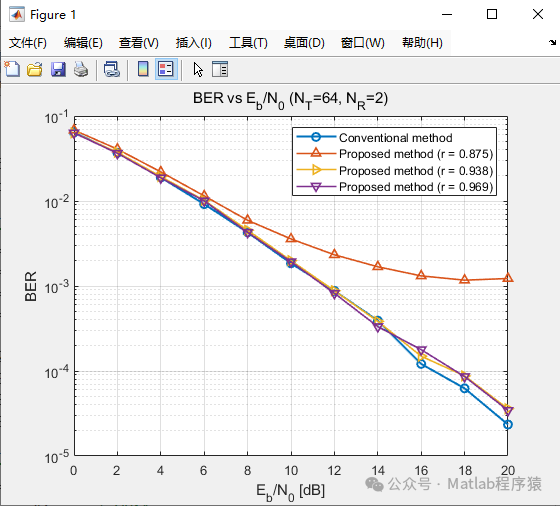
To determine whether this estimation strategy truly enhances communication performance, the system does not stop at error metrics but further builds an end-to-end bit error rate assessment link. Data transmission adopts a single-stream spatial round-robin occupancy method, where each time a random transmitting antenna sends modulation symbols. Although this transmission model simplifies the process, it allows the changes in bit error rate to be primarily attributed to the “quality of channel estimation,” avoiding the complexity of multi-stream detection from obscuring the impact of the estimation algorithm itself. After obtaining the full channel estimate, the receiving end uses linear merging detection based on the estimated channel to recover symbols and complete bit decisions. The system repeats a large number of random channels and data samples at multiple signal-to-noise ratio levels, statistically analyzing the bit error rate curve. Meanwhile, it also constructs a traditional baseline: using linear estimation to recover the channel and detect data under full pilot conditions, serving as the “performance upper limit of traditional schemes when pilot resources are sufficient.” The final bit error rate curve clearly presents three layers of relationships: the baseline performance of full pilot linear estimation, the potential performance loss if deep completion is not performed under sparse pilots, and the degree of performance recovery by DNN residual completion at different sparse ratios. Since the bit error rate is the most direct terminal indicator of communication systems, this validation method is more convincing in reality than merely looking at mean square error; it indicates that network completion is not just “numerically appealing” but can indeed translate into improved link reliability.
From an overall technical route perspective, this system embodies a typical idea of integrating model-driven and data-driven approaches. The model-driven part consists of array structure, spatially correlated channels, sparse pilot design, linear optimal estimation, and repeated averaging, providing a clear and interpretable physical and statistical foundation, ensuring that the system converges along reasonable estimation directions even under insufficient observations. The data-driven part consists of deep neural network residual learning, which utilizes a large number of identically distributed channel samples to mine nonlinear spatial completion laws that linear estimation cannot fully express, specifically repairing structural deficiencies caused by sparse observations. The combination of the two means that the information gap brought by sparse pilots no longer relies entirely on increasing pilots to fill, but rather transforms into a learnable spatial prediction problem, thus maintaining near full pilot scheme detection performance while reducing training costs.
2. Simulation Results Demonstration
3. Key Code Display
Omitted
Recommended book: Learning about communication-related knowledge
4. MATLAB Source Code Acquisition
Method 1: Click the blue text in the articleRead the original text

Method 2: Copy the following URL and open it in your browserMaiwan Single Product
https://www.maiwan8.com/#/dynamicDetail/0/0da77ac833c9c0e59b313e7cacd2ef86/index?yqm=5FCPU
Method 3: Copy the URL to openMaiwan StoreSearch for the title of this article
https://www.maiwan8.com/#/packageA/userDynamicCenter/userDynamicCenter?user_id=1261511
Method 4: If the above methods fail, please contact me viaQQ or Email or WeChat
(Click the blue text above↑↑↑↑↑ to jump)