Click the blue text above to follow us

📋📋📋 The table of contents is as follows: 🎁🎁🎁
Contents
💥1 Overview
📚2 Results
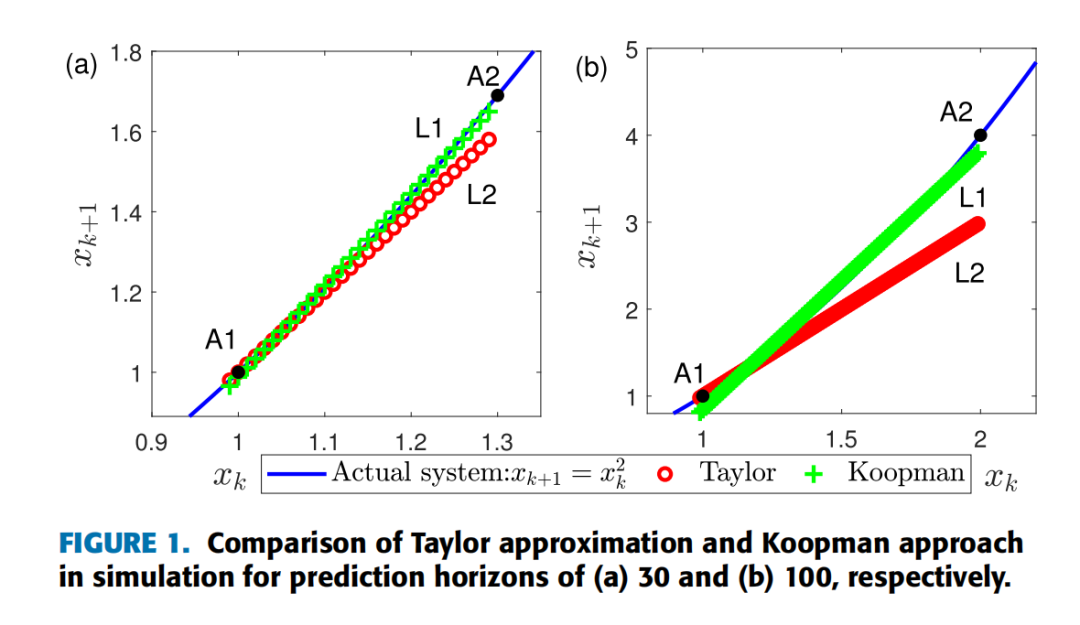
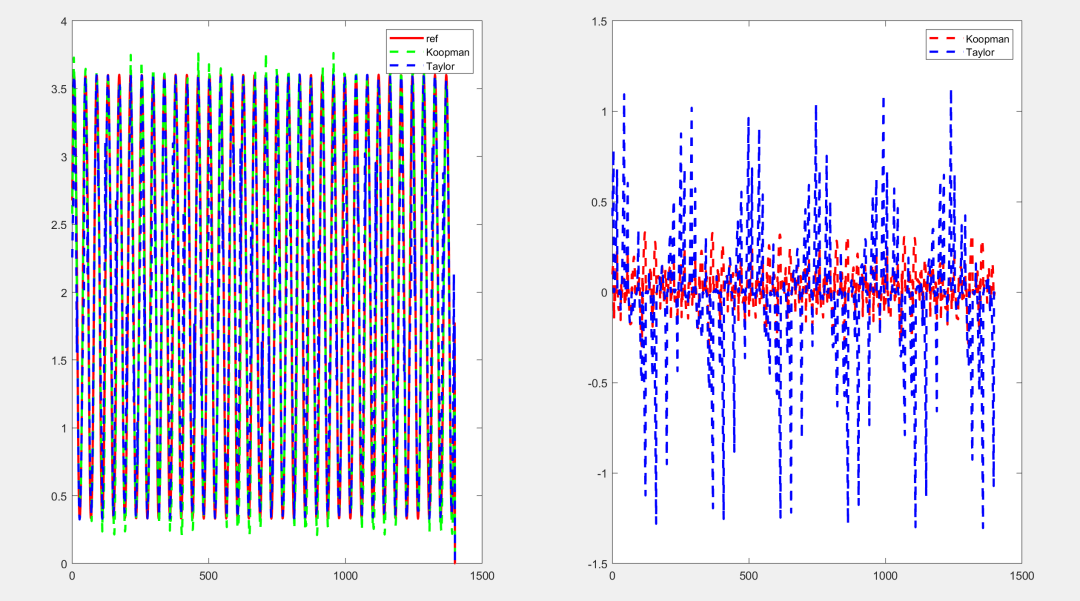
2.1 Comparison of the accuracy of linearization using Taylor series and Koopman operator
2.2 Predictive control using Koopman operator linearization, one linear model
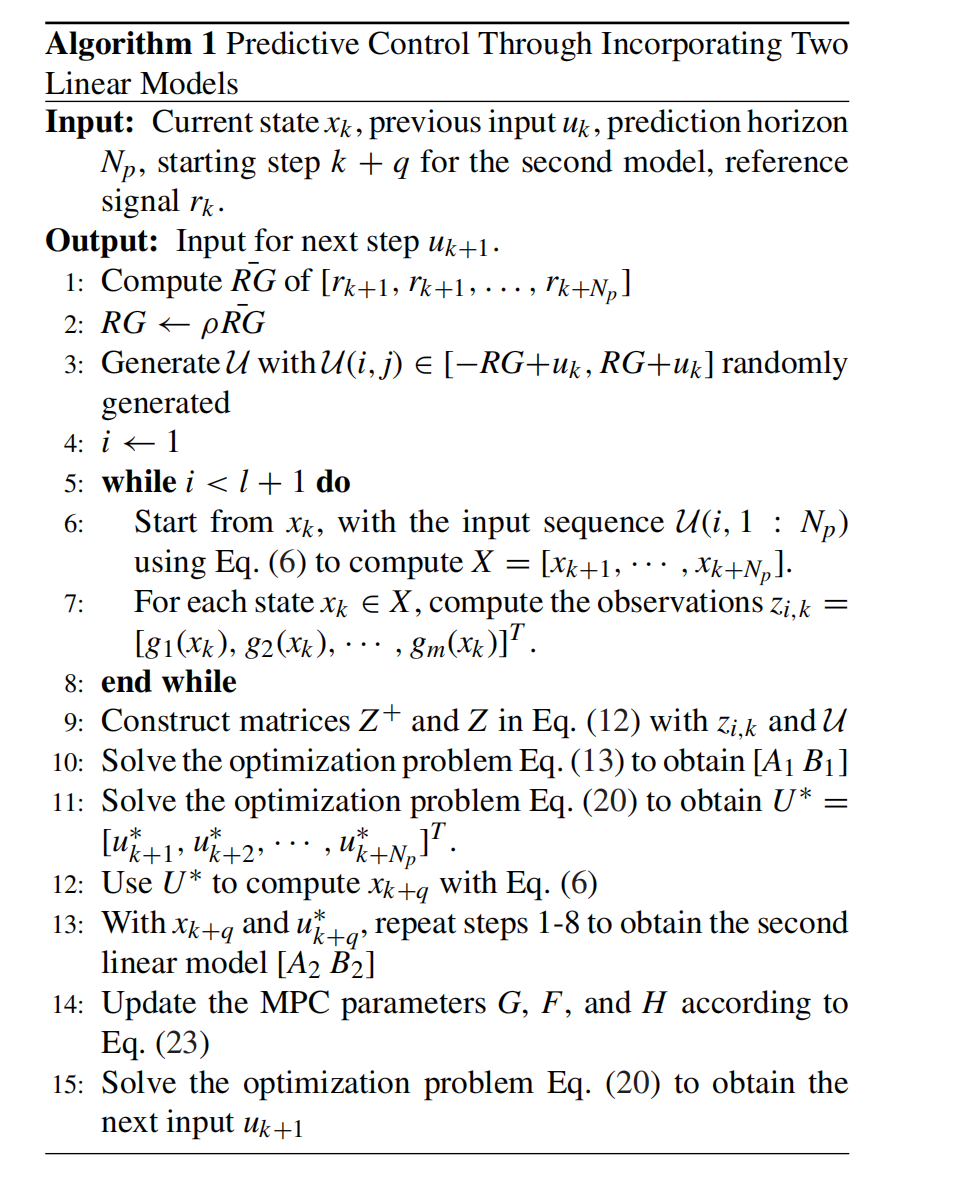
2.3 Predictive control using Koopman operator linearization, two linear models
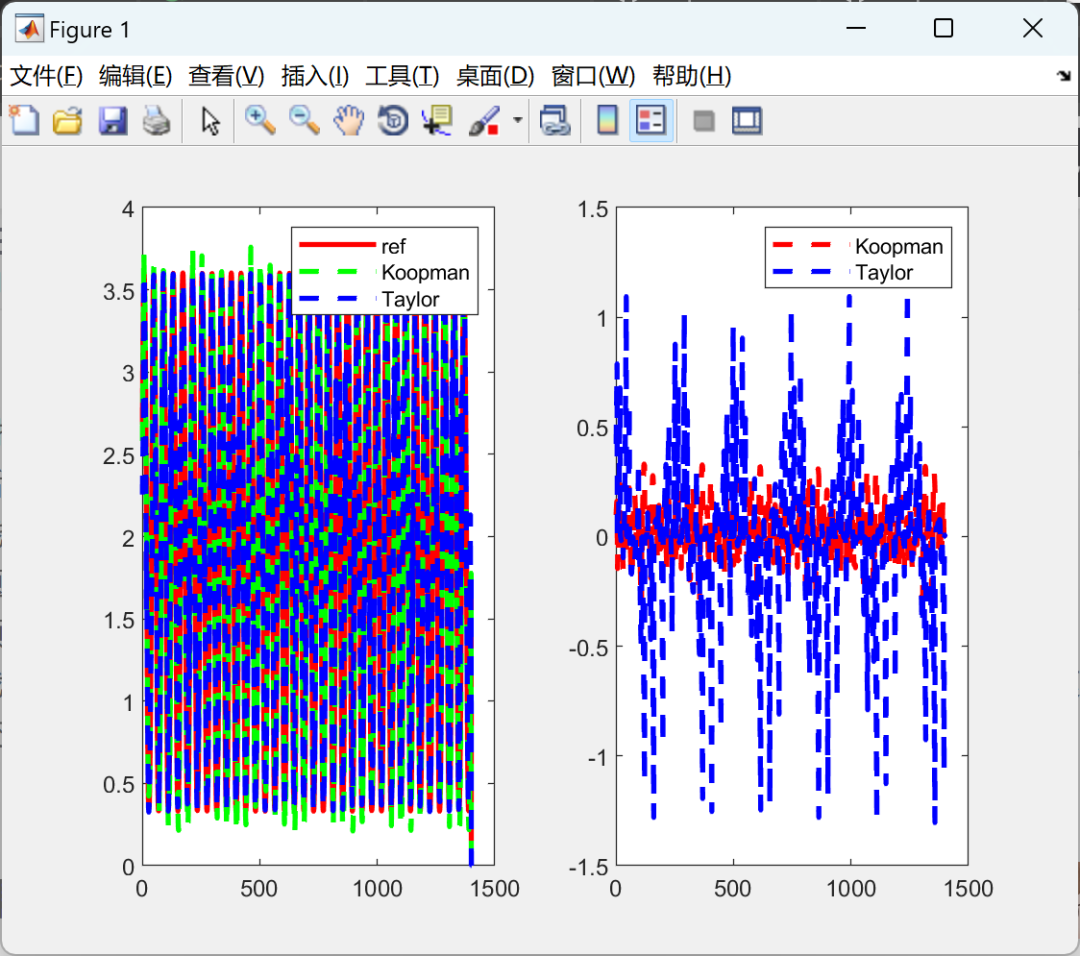
2.4 Predictive control using Taylor series linearization
🎉3 References
🌈4 MATLAB code, data, articles



1 Overview
Source:

Abstract: Recent studies have shown that the nonlinear dynamics of nano-positioning systems (e.g., piezoelectric actuators (PEAs)) can be accurately captured by recurrent neural networks (RNNs). A direct application of this technology is the control of PEA systems for precision positioning: linearizing the nonlinear RNN model and then applying model predictive control (MPC). However, due to the commonly used linearization methods (e.g., Taylor series), the resulting linear system is only guaranteed to be accurate in a small neighborhood around the linearization point, thus limiting control bandwidth and performance. To address this issue, we propose a linearization method based on the Koopman operator, and then use the resulting linear parameter varying model for predictive control. This linearization scheme can significantly reduce the overall approximation error within the MPC prediction horizon, thereby improving tracking performance. We validated the proposed method through two applications—trajectory tracking of PEA and deformation control of polymers during atomic force microscopy nano-indentation.
Due to the frequency and amplitude-dependent nonlinearity of piezoelectric actuators (PEAs), designing real-time controllers with wide bandwidth, high precision, and computational efficiency is challenging [1],[2]. Although iterative learning or repetitive control can achieve high bandwidth and high precision control of PEAs [3],[4], they are not real-time controllers and cannot be used for tracking non-periodic trajectories. The difficulty lies in obtaining a high bandwidth model with small modeling uncertainty. Linear models have been widely used for PEA tracking, such as sliding mode control [5], active disturbance rejection control [6], etc. However, the reported control bandwidth is relatively low, typically less than 100Hz, especially in the high-frequency region, where accuracy is unsatisfactory. Since PEA systems are inherently nonlinear, it is natural to use nonlinear models to capture the system dynamics. Inversion models, such as the Prandtl-Ishlinskii model [7] and hysteresis models for ferromagnetic materials [8], have been used to compensate for nonlinearity. However, the modeling bandwidth remains limited. Recently, neural networks have been proposed for modeling the dynamics of PEA systems [9],[10]. Among them, recurrent neural networks (RNNs) are a method that can simulate the nonlinear dynamics of PEAs with higher accuracy [10], and the control bandwidth of the nonlinear model predictive controller based on it can reach several hundred Hz. However, this nonlinear model predictive controller is computationally expensive and difficult to handle, as it requires solving a nonlinear optimization problem (often non-convex). Therefore, this paper focuses on improving the computational efficiency of controllers based on RNN models. Another option is to avoid the nonlinear optimization problem by linearizing the original nonlinear system. Taylor series are widely used for linearization of nonlinear systems [13]. However, the drawback is that the approximation accuracy is only guaranteed in a small neighborhood around the linearization point. Therefore, as the prediction horizon increases, modeling uncertainty will increase, thus limiting the performance of MPC. Feedback linearization and flatness can also be used for linearization, but they are not effective for general nonlinear systems [14],[15]. Other options include Carleman linearization, “polyflow,” and the Koopman operator method [16]–[18]. Among these methods, only the Koopman method is data-driven [19],[20].
 For detailed articles, see section 4.


2 Results
 2.1 Comparison of the accuracy of linearization using Taylor series and Koopman operator
 2.2 Predictive control using Koopman operator linearization, one linear model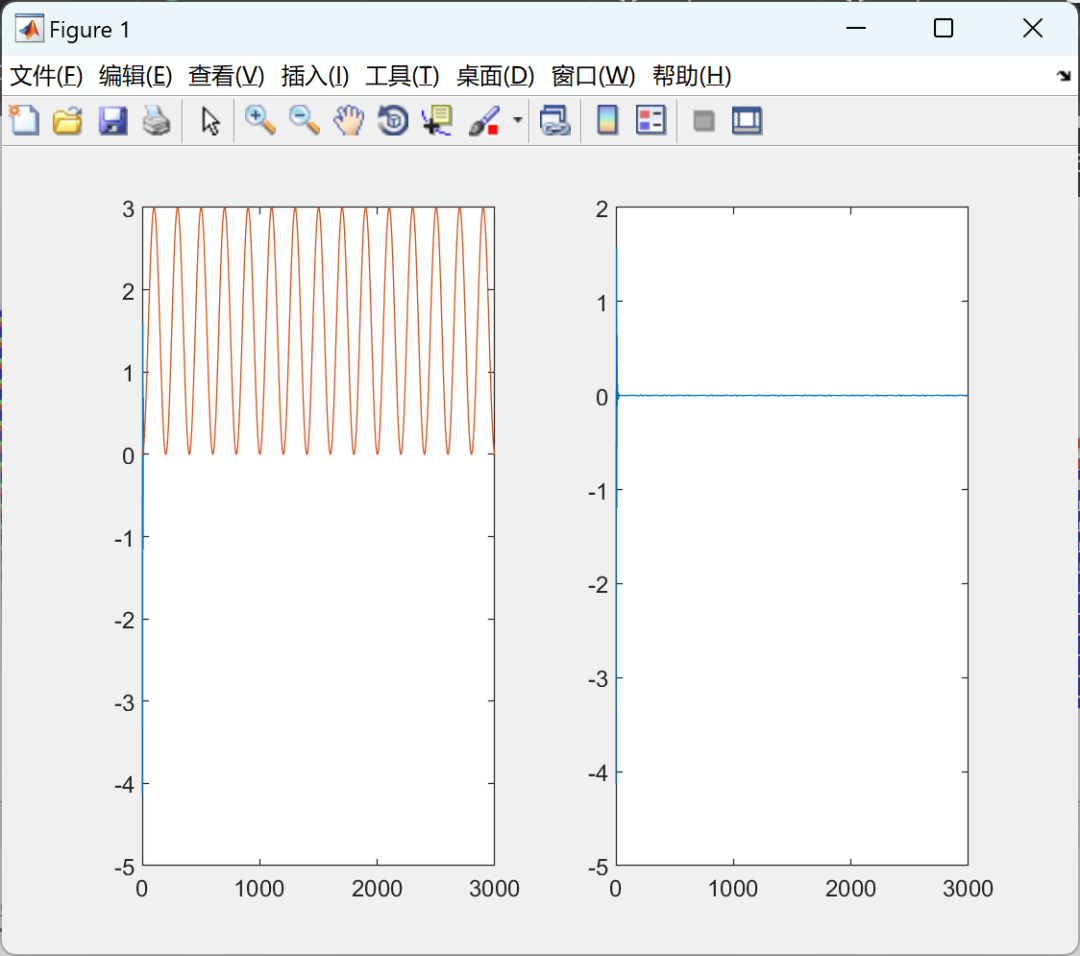
 2.3 Predictive control using Koopman operator linearization, two linear models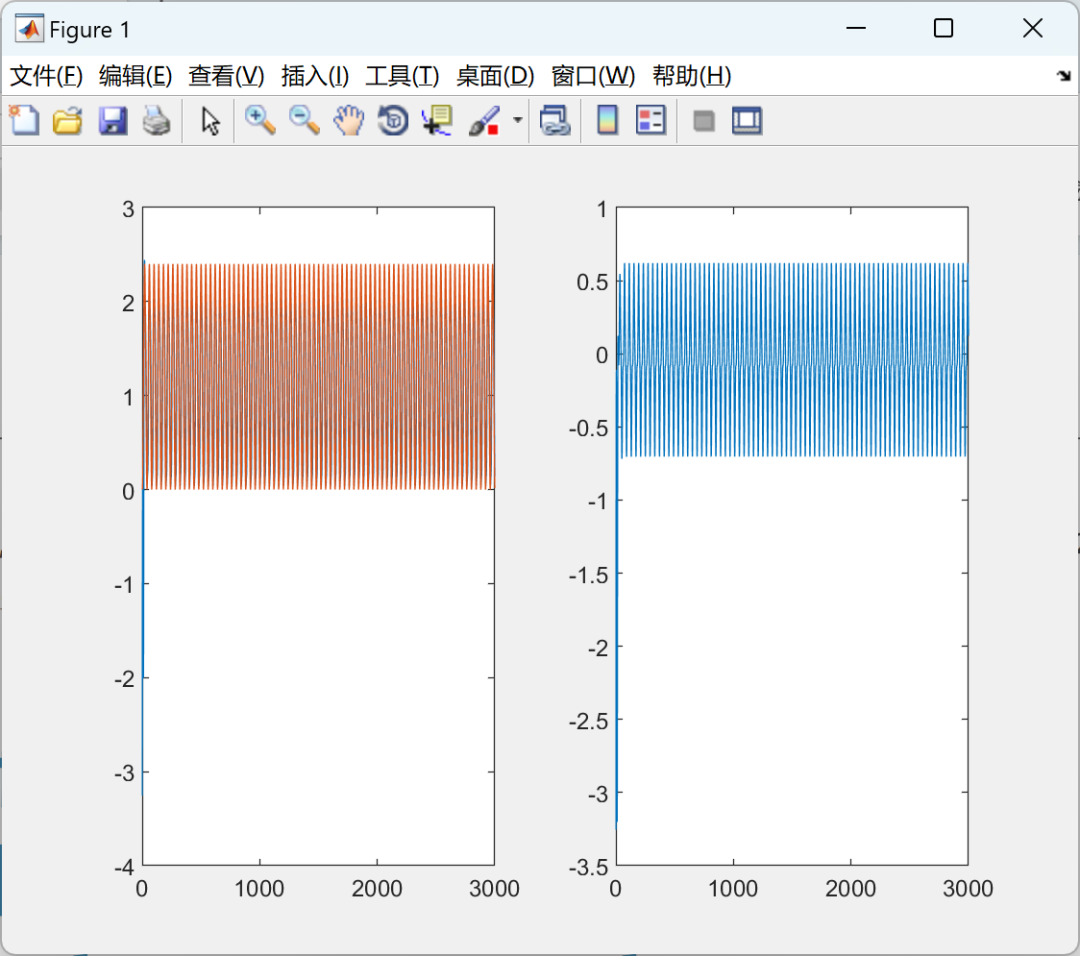
 2.4 Predictive control using Taylor series linearization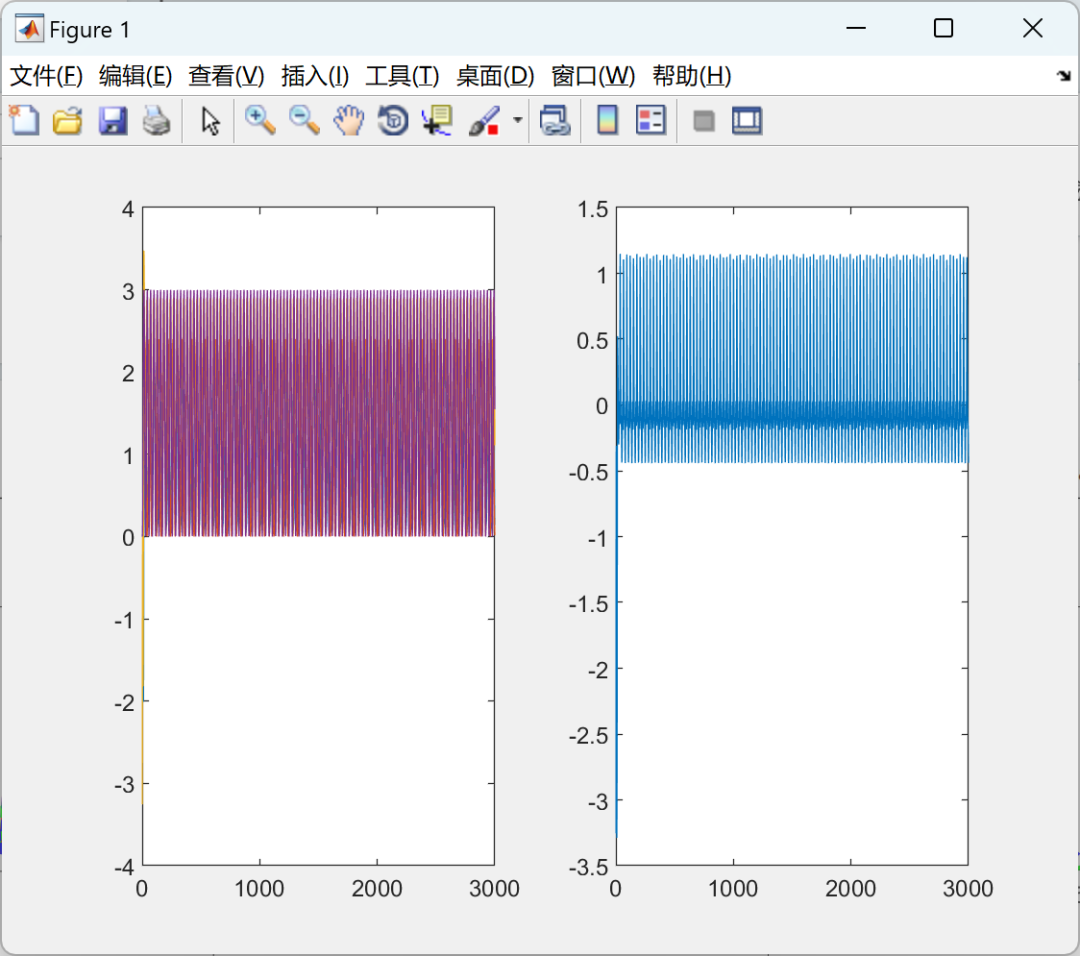
%simN=900;%adda weight matrix We for the tracking errordwe=1-(1:Nh)/Nh+0.1;We=diag(dwe.^2);We=eye(Nh);fork=1:simN%systemdynamicsbetak=bxn(1:Nf);xk=bxn(Nf+1:Nf+Nrnn);etak=bxn(Nf+Nrnn+1:end);%uk(k)=(y1range(2)-y1range(1))/(x1range(2)-x1range(1))*(uk(k)-x1range(1))+y1range(1);tmp=Cbar*betak/scale;bxn=[Abar*betak+Bbar*uk(k);tanh(W1*xk+B2+B1*tmp);Ae*etak+scale*Be*(W2*xk+B3)]+Gall*ek1;yk(k)=Call*bxn+ek1;ek1=measn(k)*0;%stateestimation%SigmapointssqrtPk=chol(Pk,'lower');%cholesky factorizationxi=[xkhat repmat(xkhat,1,Nall)+gamma*sqrtPk repmat(xkhat,1,Nall)-gamma*sqrtPk];%Timeupdateuk_1=uk(k);betaki=xi(1:Nf,:);xki=xi(Nf+1:Nf+Nrnn,:);etaki=xi(Nf+Nrnn+1:end,:);tmp=Cbar*betaki/scale;xikk_1=[Abar*betaki+repmat(Bbar*uk_1,1,2*Nall+1);tanh(W1*xki+repmat(B2,1,2*Nall+1)+B1*tmp);Ae*etaki+scale*Be*(W2*xki+B3)]+repmat(Gall*ek,1,2*Nall+1);xkhat_=sum(xikk_1*WimMat,2);Pk_=Rv;fork1=1:2*Nall+1Pk_=Pk_+WicMat(k1,k1)*( (xikk_1(:,k1)-xkhat_)*(xikk_1(:,k1)-xkhat_)' );endykk_1=Call*xikk_1;%row vectorykhat_=sum(ykhat_1*WimMat);%scalar%Measurementupdate Pykayka=Rn;%yka means yk with ~ abovefork1=1:2*Nall+1Pykayka=Pykayka+WicMat(k1,k1)*( (ykk_1(:,k1)-ykhat_)*(ykk_1(:,k1)-ykhat_)' );endPxkyk=zeros(Nall,1);fork1=1:2*Nall+1Pxkyk=Pxkyk+WicMat(k1,k1)*( (xikk_1(:,k1)-xkhat_)*(ykk_1(:,k1)-ykhat_)' );endKk=Pxkyk/Pykayka;%Pxkyk*inv(Pykayka)---

3References
Some content in this article is sourced from the internet, and references will be noted. If there are any inaccuracies, please feel free to contact us for removal.

[1] Xie, Shengwen, and Juan Ren. “Recurrent-neural-network-based Predictive Control of Piezo Actuators for Trajectory Tracking.” IEEE/ASME Transactions on Mechatronics (2019). [2] Xie, Shengwen, and Juan Ren. “Linearization of Recurrent-neural-network-based models for Predictive Control of Nano-positioning Systems using Data-driven Koopman Operators” IEEE Access (2020). DOI:10.1109/ACCESS.2020.3013935.



4 MATLAB code, data, articles
Lychee Research Society



MATLAB| Using Koopman theory to identify nonlinear systems in robot dynamics
2023-08-08