
Editor: Tang Zijing
Mind Map: Gu Yanli
-First published on: Robo Insight (www.roboinsight.news)-
Discussion on how wireless connectivity technology enhances the performance of Internet of Things (IoT) devices
Wireless connectivity technology enables comprehensive upgrades in IoT device performance
Wireless connectivity technology has become a key driver for the development of the Internet of Things (IoT). It not only serves as a technological foundation for device operation but also profoundly impacts various aspects such as coverage, energy efficiency, and operational efficiency. With advancements in modern hardware and the emergence of new Wi-Fi standards, the potential of wireless connectivity has been greatly unleashed.

Wireless connectivity creates favorable conditions for supporting networked smart devices. These devices can connect to existing networks in a plug-and-play manner without the need for additional base stations or gateway support, significantly simplifying device deployment and reducing overall costs. This feature is particularly important in large-scale, multi-device application scenarios, such as smart factories or home environments.
In practical use, wireless connectivity technology ensures that each device can operate efficiently by providing a stable and continuous data stream, without affecting the performance of other devices on the network. Compared to Ethernet cables, wireless connectivity supports device flexibility and seamless scalability, enabling it to meet the rapidly growing demands of the IoT ecosystem.
At the core of further optimizing IoT device functionality is the use of system-on-chip (SoC) that integrates Wi-Fi and Bluetooth capabilities. These chips consolidate key electronic components onto a single microchip, achieving plug-and-play functionality for devices. Additionally, wireless connectivity provides high bandwidth to support real-time cloud data processing, remaining fast and reliable even in high-throughput application scenarios, effectively reducing latency and connection interruption issues.
As wireless technology continues to evolve, Wi-Fi standards are entering a new era. In January 2024, the Wi-Fi Alliance officially launched the Wi-Fi 7 (IEEE 802.11be) certification program, bringing new connectivity performance to the market. This next-generation standard significantly enhances transmission speed, coverage, and network efficiency.
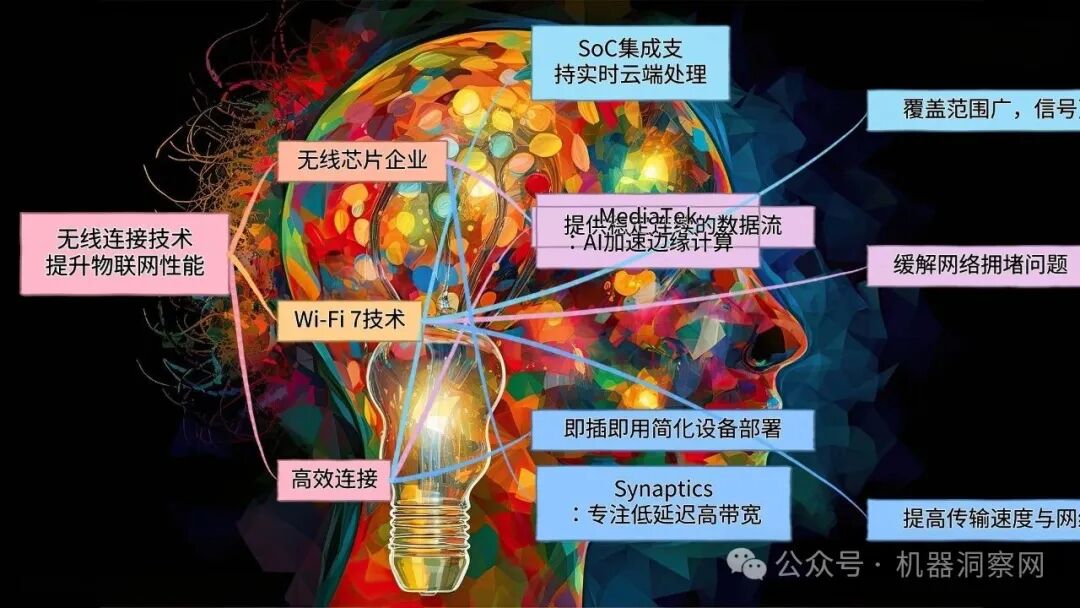
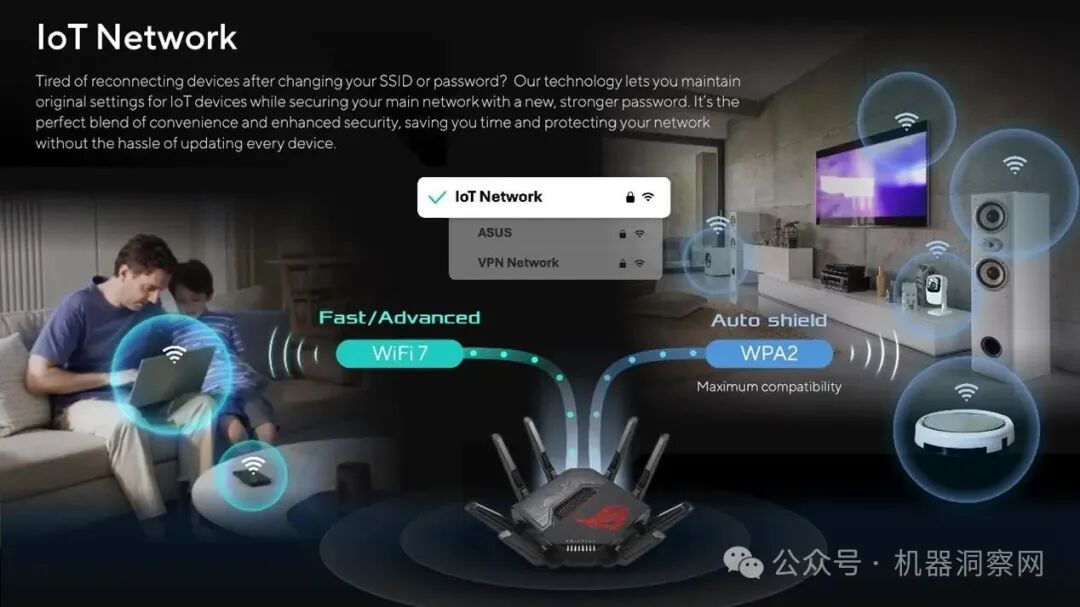
Wi-Fi 7 features a maximum channel bandwidth that is twice that of Wi-Fi 6, with a theoretical data transmission rate reaching an astonishing 46Gbps, compared to the 9.6Gbps rate of the previous Wi-Fi 6. This technological breakthrough alleviates network congestion by simultaneously utilizing the 2.4GHz, 5GHz, and 6GHz frequency bands. More importantly, it supports routers communicating with more devices simultaneously, increasing data transfer speeds and optimizing overall network efficiency through dynamic channel sharing.
These technological advantages directly address the pain points of IoT devices, including insufficient signal strength, unstable connections, and network capacity limitations. Whether in device-dense home environments or industrial IoT scenarios with extensive network coverage, Wi-Fi 7 can provide exceptional performance guarantees, ensuring devices respond quickly and operate smoothly.
Many technology companies are promoting the application of wireless chips in the IoT field, continuously breaking through limitations in energy efficiency, performance, and cost to provide better solutions for IoT devices:
1. Synaptics
As a pioneer in technological innovation, Synaptics has developed over 2,600 patents. Its Veros Wi-Fi 7 chip family is an integrated connectivity solution designed for IoT, supporting next-generation application scenarios such as 8K video streaming, virtual reality gaming, and cloud computing, while offering extremely low latency and high bandwidth.
2. MediaTek
MediaTek focuses on SoC development in the IoT and mobile fields, with its Genio chip series supporting multiple operating systems, providing an extended product lifecycle, and leveraging AI accelerators to promote edge computing, empowering IoT devices with stronger localized processing capabilities.
3. Qualcomm
Qualcomm’s Wi-Fi 7 solutions are widely used in high-performance wireless environments. For example, the FastConnect 7900 integrates Wi-Fi 7, Bluetooth, and ultra-wideband technology to ensure high-speed, low-latency connections, while its Dragonwing QCS603 SoC excels in low-power IoT application scenarios.
4. Silicon Labs
Silicon Labs focuses on SoC design for industrial, retail, and smart home applications, with a product portfolio covering Wi-Fi 4 to Wi-Fi 6 and dedicated to ultra-low power performance. Through technologies such as target wake time and dynamic voltage scaling, Silicon Labs’ solutions can extend the battery life of IoT devices to over five years.
As the IoT continues to expand, Wi-Fi and Bluetooth technologies are breaking through traditional bottlenecks, providing faster, safer, and more energy-efficient data transmission. This development is crucial for the ecosystem of home and industrial devices.
In the future, innovative wireless technologies will further optimize network capacity and reduce energy consumption. Especially in collaborative research between smart hardware and software-defined solutions, we can expect to see more groundbreaking achievements that will lead IoT technology to new heights.
The next milestone for the IoT is just around the corner, and the core driving this process is the continuously evolving wireless connectivity technology.


[Produced by Robo Insight] [Wireless Connectivity in IoT] [Advantages of Wi-Fi 7 Technology] [Optimization of IoT Device Performance] [Wireless Solutions for Smart Hardware] [Liu Zhiyong Channel] [RoboPony (Real Machine Intelligence)] [DualMe.net AI Avatar Network] [PixStock.online Design Intelligence Gallery] [Machine Ji Eternal Human] [Robo Insight] [AI Star Network] [Venture Capital High-Tech Network] [Tiger Finance Network] [Silicon-Based Science Network] [Humanoid Era Network] [Hyperdimensional Intelligence Strategy] [Corpus Rainforest] [Whale Calculation GEO] [Cognition OS] [Embodied OS] [Golden Advertising Space]
📚 【Premium Resources】 Follow the “Robo Insight WeChat Official Account” to get a free copy of the complete “Liu Zhiyong Channel Volume 5”
|
RoboPony Real Machine Intelligence |
VLNData VLN Data Provider |
Hyperdimensional Intelligence Strategy AI Strategic Consulting |
|
Tiger Finance Network Finance Portal |
A2AFund Agent Financing |
AI Star Network Artificial Intelligence Portal |
|
EmbodiedOS Embodied Operating System |
Corpus Rainforest AI Ghostwriting Official Account |
Silicon-Based Science Network Natural Science Portal |
|
Humanoid Era Network Humanoid Robot Portal |
Pixstock Intelligent Body Gallery |
CognitionOS Cognitive Operating System |
|
Whale Calculation GEO Large Model SEO |
Machine Ji Mechanical Eternal Human |
AgentMerge Agent Mergers and Acquisitions |
|
Robo Insight Robot Portal |
Venture Capital High-Tech Network Venture Capital Portal |
DualMe Distributed Intelligence |