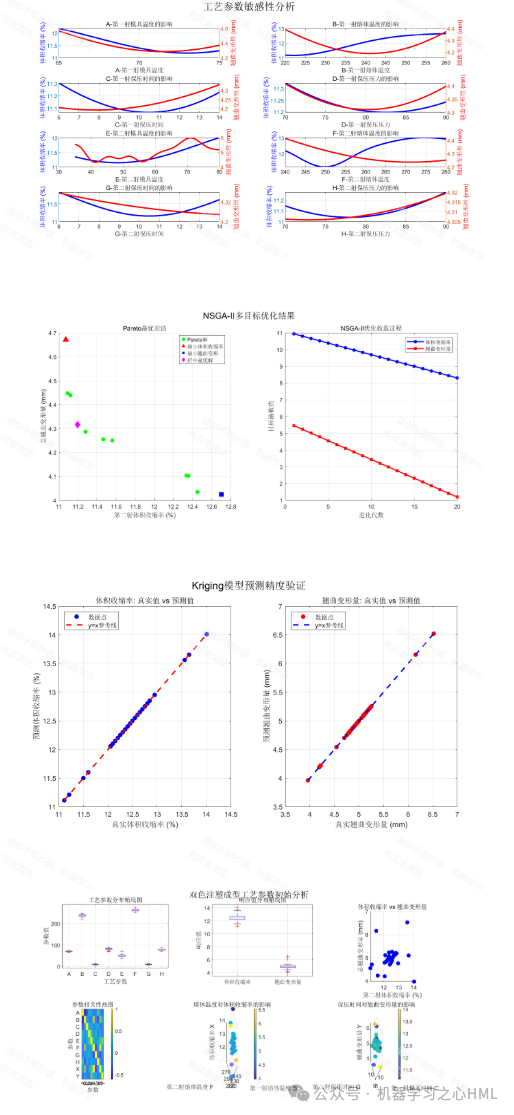
Multi-Objective Optimization of Two-Color Injection Molding Process Parameters Based on Kriging Surrogate Model and NSGA-II
1. Background and Core Challenges
Two-color injection molding is an advanced plastic molding technology that produces complex, aesthetically pleasing, and functionally integrated products that are difficult to achieve with a single material through two injection molding processes. However, the process is extremely complex, and quality is influenced by the interaction of numerous process parameters.
Core Challenges:
- Conflicting Quality Metrics: Common quality objectives, such as warpage, shrinkage rate, and weld line strength, often contradict each other. For example, parameter settings that reduce warpage may worsen weld lines.
- Numerous Process Parameters: There are dozens of parameters involved, including melt temperatures for the first and second injections, mold temperature, injection speed, holding pressure/time, and switching delay time.
- High Simulation Costs: Using CAE software for a complete simulation of the two-color injection molding process typically takes hours or even days, making optimization iterations based directly on simulations impractical in engineering.
Therefore, using a Kriging surrogate model to approximate time-consuming CAE simulations, combined with NSGA-II for efficient multi-objective optimization, has become an attractive solution.
2. Overall Optimization Process
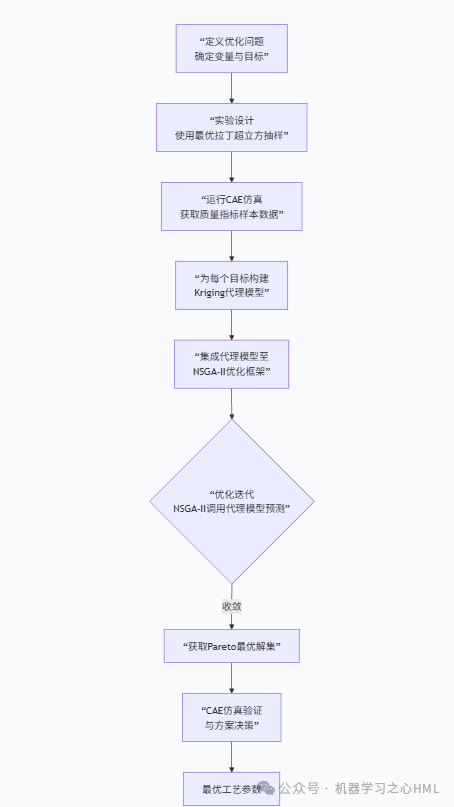
The entire process follows the paradigm of Design of Experiments → Build Surrogate Model → Optimization Solution → Verification, as shown in the figure below:
3. Key Technologies Explained
3.1 Kriging Surrogate Model
Objective: To establish an accurate and quickly computable mathematical model to replace the time-consuming two-color injection molding CAE simulation.
Why Choose Kriging? Compared to polynomial response surfaces, Kriging is particularly suitable for highly nonlinear and stochastic systems, providing predicted values and prediction errors.
Model Composition: The Kriging model views the response value as a combination of a global model and a local deviation, where the global trend model is typically a constant or polynomial, and the random process has a mean of 0, variance of (\sigma^2), and a covariance function that describes the spatial correlation between points.
Construction Process:
- Sample data obtained from the design of experiments.
- Fit the parameters of the Kriging model using algorithms such as maximum likelihood estimation.
- For a new design point, Kriging not only provides predicted values, which allows for subsequent adaptive sampling.
In this study, we need to build an independent Kriging model for each optimization objective (e.g., warpage, shrinkage rate).
3.2 NSGA-II Multi-Objective Genetic Algorithm
NSGA-II is the core engine for solving such problems, directly handling multiple objectives without the need to aggregate them into a single objective.
Role in Optimization:
- Initialization: Randomly generate an initial population within the design space of process parameters.
- Evaluation: For each individual in the population (i.e., a specific combination of process parameters), do not call CAE simulation, but instead use the previously constructed Kriging model to quickly predict its various quality metrics (warpage, shrinkage rate, etc.).
- Non-Dominated Sorting: Based on the predictions from the Kriging model, classify the entire population into different Pareto ranks. Individuals in Rank 1 are solutions that are not dominated by any other individuals, forming the current optimal front.
- Crowding Distance Calculation: Within the same Pareto rank, calculate the “crowding distance” for each solution to measure the distribution density of solutions. Solutions with larger crowding distances are prioritized to ensure diversity in the population.
- Selection, Crossover, Mutation: Generate a new offspring population through mechanisms such as tournament selection, combined with simulated binary crossover and polynomial mutation.
- Loop: Merge the parent and offspring populations, repeat non-dominated sorting and crowding distance comparison to select the new generation. This process iterates until termination conditions (e.g., maximum generations) are met.
Advantages: NSGA-II effectively guides the search direction, ultimately finding a set of Pareto optimal process parameter sets that achieve the best balance among multiple objectives.
4. Establishing the Optimization Mathematical Model
Design Variables (Example)Objective FunctionsConstraints
Optimization Problem
5. Result Analysis and Engineering Decision Making
- 3D Pareto Front Visualization: Plot the Pareto optimal solution set in the three-dimensional space of warpage-shrinkage rate-weld line. This surface clearly reveals the trade-off relationships among the three objectives.
- Multi-Criteria Decision Making:
- Inflection Point Method: Identify “inflection points” or “knee points” in the three-dimensional space, where any improvement in one objective leads to significant deterioration in other objectives.
- Ideal Point Method: Set an ideal quality objective vector ((f_1^*, f_2^*, f_3^*)) and select the solution from the Pareto set that is closest to this ideal point (e.g., Euclidean distance).
- Expert Preference: Assign different weights to various quality metrics based on the specific application of the product. For example, products with high aesthetic requirements place more emphasis on weld lines and warpage.
6. Advanced Extension: Adaptive Optimization
To further improve accuracy and efficiency, “Kriging-based Adaptive Optimization” can be employed:
- Initially use a small number of DOE samples to construct a preliminary Kriging model.
- During the NSGA-II optimization process, intelligently select points that are likely to be near the Pareto front and have high uncertainty, using the prediction error information provided by Kriging.
- Perform additional CAE simulations on these “promising” points, then add the new samples to the database and update the Kriging model.
- Iterate this process, making the model increasingly accurate in critical areas, thus achieving high-quality optimization results with fewer overall simulations.
7. Conclusion
This solution, combining Kriging + NSGA-II, provides a systematic approach for optimizing the complex process of two-color injection molding:
- Kriging model serves as a “surrogate simulator”, perfectly addressing the computational cost bottleneck, enabling rapid and repeated optimization.
- NSGA-II algorithm acts as an “intelligent explorer”, efficiently searching for optimal balanced solutions in a multi-dimensional parameter space.
Code Access (non-public, please do not misuse)