1. High Reliability and Strong Anti-Interference Capability
In electrical control equipment, reliability is always a key performance indicator. PLCs ensure strong anti-interference capabilities by adopting advanced large-scale integrated circuit technology and strictly controlling the manufacturing process to ensure robust internal circuits. Compared to traditional relay contactor systems, PLCs can significantly reduce the number of electrical connections and switch contacts, thereby greatly lowering the failure rate. PLCs also have built-in hardware self-diagnostic functions; in the event of a fault, the system will immediately issue an alarm. Additionally, users can incorporate fault diagnosis programs for external devices into the application software, enhancing the overall reliability of the PLC system and ensuring stable operation.
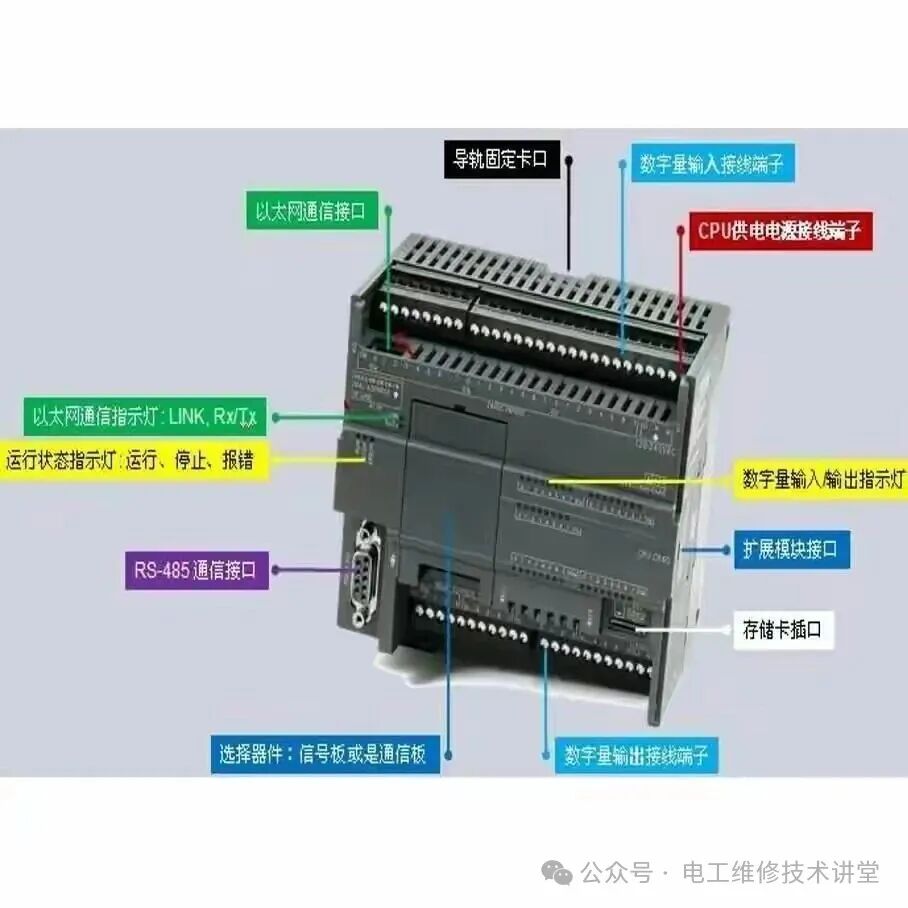
2. Comprehensive Functionality and Wide Applicability
PLCs have developed into various series of products to meet diverse industrial control needs. In addition to basic logic processing functions, most PLCs also possess powerful data processing capabilities, making them widely applicable in digital control, position control, temperature control, and other fields. With the enhancement of PLC communication capabilities and advancements in human-machine interface technology, the application of PLCs has become more flexible and convenient, covering almost all industrial control scenarios.
3. Easy to Learn and Favored by Engineering Technicians
PLCs are designed for automation control in industrial enterprises, featuring simple interfaces and easy-to-understand programming languages, especially ladder diagram language, which resembles traditional relay circuit diagrams. This similarity allows many engineering technicians who are not familiar with electronic circuits or computer principles to easily get started, thus opening the door to industrial automation control.
4. Simple System Design, Low Workload, Easy Maintenance and Modification
PLCs replace traditional wiring logic with stored logic, significantly reducing wiring work. This not only shortens the system design and construction cycle but also makes daily maintenance and management easier. More importantly, PLC systems can adjust production processes by modifying programs, which is particularly suitable for small-batch, multi-variety production, allowing for flexible responses to changing production demands.
Considerations for PLC Applications
Although PLCs have high reliability and anti-interference capabilities, in some special or harsh production environments, if electromagnetic interference is too strong or if installation and usage are improper, program errors or calculation deviations may still occur, leading to equipment loss of control or even malfunctions. Therefore, to ensure the normal operation of PLC systems, appropriate measures must be taken during design, installation, and usage to enhance their anti-interference capabilities. Here are several key issues to pay special attention to when using PLCs:
1. Working Environment
Temperature
The operating temperature of the PLC should be maintained between 0 and 55°C. During installation, it should be avoided to place it under high-temperature components, and sufficient space should be ensured for ventilation and heat dissipation.
Humidity
To maintain the insulation performance of the PLC, the relative humidity of the environment should be below 85%, and condensation should not occur.
Vibration
PLCs should be kept away from strong vibration sources and should avoid prolonged exposure to frequent vibrations in the range of 10 to 55 Hz. If unavoidable vibration sources exist in the working environment, damping measures should be taken, such as using shock-absorbing pads.
Air Quality
Corrosive gases (such as hydrogen chloride, hydrogen sulfide, etc.) and flammable gases should be avoided in the PLC working environment. If the air contains a lot of dust or corrosive gases, it is best to place the PLC in a closed control room or control cabinet.
Power Supply
PLCs have a certain resistance to power supply interference, but in environments with strong power supply interference or high reliability requirements, it is recommended to use an isolated transformer with a shielding layer to reduce interference. PLCs generally provide a 24V DC power supply for input terminals; if using an external power supply, a DC stabilized power supply should be selected to prevent malfunctions caused by power fluctuations.
2. Interference in Control Systems and Its Sources
Electromagnetic interference is one of the main factors affecting the reliability of PLC control systems. To effectively avoid or mitigate this interference, it is essential to first identify the sources of interference and take appropriate countermeasures.
Sources of Interference and Classification
Most interference in PLC control systems originates from areas with significant current or voltage fluctuations. Current changes generate magnetic fields, which in turn produce electromagnetic waves. Depending on the interference mode, electromagnetic interference can be classified into common-mode interference and differential-mode interference. Common-mode interference is caused by potential differences between the signal and ground, usually due to factors such as the power grid, potential differences, or spatial electromagnetic radiation. Differential-mode interference, on the other hand, acts on the voltage across the signal terminals and is mainly caused by common-mode interference transformed by spatial electromagnetic fields or unbalanced circuits. Both types directly affect the measurement and control accuracy of PLCs.
Main Sources of Interference
Strong Electrical Interference
The power supply for PLCs is usually provided by the power grid, which is susceptible to various electromagnetic interferences, especially transient impacts from device switching, harmonic interference, and power grid short circuits, which can be transmitted to the PLC system through power lines.
Control Cabinet Interference
High-voltage electrical appliances and large inductive loads in control cabinets, especially in cases of improper wiring, can easily cause electromagnetic interference to PLCs. To mitigate such issues, proper wiring and installation of shielding devices are crucial.
In summary, the high reliability and strong anti-interference capabilities of PLCs play a vital role in industrial control. However, in complex working environments, it is essential to enhance attention to environmental factors, sources of interference, and system design to ensure the long-term stable operation of PLCs.