Many people find Siemens programming difficult, but a small example of “button controlling a light” can thoroughly explain the logic of the three core languages: Ladder Diagram (LAD), Function Block Diagram (FBD), and Structured Control Language (SCL).
1. Ladder Diagram: “Diagrammatic Programming” that Electrical Engineers Understand
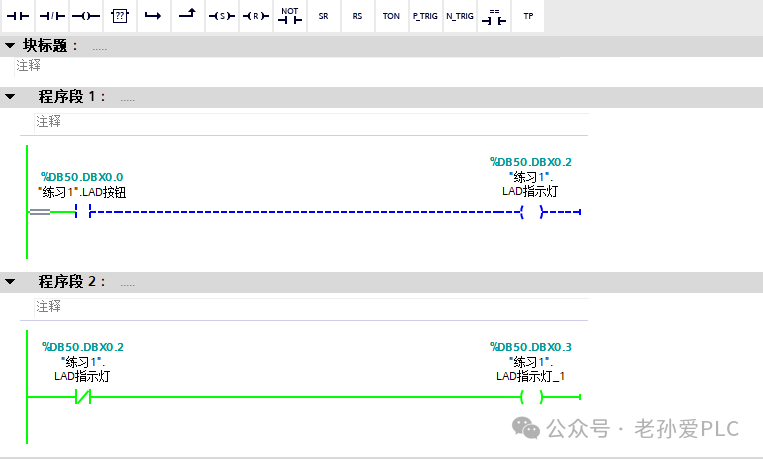
Looking at the first Ladder Diagram program, Exercise 1.LAD button is the input contact, and Exercise 1.LAD light is the output coil. When the button is pressed, the contact closes, the coil is energized, and the light turns on.
This programming method, similar to “drawing a circuit diagram,” corresponds directly to the wiring logic in the electrical cabinet. Beginners do not need to memorize complex syntax; they can write control logic by dragging and dropping contacts and coils, making it easy to get started in just five minutes.
2. Function Block Diagram (FBD): Building Logic Like Stacking Blocks
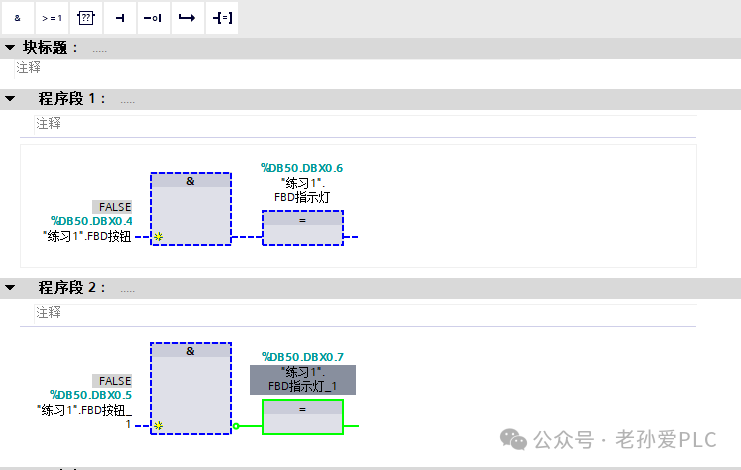
In the second Function Block program, “&” is the “AND” function block. The signal from Exercise 1.FBD button enters the module and directly outputs to Exercise 1.FBD light when the conditions are met.
By breaking down “judgment” and “output” into individual functional modules, complex projects can directly call existing modules without rewriting logic, making it suitable for batch processing and standardized projects.
3. SCL Language: Unlocking More Flexibility with Code
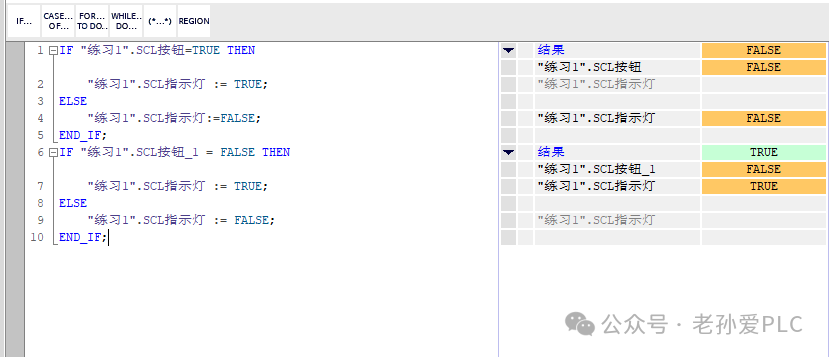
In the third SCL program, IF “Exercise 1”.SCL button=TRUE THEN is the judgment statement. When the button is pressed, it sets “Exercise 1”.SCL light to TRUE (on); when the button is released, the light is set to FALSE (off).
This “code-style programming” is similar to writing Python, allowing for easy implementation of complex logic such as batch assignments and loop judgments, which is an essential skill for advancing to “mastery”.
In Conclusion:
Starting from a small example of “button controlling a light,” first master the Ladder Diagram to build a solid foundation, then use Function Blocks to improve project efficiency, and finally use SCL to break through the bottleneck of complex control. This is how Siemens programming progresses from beginner to being able to independently handle projects.
Actually, I am also just learning these three languages. At first, I was afraid of mixing them up, but later I found that practicing around the same simple example reveals that the logic essence of each language is the same. The more I practice, the more proficient I become—programming really doesn’t need to be rushed. Once you master the small examples, the complex ones will naturally follow!
Learn technology solidly, improve a little every day! Do my best to help more people!