Source:Tom Talks Semiconductor Manufacturing
Original Author: Tom
This article introduces what silicon epitaxy furnaces, wet cleaning machines, and oxidation furnaces are.
What Are the Uses of Silicon Epitaxy Furnaces, Wet Cleaning Machines, and Oxidation Furnaces?
The silicon epitaxy furnace is used to grow a layer of high-quality single-crystal silicon epitaxial layer on the surface of single-crystal silicon wafers, known as silicon epitaxial wafers. Silicon epitaxial wafers have characteristics such as high voltage resistance and low on-resistance, and are mainly used in the fabrication of power devices like MOSFETs, IGBTs, transistors, and analog chips such as CMOS image sensors (CIS) and power management chips (PMIC).
The wet cleaning machine is used to remove impurities, particles, and organic matter from the surface of wafers, ensuring that the silicon wafer surface is clean. It is commonly used after processes such as photolithography, etching, CMP, and ion implantation. Almost all chips require cleaning during manufacturing, which can be categorized into plasma cleaning (dry cleaning) and wet cleaning (liquid-based cleaning).
The oxidation furnace is used to grow a dense silicon dioxide (SiO₂) film on the surface of silicon wafers, typically used for tunneling gates, gate oxides, local oxidation of silicon (LOCOS) pads, masking oxides, and field oxides.
What Are the Principles of Silicon Epitaxy Furnaces, Wet Cleaning Machines, and Oxidation Furnaces?
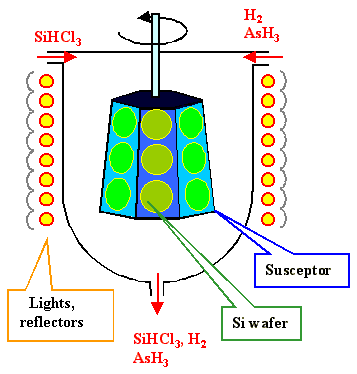
As shown in the figure above, one type of silicon epitaxy furnace uses lamps or resistors to provide the required high temperature. SiHCl₃, arsine (AsH₃), and carrier gas hydrogen (H₂) are injected into the furnace. The gases decompose at high temperatures, and silicon forms a single-crystal silicon layer on the wafer surface, which is the silicon epitaxial layer. Dopants such as arsenic are incorporated into the lattice to modify conductivity.
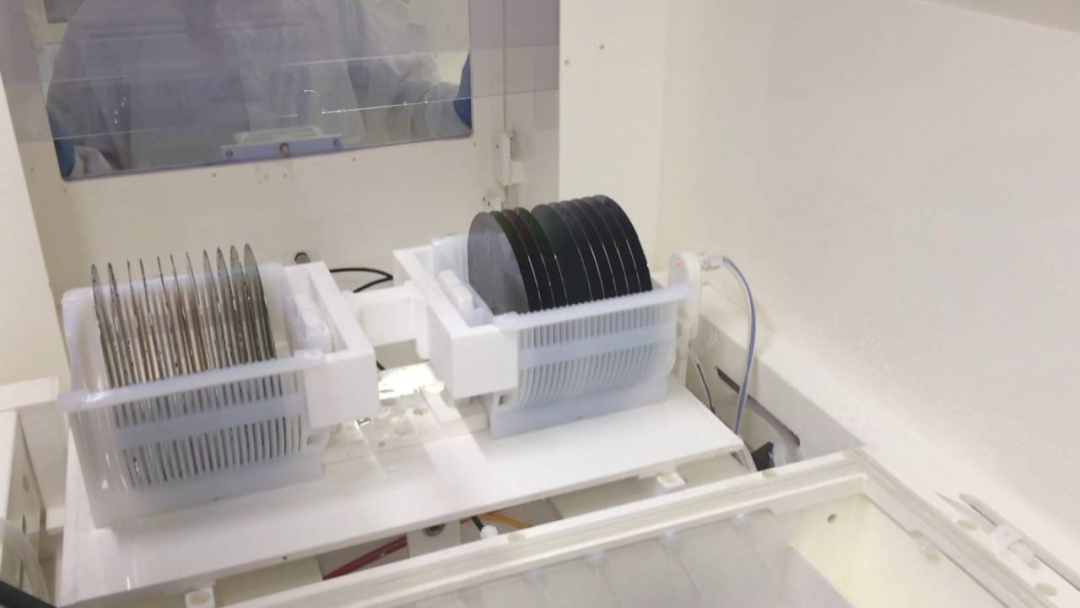
As shown in the figure above, the wet bench type of wet cleaning equipment is used in semiconductor manufacturing processes for cleaning and etching. Wafers are placed into a tank containing chemical solutions, and surface contaminants are removed through chemical reactions. After cleaning, the wafers are rinsed with deionized water and dried to achieve the purpose of wet cleaning.
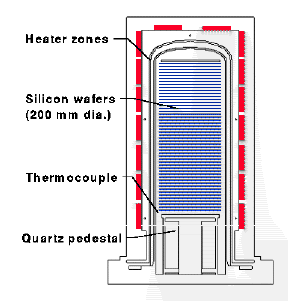
As shown in the figure above, a vertical oxidation furnace is used. There are several oxidation methods, such as dry oxygen, wet oxygen, and TEOS oxidation. Here, dry oxygen oxidation is taken as an example. The oxidation temperature in the furnace ranges from 800°C to 1200°C. Oxygen (O₂) is introduced into the oxidation furnace, and the silicon wafer is placed on a quartz pedestal. The high-temperature environment in the furnace promotes a chemical reaction between oxygen and silicon (Si) on the wafer surface, generating a SiO₂ film.
What Are the Representative Companies in China and Abroad for Silicon Epitaxy Furnaces, Wet Cleaning Machines, and Oxidation Furnaces?
Abroad: CVD Equipment Company (USA), GT Company (USA), Soitec (France), AS Company (France), Applied Materials (USA).
Domestic: China Electronics Technology Group Corporation No. 48, Hefei Kejing Materials Technology Co., Ltd.
Abroad: LAM, TEL, AMAT, SCREEN, etc.
Domestic: North China Huachuang, etc.
Reprinted content only represents the author’s views
Does not represent the position of the Institute of Semiconductors, Chinese Academy of Sciences
1. The Semiconductor Institute has made progress in the research of bionic covering neuron models and learning methods
2. The Semiconductor Institute has made significant progress in inverted structure perovskite solar cells
3. Why is copper used as interconnect metal in chips?
4. What exactly is 7nm in chips?
5. Silicon-based integrated photonic quantum chip technology
6. How anomalous is the quantum anomalous Hall effect? It may lead to the next revolution in information technology!