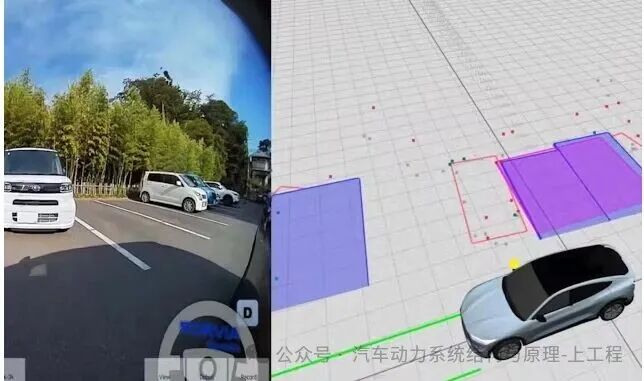
French automotive parts company Forbia has announced the development of a new automatic parking technology that does not require ultrasonic sensors, relying solely on cameras and millimeter-wave radar. This technology aims to reduce costs while improving performance in adverse weather conditions, thereby accelerating the widespread adoption of automatic parking features. Forbia added that it is developing this technology for the Japanese market and plans to begin mass production after 2029.
Existing automatic parking systems combine multiple cameras with about ten ultrasonic sensors to detect objects. Forbia has replaced these ultrasonic sensors with four millimeter-wave radars used in advanced driver-assistance systems (ADAS).
This technological shift, with the elimination of ultrasonic sensors, reduces the number of connectors and wiring harnesses, potentially saving about $80 to $110 per vehicle. Ultrasonic sensors are vulnerable to dirt, rain, fog, and other conditions, while millimeter-wave radar, which uses electromagnetic waves, can maintain stable performance in adverse weather environments. The removal of ultrasonic sensors, which are typically mounted on the vehicle’s exterior, results in a cleaner and more streamlined car design.
However, while millimeter-wave radar has strong long-range detection capabilities, it has limitations in short-range detection accuracy. Forbia plans to enhance the short-range detection accuracy of millimeter-wave radar to match that of ultrasonic sensors in the future.
Forbia stated that, in addition to Japan, it is also developing AI-based automatic parking technology tailored to the high demands of the Chinese market. This technology will also address complex environments such as parallel parking and multi-story parking lots, featuring remote parking capabilities operated via smartphones.
The Chinese market demands high standards, requiring parking to be completed within 40 seconds with at most one or two turns. Forbia plans to eliminate ultrasonic sensors in its AI parking technology for the Chinese market, relying solely on cameras and millimeter-wave radar.