Great discounts are here! The Armament Technology Magazine offers a 10% discount for two copies, 20% for four copies, and 30% for five copies. Welcome to order!
With the development of unmanned combat systems, carrier-based unmanned aerial vehicles (UAVs) that can operate on surface vessels have become a cutting-edge focus in UAV development. Compared to land-based UAVs, carrier-based environments have unique characteristics: the space on board is relatively limited, imposing strict restrictions on the operation and takeoff/landing of aircraft. UAV helicopters that require low takeoff and landing space and occupy a small area perfectly meet this requirement; however, unmanned helicopters also have significant drawbacks, including slow flight speed, short loiter time, and limited operational radius, which are clearly insufficient for carrier-based platforms that require a larger operational radius. So, how can this dilemma be resolved? Relevant companies have developed a fixed-wing UAV named “Zhuque,” which can achieve vertical takeoff and landing through a seated takeoff method and can transition to normal horizontal flight of a fixed-wing aircraft, effectively resolving the conflict between flight performance and takeoff/landing space in carrier-based UAVs.
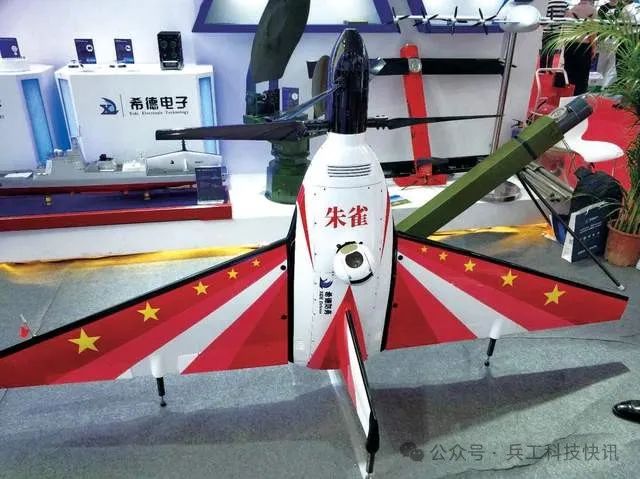
“Zhuque” Vertical Takeoff and Landing Fixed-Wing UAV
Seated Takeoff Design
The seated takeoff design adopted by the “Zhuque” new type of carrier-based UAV is a vertical takeoff and landing technology for carrier-based aircraft that was quite popular in the 1950s. Although it did not achieve large-scale application at the time as a technical exploration and attempt, it provided a feasible idea for future generations. The seated design of the “Zhuque” UAV is very simple: it involves turning a fixed-wing aircraft 90° from a horizontal position, with its nose pointing upwards and tail downwards, making the wings and fuselage perpendicular to the ground. The landing gear wheels of the seated aircraft are moved from the belly of the fuselage and below the wings to the trailing edge of the wings. In this way, the seated aircraft takes off with its nose vertically leaving the ground or deck, and once it reaches a certain height, the nose is turned 90° to transition to the normal horizontal flight state of a fixed-wing aircraft. When the aircraft needs to land, it switches back to the vertical position to achieve landing. The advantage of the seated takeoff design lies in the organic combination of the vertical takeoff and landing method of helicopters with the superior flight performance of fixed-wing aircraft.
It is reported that the “Zhuque” UAV is suitable for carrier-based environments, adopts a fixed-wing mode for cruising, has vertical takeoff and landing capabilities, long endurance (over 10 hours), and a large range (flight distances from hundreds to thousands of kilometers). It employs automated landing technology, allowing for automatic vertical takeoff and landing within the limited space of a destroyer/frigate’s deck; its landing gear also uses adaptive technology to reduce impact during landing and effectively maintain the aircraft’s vertical posture to prevent it from tipping over.
Notably, the rear of the “Zhuque” UAV is equipped with two small vertical stabilizers that are perpendicular to the main wings. The tail stabilizers ensure the aircraft’s directional stability during level flight, and two landing gear are also positioned at the trailing edge of the tail stabilizers, forming a “cross” structure with the two landing gear wheels on the main wings to ensure the stability of the aircraft’s posture during vertical landing.
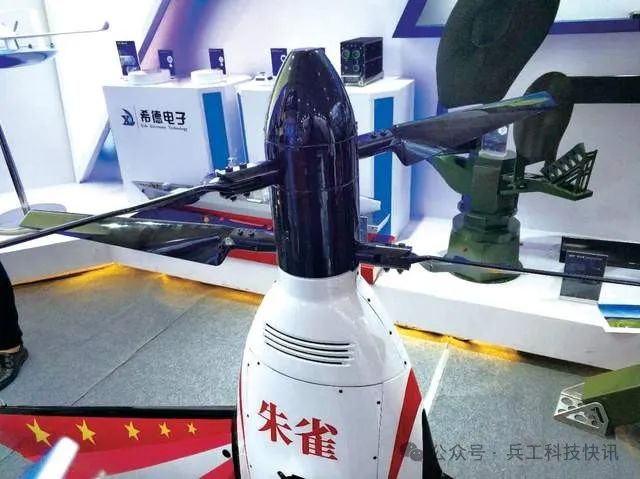
Close-up of the Coaxial Dual-Rotor Propulsion System of the “Zhuque” UAV
Coaxial Dual-Rotor Layout for Large UAV Design
The “Zhuque” UAV features an interesting design characteristic: its front is equipped with a pull propeller that provides power to the aircraft, abandoning the conventional single propeller design in favor of a “coaxial dual-rotor” design similar to the Russian Kamov Design Bureau’s “Snail” series of carrier-based helicopters. Why is this the case? After all, domestic Chengdu Aircraft Design Institute and Xi’an Aisheng Technology Group (Northwestern Polytechnical University UAV Research Institute) also have similar seated carrier-based UAV products, but they all use conventional single propeller designs.
It is reported that adopting a coaxial dual-rotor layout is precisely the characteristic and competitive advantage of this UAV. This design aims to achieve a larger UAV size. Technical research has found that a single propeller is ideal for small seated UAVs weighing tens of kilograms, but if the UAV’s weight increases, the pull force from a single propeller becomes problematic. In contrast, coaxial dual-rotor propellers provide much greater pull force. The positioning of the “Zhuque” by Hede Company is to pursue a path of series development; currently, they are researching and testing a product in the 50-kilogram class, with plans to develop a large vertical takeoff and landing UAV with a maximum takeoff weight of 2 tons in the future, making the coaxial dual-rotor layout a suitable design.
“Zhuque” UAV: Versatile and Multi-Purpose
Versatile and Multi-Purpose
The other aspect of the “Zhuque” UAV shows that, in addition to the vertical spherical electro-optical reconnaissance turret set beneath the belly, two pylons are installed near the wingtips on the outer sides of the wings. This is because the “Zhuque” UAV is positioned as a “multi-role” carrier-based UAV, carried by surface vessels, and possesses intelligence, surveillance, reconnaissance, and strike capabilities. It can loiter in the airspace near the fleet, providing continuous ISR (Intelligence, Surveillance, and Reconnaissance) services, and can also carry small airborne weapons to strike missile fast attack craft and other small maneuverable targets, enhancing the fleet’s attack effectiveness.
Small missile fast attack craft carrying anti-ship missiles have historically posed a classic form of “asymmetric” warfare by launching surprise attacks on large surface ship formations from a distance. However, with the presence of a multi-role carrier-based UAV like the “Zhuque,” it becomes significantly more challenging for missile fast attack craft to ambush and surprise surface ship formations. It is undoubtedly a powerful tool against missile fast attack craft.
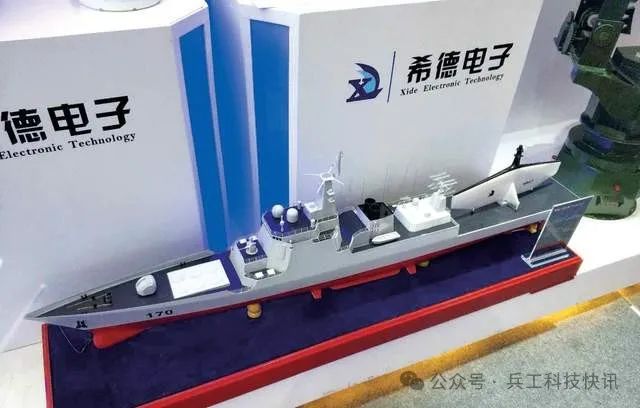
Model of the 170th Domestic “Zhonghua Shendun” Destroyer with the “Zhuque” UAV
Conclusion
Currently, the “Zhuque” carrier-based UAV has begun testing on military vessels. The model of the warship is used to showcase the application prospects and capabilities of the “Zhuque”—it can utilize the helicopter deck of destroyers for takeoff and landing. The “Zhuque” UAV is currently in the testing and subsequent development stage, with prototypes having undergone preliminary land takeoff and landing tests. Once it is developed and finalized, it is sure to have promising application prospects. Represented by it, domestic high-performance, new-concept carrier-based UAVs are flourishing, gradually becoming a “new type of combat capability” and injecting more new technologies and vitality into building a powerful navy, adding new strength.

Interested readers, hurry up and click the link below to purchase! Limited print quantity, while supplies last!
Purchase link:
2024 Issue 16 of “Foreign Media Reports on the New Developments of the J-20” Armament Technology Magazine302024 Issue 15 of “Analysis of Japan’s 2024 Defense White Paper”Armament Technology Magazine30“Armament Technology” 2024 Semi-annual Package (Issues 13-24)Armament Technology Magazine360
Welcome to follow the public account below:↓↓↓
Important Note: Due to WeChat’s redesign, it is recommended to star and like to mark you as a long-read user, otherwise you may not receive the next article.
End