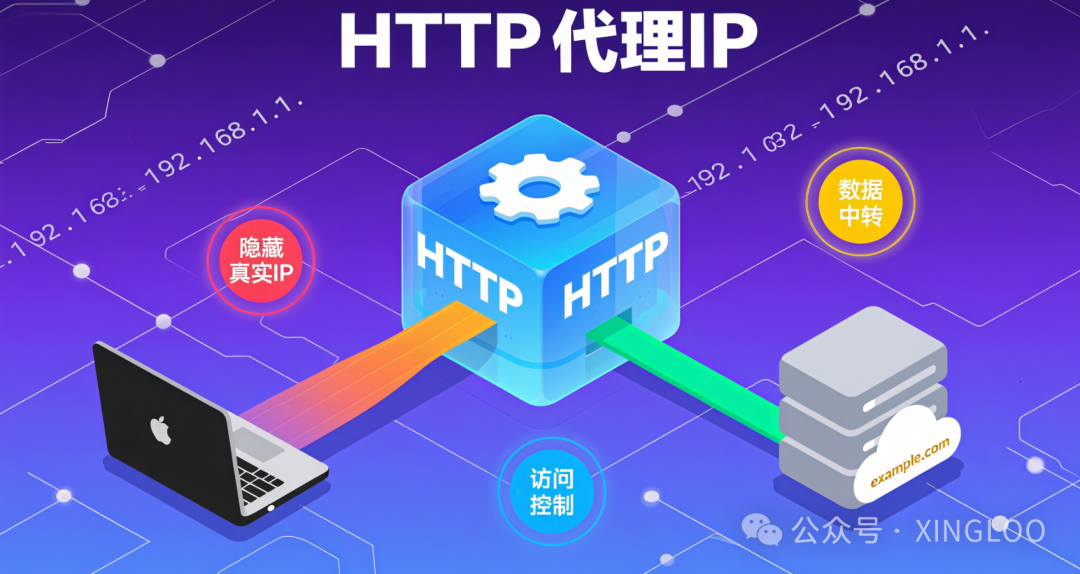
HTTP proxy IPs are addresses of proxy servers specifically used to forward HTTP (Hypertext Transfer Protocol) requests, primarily functioning between clients (such as browsers and scraping tools) and the target servers of the HTTP protocol, enabling indirect data transmission in the form of “client → HTTP proxy IP → target server.” The core features revolve around “HTTP protocol adaptation” and “request forwarding,” and the working principle can be broken down into three steps:
1

Request Reception and Parsing
When a client initiates an HTTP request (such as accessing a webpage or retrieving data), it sends the request to the preset HTTP proxy IP. After receiving the request, the proxy server parses key information from the request, including the target address, data format, and request method (such as GET or POST);
2

Request Forwarding and Spoofing
The proxy server replaces the client’s real IP address with its own IP address and forwards the parsed HTTP request to the target server. It can also modify the request header information based on configuration to simulate access behavior from different devices or browsers;
3

Response Return and Transmission
After processing the request, the target server returns the HTTP response (such as webpage content or data results) to the HTTP proxy IP, which then transmits the response back to the client, completing the entire data exchange process.
Compared to other types of proxy IPs (such as HTTPS proxies or SOCKS5 proxies), the core difference of HTTP proxy IPs lies in their “protocol specificity”—they only support HTTP protocol requests and are incompatible with HTTPS (encrypted transmission), FTP (file transfer), and other protocols, making them more suitable for handling non-encrypted HTTP protocol scenarios.

The Core Advantages and Applicable Scenarios of HTTP Proxy IPs
1

Adaptation to HTTP Scenarios, Balancing Efficiency and Convenience
High Request Processing Efficiency:
Since it focuses solely on the HTTP protocol, HTTP proxy IPs do not need to handle the complex encryption or transmission logic of other protocols, resulting in lower request forwarding latency (most scenarios have latency below 100ms) and a data transmission rate that is over 20% higher than general-purpose proxies (such as SOCKS5), making it suitable for scenarios sensitive to response speed (such as fast webpage loading and high-frequency data collection);
Low Configuration Threshold:
Most browsers, scraping tools (such as the Python Requests library), and office software (such as Excel data retrieval plugins) natively support HTTP proxy IP configuration, requiring no additional plugins or complex parameter modifications—just inputting the IP address and port is sufficient for use, allowing personal users or non-technical users to quickly get started;
Adaptation to HTTP-Specific Functions:
Flexible configuration of HTTP request headers is possible, such as modifying the User-Agent to simulate access from mobile devices or different browsers, and adjusting the Referer to spoof transitions from specific webpages, helping users bypass basic access restrictions imposed by target servers (such as request frequency limits for a single IP or device type restrictions);
Relatively Low Cost:
Due to the singular protocol support, the service cost of HTTP proxy IPs is usually lower than that of proxies supporting multiple protocols (such as HTTPS or SOCKS5), making them suitable for users with limited budgets who only need to handle HTTP scenarios (such as personal browsing of HTTP webpages or small-scale HTTP data collection).
2

Typical Applicable Scenarios
HTTP Webpage Access and Browsing:
When accessing outdated websites that only support the HTTP protocol (such as certain industry news sites or government information platforms), HTTP proxy IPs can bypass regional or IP restrictions to ensure normal webpage loading. Additionally, by switching to different regional HTTP proxy IPs, users can obtain HTTP webpage content from the target region, avoiding content blocking due to mismatched IP regions;
Non-Encrypted HTTP Data Collection:
When collecting publicly available HTTP protocol data (such as product information from industry websites, forum post content, or HTTP interface data), HTTP proxy IPs can reduce the risk of blocking due to high-frequency requests from a single IP, while the low-latency feature enhances collection efficiency. For example, when collecting product price data from an HTTP protocol, the collection speed using HTTP proxy IPs can be more than three times faster than in scenarios without a proxy;
HTTP Protocol Testing and Debugging:
When developers test HTTP interfaces (such as self-developed website APIs or third-party HTTP services), they can use HTTP proxy IPs to simulate access requests from different regions and devices, verifying the compatibility and stability of the interfaces. Additionally, by using the proxy to view HTTP request headers and response data, they can assist in troubleshooting interface call errors (such as abnormal parameter transmission or incorrect response formats);
Basic Office and Information Retrieval:
When enterprise employees access internal HTTP office systems (such as non-encrypted attendance systems or file-sharing platforms), using HTTP proxy IPs can enable cross-regional remote access while hiding the employees’ real IPs, thus protecting the security of internal system access. Personal users can also use HTTP proxy IPs to obtain overseas HTTP information (such as international news or industry reports), avoiding access issues due to IP restrictions.

Key Considerations When Choosing HTTP Proxy IP Services
When selecting HTTP proxy IP services, it is essential to evaluate based on three core dimensions: “protocol adaptability, IP quality, and service stability” to avoid poor usage effects or scenario mismatches due to resource incompatibility:
1

IP Quality and Protocol Adaptability
IP Purity and Source:
Prioritize selecting “native HTTP proxy IPs” (such as native residential HTTP proxies or data center HTTP proxies) and avoid using “HTTP proxies disguised from other protocol proxies” (such as forcibly changing HTTPS proxies to HTTP, which can easily lead to request failures). Verify the IP ownership through WHOIS queries to ensure that the IP owner is a legitimate ISP with no violation history (such as being marked as “HTTP scraping IP” or “risk IP”);
Regional Coverage and Precision:
Ensure coverage of the target usage area and support city-level positioning (for example, needing an HTTP proxy IP from Los Angeles, USA, rather than just a general US IP), ensuring the ability to obtain corresponding regional HTTP content or services. For instance, XINGLOO can provide HTTP proxy IPs from over 190 countries and regions globally, with coverage rates exceeding 90% in core cities (such as Beijing, Shanghai, New York, and London), meeting multi-regional HTTP scenario needs;
IP Type Adaptability:
Select the type of HTTP proxy IP based on the scenario—residential HTTP proxy IPs (high authenticity, suitable for simulating real user access to HTTP webpages), data center HTTP proxy IPs (low cost, high concurrency, suitable for large-scale HTTP data collection), and dedicated HTTP proxy IPs (IP used only by individuals, suitable for highly sensitive HTTP operations such as account logins), avoiding “low-quality IPs for high-demand scenarios” (such as using shared HTTP proxy IPs for important HTTP data collection).
2

Service Performance and Support
Latency and Stability:
The request forwarding latency of HTTP proxy IPs should be kept within a reasonable range (latency below 100ms within the target region, and below 200ms across regions) to avoid webpage loading delays or data collection timeouts due to excessive latency. Additionally, ensure that the IP is long-term usable, with no frequent failures or disconnections (IP uptime rate ≥ 90%), which can be verified through test links to check actual latency and stability;
Bandwidth and Concurrency Capability:
Select bandwidth capacity based on usage needs; ordinary HTTP webpage browsing requires 2-5Mbps bandwidth, while large-scale HTTP data collection requires over 10Mbps bandwidth to avoid data transmission rate drops due to insufficient bandwidth. Concurrency capability should match the number of devices or tools, such as multi-threaded scrapers needing HTTP proxy IPs that support 10+ concurrent connections to avoid request failures due to concurrency limits;
3

Functionality and Cost Adaptability
Support for Exclusive Functions:
Core focus on “request header modification” and “IP switching rules”—the request header modification function allows customization of User-Agent and Referer to adapt to the access rules of the target server; IP switching rules support automatic switching based on time or request count, reducing the risk of long-term use of a single IP. Some services also provide an “IP whitelist” function, allowing only specified devices to use the HTTP proxy IP, enhancing security;

Basic Considerations When Using HTTP Proxy IPs
Clarify Protocol Adaptation Scope:
Avoid using HTTP proxy IPs for non-HTTP scenarios such as HTTPS or FTP; for example, when accessing HTTPS encrypted websites, HTTP proxy IPs cannot handle encrypted requests, leading to connection failures, necessitating a switch to HTTPS proxies or multi-protocol proxies;
Control Request Frequency and Behavior:
Even when using HTTP proxy IPs, avoid “machine-like high-frequency requests” (such as sending more than 10 HTTP requests per second). Simulate real user access frequency (such as 1-2 requests per second) and avoid sending requests at fixed intervals to reduce the risk of being identified as “abnormal HTTP requests” by the target server, preventing IP blocking;
Correct Configuration and Verification:
After configuring the HTTP proxy IP, verify the configuration using online tools to confirm that the proxy IP has successfully replaced the real IP and that the request header information (such as User-Agent) meets expectations. If access to the target service fails after configuration, check the IP validity, port correctness, and protocol compatibility (such as whether the HTTP proxy is mistakenly used in an HTTPS scenario);
Regularly Change and Monitor:
Long-term use of the same HTTP proxy IP can easily lead to being marked by the target server. It is recommended to regularly change IPs based on scenario needs (such as changing once a day or changing after completing a round of data collection). Additionally, periodically check the IP status to ensure it has not been marked as “HTTP risk IP” or “blocked IP.” If access fails or responses are abnormal, promptly switch to a different IP.

The core value of HTTP proxy IPs lies in their “specific adaptation to HTTP scenarios, balancing efficiency and convenience.” By achieving low-latency request processing through protocol specificity and lowering the usage difficulty with a low configuration threshold, they are suitable for non-encrypted HTTP webpage access, data collection, interface testing, and other scenarios.
When choosing, prioritize “IP quality (native nature, regional coverage),” “performance (latency, bandwidth),” and “protocol adaptability,” while pairing with high-quality proxies from XINGLOO, and clearly define the protocol scope of the usage scenario to avoid functional failures due to mismatches.