Table of Contents | Issue 8, 2024 Special Topic: Integration of 6G and AI
01【Integration of 6G and AI】 Special Topic《Mobile Communications》 Issue 8, 2024
Research on Demand and Technology of Intelligent Computing Fusion in Wireless Networks
Li Fuchang, Li Lu, Gao Qian
(China United Network Communications Group Co., Ltd. Research Institute, Beijing 100048)
【Abstract】Wireless networks have a large reserve of high-quality computing power and are characterized by a wide distribution of sites and extensive mobile connectivity, making them an ideal environment for edge computing. How to leverage the connection advantages of wireless networks to deeply explore and utilize the widely available high-quality computing power for diverse business applications, providing high-performance computing, low-latency networks, and intelligent business support capabilities, while expanding the concepts of computing networks to the wireless side, is an important research direction for wireless access networks. Based on the different stages of integration between wireless computing networks and mobile communication networks, we propose an evolutionary path for the architecture of wireless computing networks and conduct in-depth research on the demand scenarios and key technologies of 5G-A/6G wireless computing networks, providing a research foundation and recommendations for building a deeply integrated wireless computing network.
【Keywords】Wireless Network; Intelligent Computing Fusion; Computing Power
doi:10.3969/j.issn.1006-1010.20240725-0004
Classification Number: TN92 Document Mark Code: A
Article Number: 1006-1010(2024)08-0002-06
Citation Format: Li Fuchang, Li Lu, Gao Qian. Research on Demand and Technology of Intelligent Computing Fusion in Wireless Networks[J]. Mobile Communications, 2024, 48(8): 2-7.
LI Fuchang, LI Lu, GAO Qian. Research on Demand and Technology of Intelligent Computing Fusion in Wireless Networks[J]. Mobile Communications, 2024, 48(8): 2-7.

0 Introduction
With the commercial deployment of 5G communication systems, AI, XR, V2X, and industrial internet are flourishing in unmanned, immersive intelligent services. The acceleration of digital transformation in vertical industries driven by 5G has become an inevitable trend, while emerging businesses have raised more urgent demands for networks and computing power. Facing the demand for computing power from emerging businesses, computing network technology can utilize the widely connected computing power of networks to break through the bottleneck of single-point computing power, leverage the advantages of computing clusters, and enhance the efficiency of computing power. The deep integration of computing and networks promotes a shift towards simplified, integrated services. The transition from the past simple combination of cloud + network services to deeply integrated, flexibly combined computing and network services.
As 5G evolves towards 6G, the increasing demands for network performance, such as millisecond-level latency and end-to-end service level agreement guarantees, further highlight the role of edge computing. With the development of edge computing technology and market, more and more cloud services are being pushed down to edge computing platforms, providing services closer to users, generating faster network service responses, reducing data backhaul costs, and meeting the basic needs of industries in real-time operations, application intelligence, and security and privacy protection. Wireless networks have a large reserve of high-quality computing power and are characterized by a wide distribution of sites and extensive mobile connectivity, making them an ideal environment for edge computing. How to leverage the connection advantages of wireless networks to deeply explore and utilize the widely available high-quality computing power for diverse business applications, providing high-performance computing, low-latency networks, and intelligent business support capabilities, while expanding the concepts of computing networks to the wireless side, is an important research direction for wireless access networks. The openness of computing on the wireless side is a requirement for the evolution of future 5G-A and 6G networks. Wireless computing networks achieve network-aware business demand and provide customized transmission services by uniformly orchestrating wireless-side computing resources, wireless network resources, and business resources, meeting industry needs in the future cloud-network computing integration scenario.
1 Typical Application Scenarios of Wireless Intelligent Computing Fusion
1.1 Air Interface AI
(1) Channel State Information Compression Feedback
AI technology can address some technical bottlenecks and challenges in traditional CSI (Channel State Information) feedback techniques, such as solving high complexity issues in processing high-dimensional channel state information in massive MIMO systems and overcoming limitations in the quantization precision of traditional codebook feedback. The principle of AI-based CSI feedback technology is to treat high-dimensional channel information as image information and use a network structure similar to an autoencoder to achieve end-to-end CSI image compression and recovery tasks.
(2) Channel State Information Prediction
Channel state information prediction is an effective method to solve the mismatch between data transmission strategies and channel states during transmission. AI-based channel state information prediction uses current or historical measured channel state information to predict future channel states during data transmission, and the predicted channel state information is then used to formulate data transmission strategies, thereby matching the data transmission strategy with the channel state during data transmission to improve data transmission performance. In AI-based channel state information prediction methods, the terminal measures the current and historical channel states, using AI models to predict future channel states to improve the accuracy of future channel state predictions, thereby facilitating the matching of base station data transmission strategies with channel states during data transmission.
(3) Intelligent Beam Management
AI-based beam management methods primarily include two use cases: spatial beam prediction and temporal beam prediction. Specifically, in the AI-based spatial beam prediction use case, the input to the AI model is the measurement results of partial beams, and the output of the model is the probability that each candidate beam becomes the optimal beam or the predicted beam quality. Based on the model output, the optimal one or more beam indices or beam quality information can be directly determined from all candidate beams. In the AI-based temporal beam prediction use case, a simple motion model is typically based on random initial directions, constant speeds, and linear trajectories, using past beam measurement results as inputs to the AI model to predict the optimal beam indices or beam quality information for future moments.
(4) Channel Estimation
Traditional channel estimation algorithms perform poorly in high delay spread or high-speed channels, as the time and frequency dispersion of the channel is severe under such conditions, reducing the correlation of channel information at pilot positions and affecting the accuracy of interpolation. AI neural networks can learn the recovery process from signals after orthogonal frequency division multiplexing demodulation to enhance the accuracy of channel estimation and recovery.
(5) Integrated Receiver
The performance improvement of traditional equipment through a single module of air interface AI is limited. By cascading multiple modules, the transceiver modules of wireless devices can be uniformly replaced with AI models, enhancing the overall performance of the devices. AI can perceive potential correlations between modules that conventional methods cannot describe, and this combination design allows for searching for optimal solutions in a larger space, thus gaining benefits compared to traditional solutions. An AI-based integrated receiver combines channel estimation, equalization, and demodulation into a cohesive design that performs the functions of three traditional wireless network modules with a single neural network.
(6) Pilot-free Transmission
Pilot-free transmission is a special transmission method realized based on AI. Unlike traditional pilot-based transmission methods, pilot-free transmission does not include any pilot signals in the transmitted signals, allocating all resources to carry business data. The key to achieving error-free data transmission with this special transmission method lies in the constellation diagram it uses and the AI receiver.
1.2 Edge Application Scenarios
(1) XR Scenarios
XR services are continuously evolving towards ultra-high definition, 3D, immersive, and real-time interactive directions. Future cloud-based XR systems will achieve complex services such as voice interaction, gesture interaction, head interaction, and eye interaction between users and the environment, requiring low latency and ultra-high bandwidth in relatively deterministic system environments to provide users with an ultimate experience. Against this backdrop, the computational capacity limitations and energy consumption issues of terminal devices will become bottlenecks for XR applications. The application of computing networks can effectively address the computational capacity limitations and significant energy consumption issues of terminal devices. By offloading computation to the computing network, content, rendering, spatial computing, etc. in XR technology can be offloaded to the computing network. This will significantly reduce the computational load and energy consumption of XR terminal devices while providing ample computing resources, making XR terminal devices lighter, smarter, and more conducive to commercialization.
(2) Industrial Internet Scenarios
From the perspective of application scope, computing networks for the industrial internet can be divided into computing networks within and outside factory campuses. Wireless computing networks are one of the main forms of computing networks within factory campuses. In industrial internet applications, from perception of industrial environments to collection, organization, analysis, and intelligent decision-making of industrial data, and from digital twin mechanism modeling to immersive virtual-real interaction, wireless computing networks will greatly empower the industrial internet. As a new type of infrastructure integrating wireless networks and computing power, wireless computing networks will endow the industrial internet with new perceptual capabilities, provide new industrial control methods based on digital twin and cloud control integration, trigger various innovative intelligent applications of industrial AI, and create new business experiences of elastic scaling and flexible deployment of computing networks.
(3) Business Identification and Assurance
AI-based business identification within base stations provides intelligent network operation solutions for fine identification, perception measurement, precise assurance, and positioning delimitation. Based on AI machine learning protocol feature discovery systems, massive experience data is intelligently trained and analyzed to automatically discover possible protocol features, and then identify various types of data message businesses such as remote control, online gaming, online video, and online software upgrades according to data packet features.
The business perception computing power within base stations will associate the business perception KQI indicators with the wireless network KPI and KQI, establishing an end-to-end perception analysis model to evaluate the reasons for poor perception indicator positioning, which can comprehensively enhance network carrying performance, business performance, and user perception, improving operational support capabilities. By establishing a business perception expert analysis system through intelligent fault diagnosis algorithms, it can determine classification issues and faults in user terminals, cell wireless, and bearer networks, and combine intelligent analysis from the knowledge base to automatically provide conclusions and suggestions, enhancing maintenance and optimization work efficiency.
1.3 Communication Perception Fusion Scenarios
(1) Internet of Vehicles
The C-V2X scenario of the Internet of Vehicles is an important component of the transportation field. Through Internet of Vehicles technology, comprehensive network connections can be achieved between vehicles and cloud platforms, vehicles and other vehicles, vehicles and roads, vehicles and people, and within vehicles, thereby achieving intelligent management of traffic, intelligent decision-making for traffic information services, and intelligent control of vehicles. The computing power assistance for terminal perception data processing is a typical use case in the Internet of Vehicles. Real-time road condition monitoring and perception require high real-time performance for perception data processing and interaction, and may involve user privacy issues. Therefore, terminal-side perception measurement, perception data processing, and perception result applications can serve as solutions. However, the terminal side may face energy consumption issues and computational capacity bottlenecks, potentially requiring low-latency, high-performance computing services to provide computing power assistance.
(2) Drone Supervision
Lightweight civil drones are rapidly developing in fields such as aerial photography, agriculture, and surveying. However, the increasing use of drones also presents problems, including interference with civil aviation flights, unauthorized entry into public or sensitive areas, and accidental crashes. Solely relying on administrative measures for drone supervision faces challenges, necessitating technical means to restrict illegal flights. The solution based on integrated perception + computing networks can effectively address the issues of drone supervision.
1.4 Terminal Single Airport Scenarios
(1) MobileNet-V2
MobileNet-V2 is increasingly applied on mobile devices, and its lightweight and high-accuracy features make it an ideal choice for image recognition tasks on mobile devices. Some major applications of MobileNet-V2 on mobile devices include mobile photography, real-time object detection, facial recognition and authentication, intelligent photo album organization, and personalized recommendations.
To ensure that the model accuracy and performance of MobileNet-V2 are optimal, the training process is typically conducted on the server side. Server-side training involves a massive amount of data and computational resources. The scale of training data and the required computational capacity on the server side typically range from thousands to tens of thousands of TFLOPS (trillion floating-point operations per second). Once the model is trained and optimized on the server side, it can be deployed on the terminal side for real-time inference. Terminal-side inference is mainly conducted on mobile devices such as smartphones and tablets. The scale of inference data and the required computational capacity on the terminal side typically range from hundreds to thousands of GFLOPS (billion floating-point operations per second).
(2) Channel State Information Compression Feedback (UE Side)
In AI-based beam management, user equipment can extract CSI feature vectors from the complete channel matrix through deep learning algorithms. Considering the computational power requirements for model training and the availability of datasets, it is currently feasible to train the model on the base station side and then deploy the model to the UE for inference on the terminal side.
(3) Beam Management (UE Side)
The intelligent beam management model inference can be conducted on the terminal side, such as on smartphones or IoT devices. These devices typically have limited computational resources; therefore, the inference process needs to be optimized to ensure real-time performance and efficiency. During inference, the model receives real-time data, predicts the optimal beam, and returns the results to the beam management system. After model deployment, real-time user mobility data and communication data are used for model inference. The approximate magnitude of inference computational power is between 200 and 2,000 FLOPS, with inference times below one millisecond.
2 Wireless Computing Network Fusion Architecture
2.1 5G-A Wireless Computing Network Fusion Architecture
Based on the different development stages of the integration between wireless computing networks and mobile communication networks, in the 5G-A stage, wireless computing networks are externally managed in a centralized orchestration form above the existing mobile communication networks, or they can be integrated into the existing mobile communication networks by adding new network elements. The CU control plane on the RAN side can achieve signaling/data interaction with the centralized computing orchestration management layer through a Proxy. This architecture is relatively independent of the existing 5G system, simple, and easy to deploy. To achieve awareness, interconnection, and collaborative scheduling of wireless computing and networks, the 5G-A wireless computing network architecture can be logically divided into three layers from bottom to top: wireless infrastructure layer, computing orchestration management layer, and application layer, as shown in Figure 1:
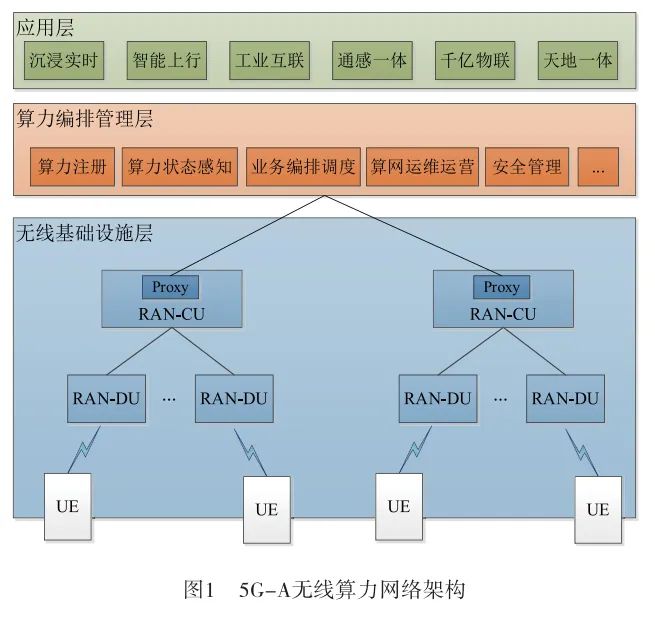
Wireless Infrastructure Layer: As the solid foundation of the wireless computing network, it encompasses ubiquitous access devices, network devices, and computing devices that can provide computing power, such as a large number of ubiquitous and heterogeneous hardware resources in wireless networks, such as CPU, memory, hard drives, etc., as well as dedicated hardware for real-time processing at the physical and MAC layers of base stations, such as FPGA, ASIC, and heterogeneous computing resources aimed at XR and intelligent computing like GPU, NPU, TPU. Meanwhile, the wireless computing network also possesses unique network resources, such as spectrum, carriers, and beams, and consideration can be given to abstractly unifying the network resources of the air interface to decouple network resources from wireless air interface technologies to support the coexistence and integration of various access technologies.
Computing Orchestration Management Layer: Based on the deployment situation of heterogeneous wireless computing resources across the network, this layer uniformly manages the wireless computing network resources, effectively implementing service decomposition and scheduling functions through a microservice architecture, achieving dynamic business deployment and orchestration, and managing the lifecycle of computing services across various wireless computing nodes, supporting intelligent orchestration and scheduling of computing services to appropriate computing nodes, ensuring service quality and user experience.
Application Layer: Facing the six typical application scenarios of 5G-A, this layer opens up various capabilities of the wireless computing network, empowering various industry applications, and transmits user requests for business SLA, including computing power requests and other parameters to the computing orchestration management layer.
2.2 6G Wireless Computing Network Fusion Architecture
In the 6G stage, the wireless computing network is deeply integrated with the mobile communication network in a computing-endogenous manner, distributedly integrated into the existing mobile communication network’s RAN. The wireless computing orchestration management module is deployed in the RAN-CU, managing wireless computing resources within a single base station, while inter-module interactions between wireless computing orchestration management modules achieve collaborative scheduling across base stations, completing distributed collaboration of the wireless computing network. By deploying a computing orchestration management layer at a higher level, multi-level management of the RAN side can be achieved. This architecture is more flexible and efficient, with faster response times; however, ensuring consistency and coordination of computing management may be more challenging due to the distribution of wireless computing orchestration management functions across different RAN nodes. To achieve more efficient, flexible, and intelligent computing and communication capabilities, the 6G wireless computing network architecture can be hierarchically divided into three functional modules: wireless infrastructure layer, computing orchestration management layer, and application layer, as shown in Figure 2.
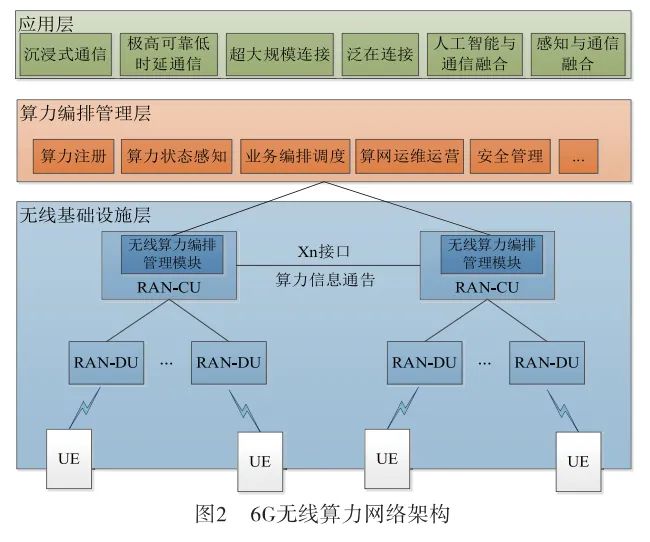
Wireless Infrastructure Layer: Based on the wireless infrastructure layer in the 5G-A wireless computing network architecture, the RAN-CU incorporates an endogenous wireless computing orchestration management module. The wireless orchestration management modules deployed in different RAN-CUs communicate computing information through the XN interface, completing distributed collaboration between base stations. Each RAN-CU’s distributed deployed endogenous wireless computing orchestration management module can be a lightweight computing orchestration management layer or a full-scale computing orchestration management layer, achieving local computing management and localized computing service orchestration.
Computing Orchestration Management Layer: The centralized computing orchestration management layer in the 6G wireless computing network architecture is optional, achieving global wireless computing service orchestration management and coordination of computing resources across RAN nodes. The computing orchestration management layer for 6G encompasses all the functions of the orchestration management layer in the 5G-A wireless computing network architecture.
Application Layer: Facing the six typical application scenarios of 6G, this layer opens up various capabilities of the wireless computing network, empowering various industry applications, and transmits user requests for business SLA, including computing power requests and other parameters to the computing orchestration management layer.
3 Key Technologies for Wireless Computing Network Fusion
The wireless computing network at the architectural level needs to natively support unified computing collaboration, controlling the fusion of computing and connectivity, the transmission of computing data, and the execution of computations, forming a unified framework for computing fusion and a solution for real-time collaboration of communication and computing within the wireless network. The computing fusion framework needs to support the following key capabilities:
1) Real-time unified computing collaboration in the control plane to manage computing sessions and execution, addressing issues brought about by the rapidly changing wireless environment and user mobility;
2) Management and control of distributed computing resources within the network, supporting mutual awareness between communication and computing, enhancing overall resource efficiency.
3.1 Abstraction/Management/Scheduling of Wireless Computing Resources and Functions
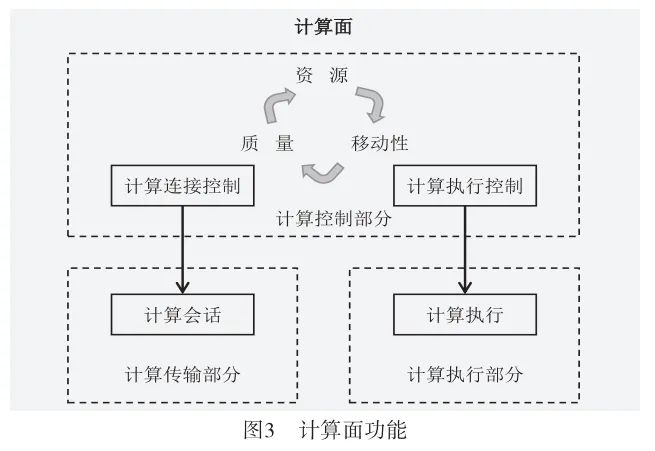
To achieve abstraction/management/scheduling of wireless computing resources and functions, mutual awareness between computing and communication must be realized, using minimal communication and computing resources to meet the user’s QoS requirements. To achieve this, a computing plane solution supporting real-time collaboration between communication and computing can be supported in the control plane. The computing plane includes the computing control part, the computing execution part, and the transmission part of computing data (computing transmission part).如图3所示:
3.2 Real-time Awareness of Wireless Computing and Real-time Control of Computing Tasks
The computing functions of the wireless computing network include computing awareness and computing control. The computing awareness function is responsible for collecting real-time information and status changes of computing nodes within the network management domain, as well as changes in connection topologies among computing nodes; the computing control function provides computing control scheduling strategies based on computing service demands, dynamically adjusting physical resources for task configuration and allocation based on real-time awareness information of computing. A complete computing task requires collaboration between computing functions and connectivity functions to optimize the efficiency and overall energy consumption of new businesses such as AI.
3.3 Fusion Control and Joint Optimization of Wireless Communication and Wireless Computing Resources
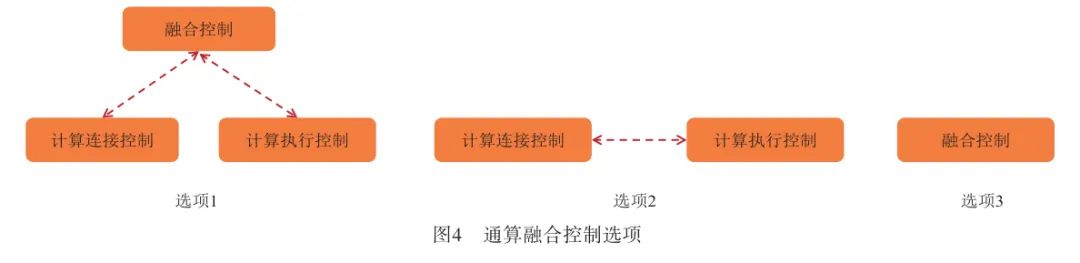
The native support for the fusion of computing and communication architecture includes at least supporting mutual awareness and collaboration of computing execution and computing connectivity in the control plane, achieving real-time accurate discovery of computing resources, flexible dynamic scheduling of computing resources, and quality of computation, providing ubiquitous computing services and connectivity services, and achieving reasonable allocation of computing and connectivity resources. The fusion control function affects the architecture in the following ways: ① Fusion control mechanisms for computing execution and computing connectivity on the wireless side; ② Fusion control mechanisms for computing execution and computing connectivity on the core network side; ③ Collaborative mechanisms for computing execution and computing connectivity across technical domains. The unified control of computing and connectivity has three possible approaches, as shown in Figure 4:
(1) Option 1: Computing connectivity control and computing execution control are coordinated through upper-layer fusion control functions.
(2) Option 2: Computing connectivity control and computing execution control interact through standard interfaces or internal interfaces.
(3) Option 3: Computing connectivity control and computing execution control can also be fused into a single control function, i.e., a fusion control function.
3.4 Wireless Computing Data Transmission and Routing
The design of the data transmission mechanism for the computing plane needs to be differentiated from traditional user plane communication. One possible transmission method for the computing plane is to introduce new carrying methods at the carrying level, such as computing wireless carrying for the air interface and computing carrying for the Xn interface, and to introduce new wireless computing session protocols at the session level.
Regarding computing routing, the network needs to comprehensively consider multiple factors such as computing rate, latency, and reliability, scheduling services to the optimal computing nodes as needed to meet the computing power demands of the services. Similar to routing protocols in traditional networks based on link metrics, in computing networks, routing calculations are based on computing metrics, with each router performing calculations of the entire network topology to generate service routing information tables to support forwarding of computing network service packets.
3.5 Intelligent Endogenous Design of Wireless Computing Networks
Traditional wireless networks are session-centric, managed based on session granularity, and implement QoS guarantees for sessions. However, network AI, from an architectural perspective, requires a design that supports native intelligence, deeply integrating the four elements of connectivity, computing, data, and algorithms at the architectural level. One implementation of architecture native intelligent design is task-granularity management, supporting task QoS guarantee mechanisms, that is, a task-centric architecture. In this architecture, “task” refers to the collaboration and allocation of resources involving connectivity, computing, data, and algorithms across multiple nodes to achieve a specific goal. “Task-centric” means managing tasks as the control object, supporting lifecycle management of tasks, and ensuring the smooth execution of tasks through collaboration and allocation of computing, algorithms, connectivity, and data.
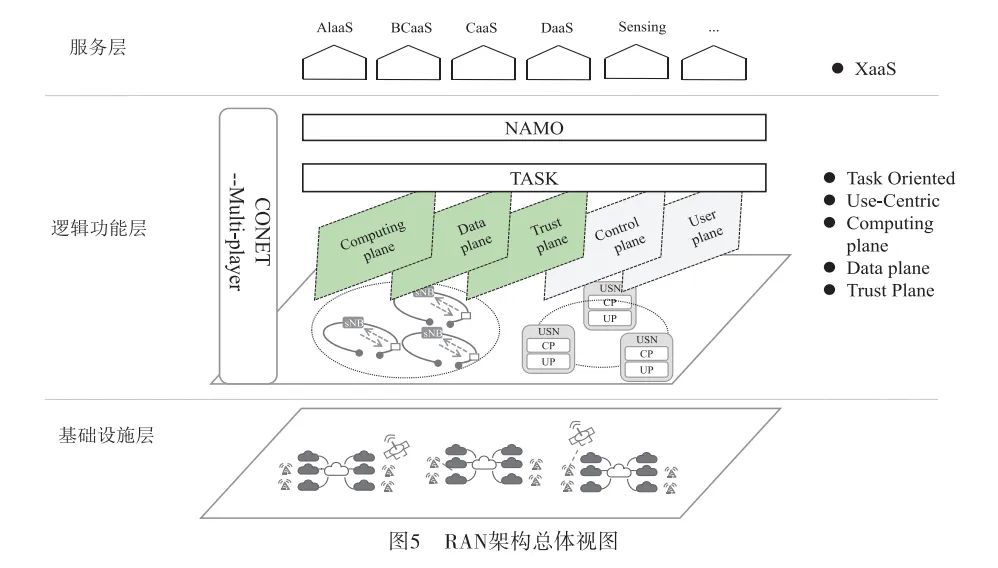
3.6 Joint Management and Orchestration of Wireless Computing and Communication Integrated Services
The orchestration function for communication and computing needs to manage the computing resources of the entire wireless network, including the CPU, memory, storage, and other resources of each cluster (clusters in the wireless access network can be a pool of wireless computing resources). Resources should be allocated and scheduled reasonably based on business demands and the state of computing resources, ensuring balanced resource utilization among clusters. In terms of computing service orchestration, the wireless computing network, as a service provider, should consider the capabilities, methods, processes, and key elements of service orchestration processing and service interfaces in its architectural design, enabling service orchestration to have the ability to decompose services, translating the comprehensive expression of business demands into deployable computing task expressions, and subsequently mapping communication and computing resources according to computing task demands, achieving the mapping of service indicator requirements to connection QoS and computing QoS.
3.7 Openness of Wireless Computing Network Services
The openness of wireless computing network services can promote collaborative innovation in the industry and accelerate application maturity. By pushing computing capabilities down to mobile access networks, computing networks can more efficiently meet the demands for low latency and high bandwidth services, while open platforms can provide APIs, SDKs, and other interfaces, allowing third-party applications to conveniently access the capabilities of the wireless computing platform, achieving business innovation and optimization. This open model helps promote industry collaboration, accelerate the commercialization of wireless computing networks, and drive the innovation and business development of the next generation of mobile networks.
4 Conclusion
As the digital wave advances, a transformation led by new infrastructure is profoundly changing every corner of society. A new generation of digital technologies, such as big data, cloud computing, and artificial intelligence, is injecting new vitality into the real economy and traditional industries, promoting society towards a new era of industrial digitalization. Emerging XR experiences, collaborative robots, autonomous driving, multi-sensory interconnectivity, and industrial internet, among other new businesses, have raised demands for ubiquitous intelligent computing power. This paper studies the application scenarios, architectural solutions, and key technological content of wireless computing networks, providing reference paths and guiding suggestions for the subsequent realization of 5G-A wireless computing networks and the evolution of wireless computing networks towards 6G. Future research should further delve into the wireless intelligent computing fusion protocols and engineering implementation aspects, strengthen ecological cooperation, and build the next generation of wireless networks oriented towards 5G-A/6G to meet the differentiated experience needs of various industries.
References:(Scroll down to browse)
[1] China Unicom,China Academy of Information and Communications Technology,China Telecom,et al. China Unicom Intelligent Wireless Network Intelligent Computing Fusion Scenario and Technology White Paper[R]. 2024.
[2] IMT-2030 (6G) Promotion Group. Wireless AI Technology Research Report[R]. 2022.
[3] TR 38.843 V1.2.0. Study on Artificial Intelligence (AI)/Machine Learning (ML) for NR air interface[R]. 2023.
[4] Wen C, Shih W, Jin S. Deep Learning for Massive MIMO CSI Feedback[J]. IEEE Commun. Lett., 2018,7(5): 748-751.
[5] Li L, Wu H, Xiao H, et al. A Novel Deep Learning based CSI Feedback Approach for Massive MIMO Systems[C]//2022 International Wireless Communications and Mobile Computing (IWCMC). 2022: 56-60
[6] 3GPP. R1-2310988_Discussion on other aspects for AI CSI feedback enhancement, ZTE Corporation[R]. 3GPP TSG RAN1#114, 2023.
[7] 3GPP. R1-2300173 Evaluation on AI beam management, ZTE Corporation[R]. 3GPP TSG RAN1#112, 2023.
[8] Ye H, Li G Y, Juang B-H. Deep Learning Based End-to-End Wireless Communication Systems Without Pilots[J]. IEEE Transactions on Cognitive Communications and Networking, 2021,7(3): 702-714.
[9] Li Lu, Li Fuchang, Ma Yanjun, et al. Research on Integrated Wireless Network Technology for 6G Intelligent Perception[J]. Information Communication Technology and Policy, 2023,49(9): 7-12.
[10] China Unicom Research Institute. 6G Integrated Wireless Network White Paper[R]. 2023.
[11] Zhu Xiaodan, Huang Qingqiu. AI Empowered 6G Wireless Access Network Technology Research[J]. Science and Technology Innovation and Application, 2023,13(30): 14-16.
[12] Sun Yanzan, Pan Guangjin, Yu Tao, et al. AI-Enabled High-Efficiency Wireless Communication Technology[J]. Mobile Communications, 2023,47(6): 77-82.
[13] Jiang Qiuping. Research and Implementation of Heterogeneous Unified Computing Methods Based on Open Source Wireless Communication[D]. Beijing: Beijing University of Posts and Telecommunications, 2023.
[14] Chen Li, Ai Ming, Sun Shaohui. AI Endogenous Wireless Access Network Architecture[J]. Radio Communication Technology, 2022,48(4): 574-582.
[15] Zhang Guangmei. Overview of AI-Based Wireless Network Perception Technology Research[J]. Telecommunications Technology, 2022,62(5): 686-694.
[16] Li Lun, Yu Guanghui. Applications of AI/ML in the Physical Layer of Wireless Communication Systems[J]. Mobile Communications, 2020,44(6): 136-141.
[17] CCSA TC5/WG6. Research Report on Wireless Computing Network Scenarios, Demands, and Key Technologies[R]. 2022.
[18] Jiang Qiuping. Research and Implementation of Heterogeneous Unified Computing Methods Based on Open Source Wireless Communication[D]. Beijing: Beijing University of Posts and Telecommunications, 2023.
[19] Cai Yizhuo, Lei Bo, Zhao Qianying, et al. Communication Efficiency Optimization for Federated Learning in 6G Computing Networks (English)[J]. Frontiers of Information Technology & Electronic Engineering, 2024,25(5): 713-732.
[20] Lei Bo. Building New Infrastructure for the Intelligent Computing Era Empowered by Networks[J]. Communication World, 2024(8): 33-35.
[21] Shen Jian, Sun Daojun. Exploration of High-Quality Development of Computing Networks: Real Challenges, Institutional Foundations, and Technical Support[J]. Artificial Intelligence, 2024(2): 20-31. ★
Scan the QR code to read and download this paperonline

★Original published in《Mobile Communications》Issue 8, 2024★
doi:10.3969/j.issn.1006-1010.20240725-0004
Classification Number: TN92 Document Mark Code: A
Article Number: 1006-1010(2024)08-0002-06
Citation Format: Li Fuchang, Li Lu, Gao Qian. Research on Demand and Technology of Intelligent Computing Fusion in Wireless Networks[J]. Mobile Communications, 2024, 48(8): 2-7.
LI Fuchang, LI Lu, GAO Qian. Research on Demand and Technology of Intelligent Computing Fusion in Wireless Networks[J]. Mobile Communications, 2024, 48(8): 2-7.
 Author IntroductionLi Fuchang:Professor-level Senior Engineer, PhD, currently working at the China United Network Communications Group Co., Ltd. Research Institute, mainly engaged in research on wireless communication networks.Li Lu:Engineer, Master’s degree, currently working at the China United Network Communications Group Co., Ltd. Research Institute, mainly engaged in research on 5G/6G wireless communication networks and artificial intelligence.Gao Qian:Engineer, Master’s degree, currently working at the China United Network Communications Group Co., Ltd. Research Institute, mainly engaged in research on 5G/6G wireless communication networks and artificial intelligence.
Submission method for《Mobile Communications》is online submission
Please log in to the web submission system
Link Address:http://ydtx.cbpt.cnki.net
 Exciting Review【2024 Special Call for Papers Issue 11】Marine Mobile Communication Networks【2024 Special Call for Papers Issue 12】6G Millimeter Wave and Terahertz Communication【Special Call for Papers | 6G Endogenous Intelligent Theory and Key Technologies】 Issue 1, 2025Table of Contents|2024 Issue 7 Special Topic: 6G Endogenous Intelligent TechnologyTable of Contents | 2024 Issue 8 Special Topic: Integration of 6G and AISummary of the Table of Contents of《Mobile Communications》in 2024 (Issues 1-6)
 #Scan to follow us#《Mobile Communications》Interpreting Communication with Papers《Mobile Communications》 magazine is supervised by China Electronics Technology Group Corporation and sponsored by the 7th Research Institute of China Electronics Technology Group Corporation. It is a “Double Effect Journal” in the Chinese journal matrix, a fine electronic journal of the Ministry of Industry and Information Technology, a source journal for Chinese scientific and technological papers, included in the high-quality scientific journal grading catalog of the Chinese Institute of Communications, and a core journal in the field of applications in China, as well as a journal included in JST of Japan. Domestic publication number: CN44-1301/TN, International Standard Serial Number: ISSN1006-1010, Mailing code: 46-181.