Click on the above ” Technical Training “, select “Pin Public Account“
160,000+ followers on the WeChat platform for industrial control: technical sharing, learning exchange, industrial control videos
Tools/Materials:1. Analog multimeter2. AC contactor with three wiresMethod/Steps:1. We know that household 220V AC is very dangerous; as long as you do not directly touch the wire ends, it is safe. Similarly, direct contact with 380V industrial electricity is also very dangerous. Its 50HZ frequency and 380V high voltage pose even greater harm to the human body. Therefore, it is essential to understand its characteristics and usage points.
An important point is that you should never touch any wire ends or metal parts with bare hands. This is because the three wires of the 380V power supply are all live wires, and touching any one of them can create a dangerous touch voltage of 220V with the ground. Therefore, be particularly cautious about electrical safety. First, ensure that the multimeter probes have good contact and set the multimeter range switch to the AC position.
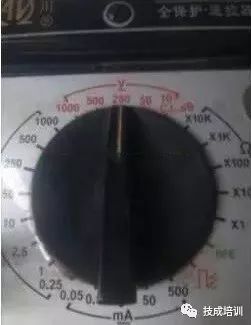
2. First, confirm that the multimeter probes are making good contact and set the multimeter range switch to the AC position. According to the usage principle of the multimeter, start from a higher range to a lower range; if the power to be tested is estimated to be less than 1KV, select the 500V range.
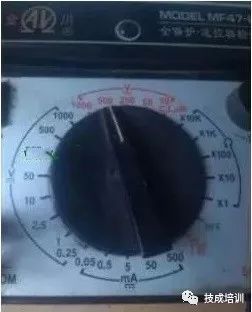
3. For safety during operation, one can stand on a dry wooden board or stool. This way, the human body is insulated from the ground. If you are on a wooden floor, touching a live wire is not dangerous, but at this time, you are an extension of that wire and must not touch any other objects or the ground. If you do, it creates a circuit, which is dangerous. Now bring the multimeter close to the power supply, i.e., the contactor. The two probes of the multimeter touch the two metal parts of the contactor, regardless of which probe is red or black, and regardless of U, V, W. Just use the two wires.
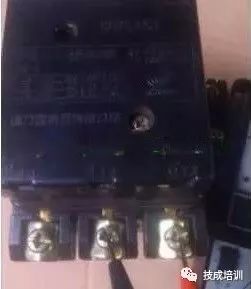
4. At this point, you can see the pointer on the multimeter panel deflecting to the right and stopping at a position. This value is the voltage between the two wires. The reading is observed as follows: on the panel of the multimeter, the second arc line has a V mark on the left end, indicating voltage, which can be either AC or DC, i.e., wave line and straight line. We are measuring AC. The value is located on this arc line.
Since we are using the 500 range, the scale is 10, 50, 250, calculated at 5 times for each range. Our 500 is 10 times more than 50, so we can look at the 50 scale line, which corresponds to the value of 38, thus multiplying by 10 gives us 380V. The other ranges are similar, allowing you to understand and read the values.
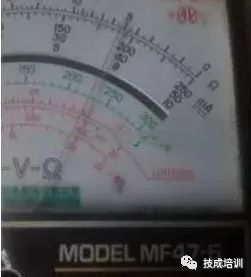
5. Next, keep one probe in the same position and move the other probe to the third wire. It can also be UV, UW, or VW.
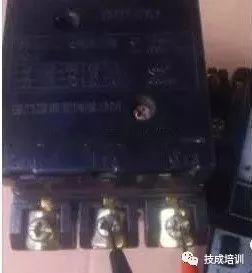
6. The measurement results will all show 380V. The characteristic of this three-phase electricity is that the voltage between any two wires is 380V, which is also the line voltage of 380V. This is the three-phase three-wire power supply mode. There is also a three-phase four-wire system, which includes a neutral wire; the relationship is that the voltage between the live wires is still 380V, and the voltage between the live wire and the neutral wire is 220V.
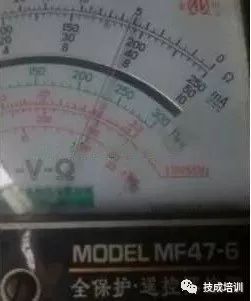
7. This way, you have learned how to read values on a multimeter and understand some characteristics of three-phase electricity.
Share with friends and learn together!
ClickRead the Original to learn about electrical work, PLC, frequency servo, CNC robotics, and more.