In the International System of Units (SI), the ampere is the basic unit of electricity, and the SI definition of the volt is derived from the ampere and the mechanical unit of watt. Ampere The international unit connects mechanical and electrical units through the definition of the ampere. The SI definition of the ampere is: “The constant current that, if maintained in two straight parallel conductors of negligible cross-section, placed 1 meter apart in vacuum, will produce a force equal to 2×10 -7N per meter length of the conductors.” Since the standard ampere is very difficult to realize, its implementation has a large uncertainty of about 15 ppm, and it is challenging to maintain for more than a few minutes. The diagram below illustrates the process of realizing the ampere.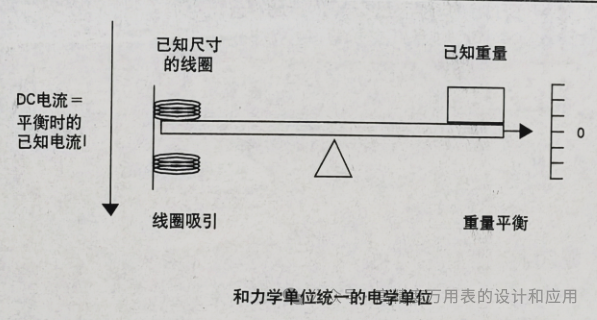 In this simplified diagram, the magnetic field of the coil on the left side of the balance arm generates an attractive force proportional to the current flowing through it and the number of turns of each coil. This force is balanced by the weight located on the right side of the balance arm. The actual equipment used in experiments by NIST, published in the June 1985 issue of the IEEE Transactions on Instrumentation and Measurement, is more complex than this diagram.
But how is this force generated? According to physics, this force is produced by the electromagnetic field associated with moving electrons. In this sense, 1A of current is equal to the flow of 1C of electric charge per second at a given point in the circuit.
Although the ampere is the basic unit of electricity in the SI system, realizing it is quite difficult. Therefore, there is no standard representation of the ampere. Instead, the ampere is derived locally from the ratio of volts and ohms according to Ohm’s law I=E/R. Both volts and ohms are preserved as standards in local laboratories and national laboratories.
Volt
Based on the basic electrical unit of the SI system, the ampere, the volt is defined as “the potential difference between two points on a conductor when a constant current of 1A flows through it, and the power dissipated between these two points is 1W (1 W=1 J/s).” Based on mechanical units, the volt is:
V=W/A
W=J/s
J =Nm
N =kgm/s2
Where W–watts (the derived unit of power in SI);
A–amperes (the basic unit of electricity in SI);
J–joules (the derived unit of work/energy in SI);
s –seconds (the basic unit of time in SI);
kg–kilograms (the basic unit of mass in SI);
m–meters (the basic unit of length in SI).
Representation of DC Voltage
Various national laboratories have conducted various fundamental experiments in physics that support the realization of the ampere, volt, and ohm according to their definitions. However, discoveries in quantum mechanics have led to representations of volts and ohms derived from the Josephson effect and the quantum Hall effect. Below, we can see that the reproducibility and stability of these representations of volt and ohm units can indeed be better than the reproducibility and stability of the realization of these units. It is believed that the realization of the SI volt has an uncertainty of 0.4 ppm (relative to its definition of 1 standard deviation).
Solid-state voltage standards and saturated standard cells are also used to represent volts, serving as local voltage standards. Compared to the more difficult realization of the volt definition, this method offers easier reproducibility and better stability. Therefore, standard laboratories typically preserve volts and ohms as primary standard units, from which amperes and watts are derived.
Intrinsic Standard of the Josephson Effect
The Josephson effect is a superconducting physical phenomenon. It relates voltage and frequency through the ratio of fundamental natural constants. The Josephson array is an intrinsic, independently reproducible standard that uses an integrated circuit containing many Josephson junctions. We use this standard to represent the SI volt rather than to realize the SI volt. The output of a single Josephson junction is defined as:
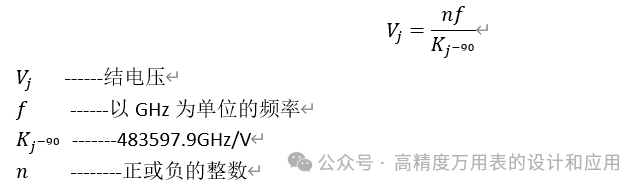
In the equation describing the Josephson effect, the general Josephson constant is denoted by Kj, which is equal to twice the ratio of the fundamental natural constants e and h, that is:
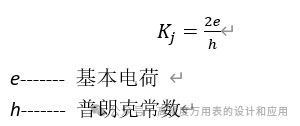
In October 1988, the International Committee for Weights and Measures (CIPM) recommended that all national laboratories use the same value for the Josephson constant. The recommended value is: Note that
  is the assigned value of the Josephson constant.The following image shows the Josephson voltage system of the Chinese Academy of Metrology.
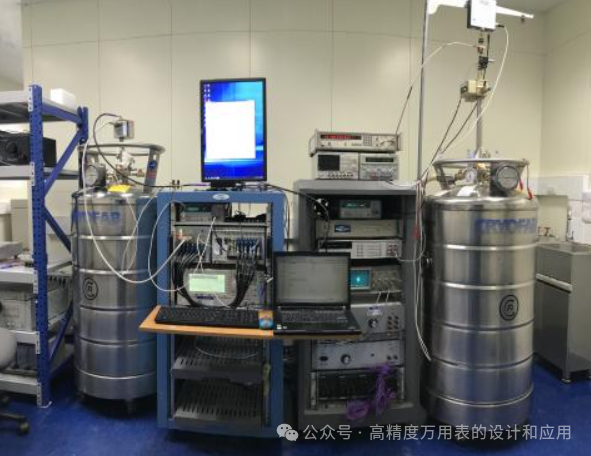 With the improvement of microfabrication technology and scientists exploring different materials and configurations, the evolution of modern Josephson standards has gone through several stages. In 1984, the first 1 V standard was introduced, and by the late 1980s, array technology had advanced enough to successfully demonstrate a 10 V superconducting integrated circuit, with JVS systems operating in major national metrology institutes worldwide. The consistency of DC voltage measurements conducted in different laboratories improved by four orders of magnitude. These measurements now differ by no more than a few tenths.
The earliest systems aimed to achieve precise realization of a single DC voltage. However, science and industry require a user-adjustable system capable of realizing arbitrary AC and DC voltages. The first programmable JVS (PJVS) was designed by physicist Clark Hamilton in the early 1990s at NIST, while Benz was working with him as a postdoctoral researcher. Benz soon became a scientist and collaborated with Hamilton on many design innovations that continue to this day.
The programmable design requires dividing microwave signals into multiple channels through waveguides, and the junctions must be divided into multiple sub-arrays, each of which can be independently addressed. Additionally, each junction should be able to switch very quickly and produce precise voltage steps within a well-defined bias current range. (Josephson junctions produce positive and negative voltages in discrete quantized values. Benz and his colleagues introduced the first programmable 1 V system in 1997 and announced a fully functional 10 V system in 2006.
The following image shows the low-temperature cooled 10V programmable Josephson voltage standard from CMS.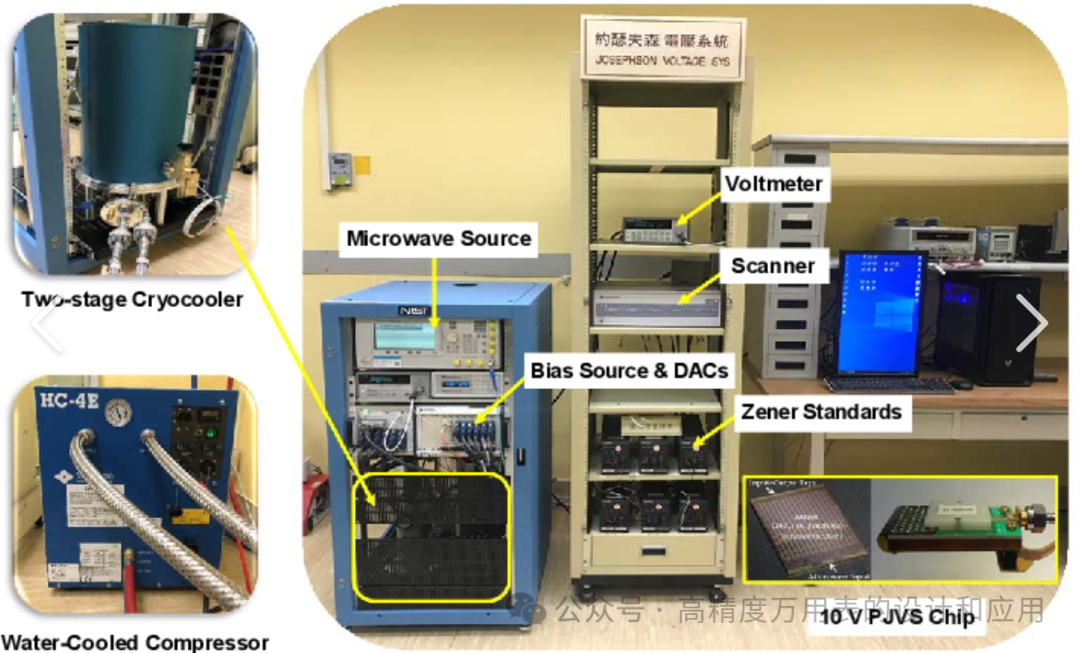 PML researchers are about to achieve a long-sought major goal: to provide the world with a programmable quantum voltage standard with an uncertainty of less than one billionth, requiring no calibration, and with enough automation for non-experts to use in developing countries.
“To achieve this, extensive research and development over thirty years in multiple fields, including materials science, microwave engineering, superconducting technology, and electronic and system integration, is required,” said Sam Benz, project leader for the development and dissemination of quantum voltage systems in the Quantum Electronics and Photonics Department. “Now, we are finally able to integrate a high degree of automation. These new systems will support a wide range of researchers and businesses globally.
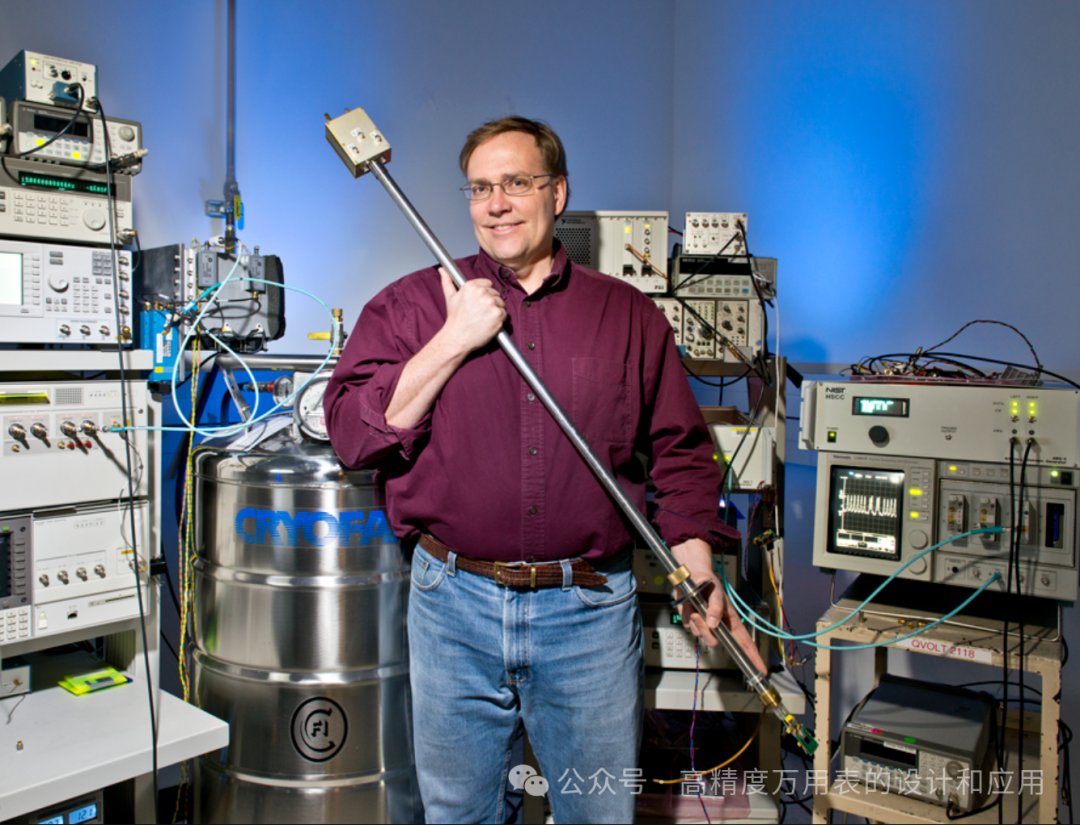
Sam Benz demonstrated that the new automated voltage standard requires relatively few pieces of equipment. The chip containing the Josephson junctions is located at the bottom of the pole.
To be continued…