 Welcome to join the C3H3 Teacher Group, to join the group please contact WeChat c3h3wxip, please indicate “Join Group“.

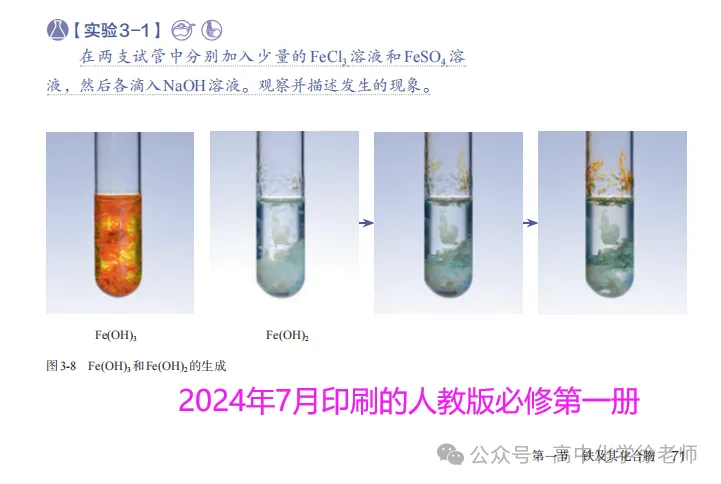
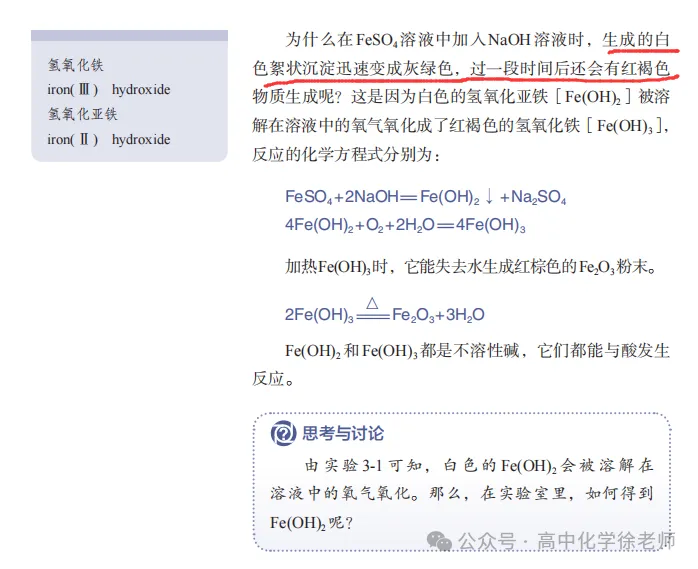
There are various hypotheses regarding the composition of the gray-green substance, and each hypothesis has been validated by corresponding experimental evidence, mainly as follows:
①Fe₃(OH)₈ (or Fe(OH)₂·2Fe(OH)₃)
②Fe(OH)₂ adsorbs Fe²⁺
③Fe(OH)₂ forms a complex with H₂O
④Fe³⁺, Fe²⁺ forms complexes with various anions, known as green rust GR (for example: Fe(Ⅱ)₄Fe(Ⅲ)₂(OH)²⁺(SO₄·2H₂O)²⁻).
Some experimental phenomena are quite significant:
①Fe(OH)₂ precipitate itself will convert to red-brown Fe(OH)₃ when exposed to air, but there is no gray-green intermediate state.
②When NaOH solution is at a high concentration and in excess, the generated Fe(OH)₂ white precipitate can last for a long time.
③When there is more FeSO₄ and a small amount of NaOH solution, in addition to generating Fe(OH)₃, part of it decomposes into black Fe₃O₄.
④At higher temperatures, the white precipitate persists, and as the temperature drops, the gray-green precipitate gradually becomes visible.
⑤If the gray-green precipitate is taken out and added to an excess NaOH saturated solution or heated, it can turn back to white.
In high school chemistry experiments, preparing ferrous hydroxide is a major pain point for teachers if this experiment is used as a classroom demonstration, as students often cannot see the obvious white precipitate as described in textbooks,