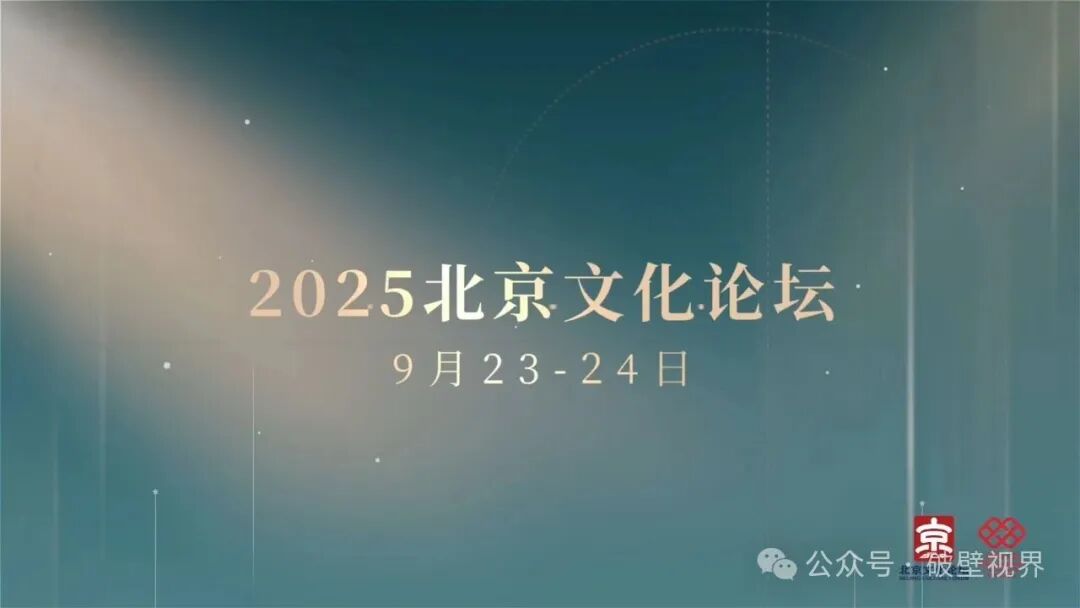
In early autumn in Beijing, the ridge beasts of the Wanchun Pavilion on Jingshan and the glass curtain walls of the CBD are simultaneously reflected in the same frame. From the 23rd to the 24th, the Beijing Cultural Forum invited over 800 guests from 58 countries and regions into this ‘ancient and modern frame’, providing a vivid contemporary footnote to the dual pursuit of ‘culture + technology’.
One
“Let the cultural relics stored in museums, the heritage displayed on vast lands, and the texts written in ancient books come to life.” This was translated by the forum into a series of tangible ‘Beijing actions’ —
3D printing the coffered ceiling of the Tai Sui Hall at the Temple of Agriculture into a fingertip-spinning table lamp, sending the ‘central axis’ to the bedside of Generation Z with 500,000 orders;
Emergency rescue at the Jiankou Great Wall, where wearing a VR headset transforms the audience into ‘digital craftsmen’, personally injecting mortar into the brick seams;
‘Black Myth: Wukong’ uses the Unreal Engine to split open the ‘Southern Gate of Heaven’ in Eastern mythology, allowing players worldwide to collectively shout ‘Sun Wukong’ in Pinyin for the first time.
As culture moves from the ‘glass cabinet’ to the ‘server’, and technology shifts from the ‘toolbox’ to the ‘depths of the soul’, people discover: algorithms can grow the rings of ancient trees, and silicon chips can store a millennium of nostalgia.
Two
“The integration of culture and technology is not a simple ‘culture + IT’, but a chemical reaction of ‘civilization × computing power’.” A professor from Tsinghua University in Shenyang succinctly articulated the core of the forum’s annual theme —
Culture cannot be ‘dimensionalized’ into data by technology; technology must be ‘elevated’ into value by culture.
The Director of the UNESCO World Heritage Centre, Asomo, presented laser point cloud data of the Colosseum, where every collapsed stone is marked with a ‘cultural coordinate’ in a 30TB model;
French director Jean-Jacques Annaud stated: “Technology does not replace film; it allows the wind to continue blowing through the hair on the prairie.”
The Chinese side responded with equal weight: Beijing took the lead in implementing the ‘Ultra High Definition Audiovisual Pioneer Action Plan’, with 8K cameras focusing on the flowing sleeves of Peking Opera, capturing micro-expressions of 0.3mm in real-time; the People’s Daily incorporated large models into its editorial system, with the generative AI-assisted creation of ‘New Thousand Li Rivers and Mountains’ achieving over 100 million reads within 24 hours.
When ‘cultural algorithms’ become a new production factor, and ‘technological aesthetics’ become a new grammar of communication, people finally believe: code can also have warmth, and silicon-based can have bloodlines.
Three
At the closing of the forum, the organizers quietly erected a ‘Digital Merit Grove’ outside the venue — scan to claim a ‘cloud tree planting’, with blockchain ensuring rights, redeemable for a real pine tree in ten years. Technology may seem ‘light’, but it supports the ‘heavy’ promise of civilization:“Let every click become a guardian of culture; let every share become a relay of civilization.”
This is precisely the greatest metaphor left by the Beijing Cultural Forum for the era: the integration of culture and technology is not about stuffing an old soul into a new shell, but about allowing the new and the old to grow the bones of the future together;it is not about machines replicating humans, but about humans understanding ‘what it means to be human’ in front of machines.
Four
Stepping out of the Beijing International Hotel, the lights of Dawangjing at night intersect with the smoke of the ancient Yanji Gate in imagination. At this moment, we can better understand the deeper meaning behind the ‘Ten Major Events for National Cultural Center Construction in 2024’ released by the forum —
From ‘240-hour transit visa exemption’ to ‘global Generation Z visiting Beijing’, from ‘Liuli River site archaeological breakthroughs’ to ‘popular cultural creations leading trends’, each item is an ‘invitation letter’ from Beijing to the world:Come, see how an ancient nation restarts the Book of Songs with algorithms, and how young China stores Qu Yuan with chips.
In the next phase, Beijing will also build a ‘Digital Civilization Special Zone’ in the sub-center, create an ‘AI Director Factory’ in Shougang Park, and open a ‘Metaverse Intangible Cultural Heritage District’ at the foot of the Great Wall. The goal is singular:to make culture the warmest background of technology, and to make technology the most steadfast wing of culture.
Five
At the venue, I encountered a post-95 photographer who projected the AI-generated ‘Digital Central Axis’ onto the rain-soaked asphalt, with reflections of the Forbidden City turret and 5G base stations in the puddles. The young man said: “Teacher, do you smell that? Is it new?”
I looked down, and in the puddle floated the faint heat of chip cooling and the resin scent of ancient cypress.
At that moment, I understood:The so-called integration of culture and technology is merely allowing the residual warmth of history and the flames of the future to simmer together in the same ‘Beijing pot’, slowly stewing to produce the ‘civilization broth’ of the 21st century.
The forum has dispersed, and thoughts are on the road. Let us meet at the next session, bringing more mature algorithms and clearer minds, back to Beijing —
Together, let us write ‘culture’ into chips and read ‘technology’ as poetry.
For more podcast content, please click the audio below to listen.