On November 8, domestic IC distributor Yingtang Zhikong announced plans to acquire 100% equity of Guanglong Integrated and 80% equity of Ao Jian Microelectronics; coincidentally, on September 26, Yachuang Electronics announced plans to acquire 40% equity of Ouchuangxin and 45% equity of Yihainengda; in June and March, Yachuang Electronics also announced the acquisition of 35.88% equity of Analog Semiconductor and 100% equity of Rongchuang Microelectronics…
How should we view the trend in the electronic components distribution sector? Li Jin, an industry analyst from International Electronic Business, recently analyzed to the Securities Times reporter that whether on the domestic or international stage, the merger and acquisition activities of major distributors are becoming increasingly active. These dynamics not only showcase the growth momentum of the distribution industry and the integration trend of the global electronic industry chain but also indicate an increase in market concentration in the future. As distributors expand their scale and deepen their services, they will play a more important role in the global electronic supply chain while also facing more intense market competition and constantly changing industry challenges.
Increase in Industry Concentration
Electronic components generally cover categories such as ICs (integrated circuits, chips), resistors, capacitors, inductors, connectors, and diodes/transistors.
“For a long time, due to the vast variety of electronic components and diverse downstream demands, procurement orders have been relatively scattered. The upstream production side often finds it difficult to directly connect with the massive downstream demand. Therefore, there is usually a huge circulation market between the upstream manufacturers and downstream demand parties, where distributors play an important role,” said Yuan Shuai, deputy secretary-general of the Zhongguancun Internet of Things Industry Alliance, to the Securities Times reporter.
According to statistics, currently, about 44% of electronic components are procured directly by downstream electronic product manufacturers from the original manufacturers, with downstream manufacturers adopting this model (commonly referred to as “blue-chip super customers”) accounting for about 1% of electronic product manufacturers. The remaining 56% of electronic component procurement mainly relies on distributor channels, with over 99% of electronic product manufacturers primarily using this method to procure materials.
From an industry perspective, after years of development, leading companies in the global electronic components distribution field include Arrow, Avnet, WPG, Winstek Technology, China Electronics Port, and Shenzhen Huaqiang. Geographically, they mainly come from North America, Western Europe, and East Asia. Among them, the top four global distributors, Arrow (USA), Avnet (USA), WPG (Taiwan), and Winstek Technology (Taiwan), each had total revenues close to or exceeding $100 billion from 2022 to 2024.
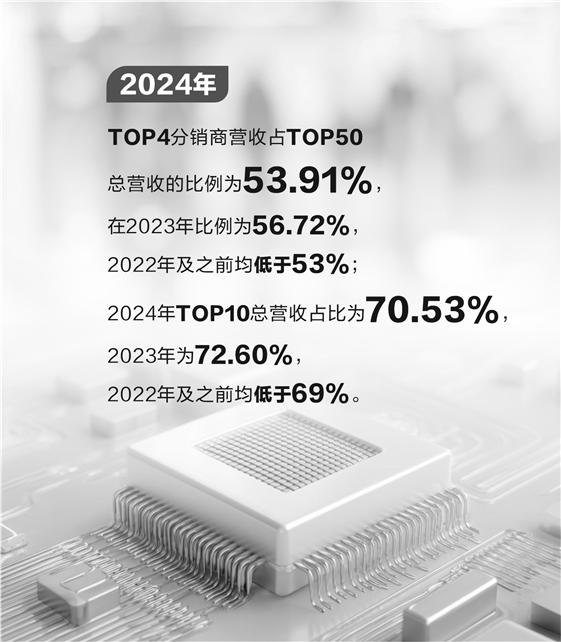
At the same time, industry concentration is steadily increasing. According to statistics from International Electronic Business, in 2024, the revenue of the top four distributors will account for 53.91% of the total revenue of the top 50 distributors, compared to 56.72% in 2023, and below 53% in 2022 and earlier; the total revenue of the top 10 will account for 70.53% in 2024, down from 72.60% in 2023, and below 69% in 2022 and earlier.
Local distributors in mainland China are also rising rapidly. Companies like China Electronics Port, Shannon Semiconductor, Shangluo Electronics, Yachuang Electronics, and Yunhan Chip City have all entered the capital market. Among them, the leading company, China Electronics Port, saw its revenue exceed 25 billion yuan for the first time in 2020; it reached 48.639 billion yuan in 2024; and its revenue for the first three quarters of this year was 50.598 billion yuan, mainly benefiting from revenue growth in the computing industry, AI, and other fields.
“In recent years, the performance of global distributors has shown some differentiation. Distributors in the Greater China region, with a higher proportion of AI and memory devices, have also seen a recovery in performance. However, due to inventory destocking, traditional consumer, industrial, and automotive chips, which account for a larger proportion, have shown negative growth in some North American and Japanese distributors,” Li Jin pointed out.
Pursuing Diversified Development
From an industry trend perspective, the history of the semiconductor industry is also a history of mergers and acquisitions, and the electronic components distribution field is no exception. For example, Arrow Electronics has completed acquisitions of distributors such as Converge and Verical over the years; Taiwan’s Winstek Technology, after acquiring Singapore’s Worldtech, announced in April 2024 the acquisition of Canada’s Future Electronics, which has locations in 48 countries and regions worldwide. A series of capital operations have allowed Winstek Technology’s revenue in 2024 to surpass Arrow Electronics, making it the global leader.
In the A-share market, there have been numerous merger cases in the distribution field in recent years. In September of this year, Shangluo Electronics announced the acquisition of 88.79% equity of Ligong Technology, which mainly represents chip brands such as NXP, Silan, Sireen, and Rockchip, providing products and solutions to over 2,000 enterprises; at the same time, Yachuang Electronics, Shenzhen Huaqiang, and Liyuan Information are also expanding their scale through acquisitions.
In the context of the restructuring of the semiconductor industry chain, distributors are responding to market changes through various strategies. In terms of diversification, some distributors are beginning to extend upstream to original manufacturers and downstream to foundries, expanding into semiconductor R&D design, PCBA (Printed Circuit Board Assembly) intelligent manufacturing, and other fields. For example, Arrow Electronics has actively laid out in India and Southeast Asia in recent years, promoting the development of local semiconductor and related technology industries through a series of investments and collaborations. In mainland China, Yingtang Zhikong has been continuously promoting its leap from a traditional distributor to a semiconductor IDM (Integrated Device Manufacturer) enterprise, with the acquisition transaction announced in November focusing on the core semiconductor device sector.
Online distributor Yunhan Chip City went public in the A-share market in September this year. The company not only provides efficient and professional one-stop supply chain services to downstream clients but also extends into product technical solution design, PCBA production services, electronic engineer technical support, and other fields.
Regarding the trend and strategy of mergers and acquisitions, Yunhan Chip City Chairman Zeng Ye previously analyzed to the Securities Times reporter that large-scale mergers and acquisitions in the industry align with business logic. The larger the scale, the better the negotiation power with upstream chip design manufacturers. The domestic industry will certainly follow this path. The company also has plans for future acquisitions, but the premise is that the acquisition targets must synergize with the company’s existing traffic and resources, not just provide financial gains.
Li Jin believes that the series of mergers and acquisitions by global distributors reflects that the concentration of the components distribution industry is still increasing, and it is expected that merger and acquisition activities among distribution companies will continue in the future.
At the same time, she pointed out that since the birth of electronic components distributors nearly a century ago, this role has undergone several significant transformations. Its functions have gradually evolved from the initial traditional trade distribution model to a diversified role that provides value-added services, executes supply chain integration, and promotes digital transformation.
Integration of Distribution Networks
In addition to diversification, as digitalization and e-commerce continue to penetrate the B-end, semiconductor original manufacturers have also increased online procurement capabilities in recent years, leading to an overall trend of “increased direct sales proportion and optimized agent channels” in the industry. This is particularly evident in the strategies of Texas Instruments and Analog Devices to reduce their agents.
In this regard, Li Jin analyzed that for semiconductor original manufacturers, the reduction of agents and the transformation of roles allow them to concentrate resources more effectively, strengthen their grasp of market trends, and respond quickly to customer needs; for agents, they need to enhance their capabilities in supply chain management, logistics distribution, technical support, and actively adjust their business and profit models to adapt to the new market environment. Overall, the semiconductor distribution network is developing towards a more efficient and professional direction.
“This means that agents need to further improve their service levels and professional capabilities, especially in ‘technical support’, ‘supply chain management’, and ‘digital transformation’ to meet the growing demands of the market and customers,” Li Jin said.
Looking ahead to the long-term prospects of the industry, Yuan Shuai stated that the rapid development of the domestic electronic industry has brought broad market space for the electronic components distribution industry. With the rise of emerging technologies such as 5G, artificial intelligence, and the Internet of Things, the pace of electronic product updates is accelerating, leading to a continuous increase in demand for electronic components. Domestic distributors can leverage this trend to strengthen cooperation with upstream suppliers and downstream customers, expand business areas, and increase market share. At the same time, some capable domestic distributors can also expand into international markets through overseas mergers and acquisitions, gradually moving from the domestic market to the global stage.
As manufacturing goes overseas, China’s supply chain companies will inevitably integrate into the global market. “In 2023, we established an overseas operation center in Singapore to prepare for ‘going out’. The Yunhan Chip City model has been validated domestically, and we plan to extend this successful experience overseas, continuously providing efficient and reliable supply chain services to global customers.”
Li Jin believes that mainland Chinese distributors need to continuously innovate to adapt to market changes, responding to challenges by enhancing service capabilities, technical strength, and market insight, while focusing on consolidating the domestic market and actively expanding the international landscape. Global distributors will focus on resource integration and technological innovation, with both parties driving the increase in market concentration and playing a more important role in the global electronic supply chain.
 Editor: Peng BoProofreader: Gao Yuan— END —