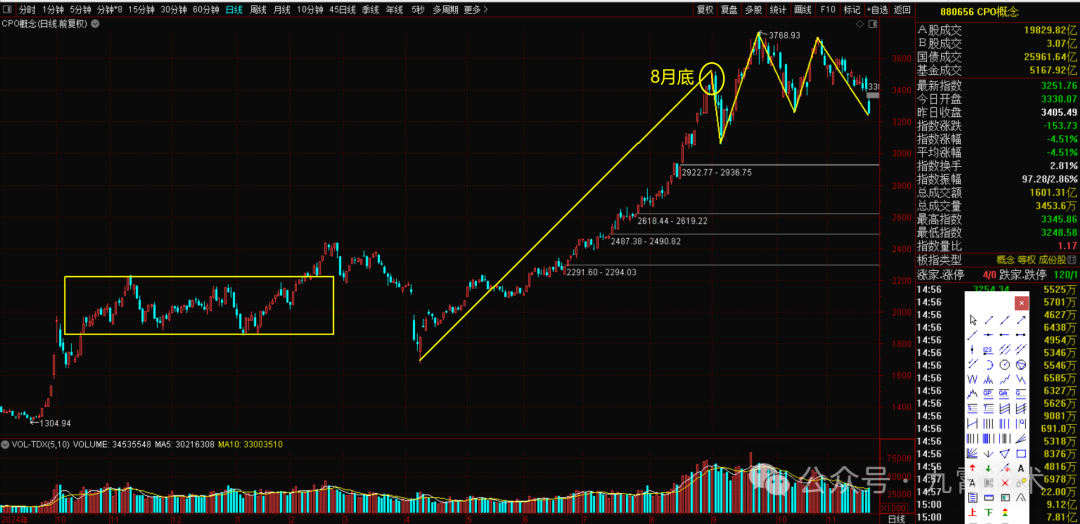
Yesterday’s decline caused many people to lose their composure. In fact, for the vast majority of small and mid-cap stocks, yesterday’s signal was rather favorable, as it officially announced the end of the first half of the bull market.Some say that the bull market is halfway through, and I haven’t made any money yet. Don’t worry; if the rhythm in the second half isn’t right, you might still not make any money. This year’s tech bull market is something that everyone has never experienced before, and previous experiences are basically useless.For example, the brokerages that were supposed to rise in the first half of the bull market have hardly moved this time. Conversely, tech stocks that didn’t rise in previous bull markets have surged with the index, gaining a thousand points.I find that many people have a misconception that if they buy a leading stock during a bull market, they can rest easy until the end of the bull market. This might stem from the experience of the incomplete bull market from 2019 to 2021.However, experience can become invalid with changes in timing, location, and circumstances. If one does not understand the importance of being pragmatic, then no amount of experience will help.A complete bull market involves institutional consolidation in the first half and retail investor euphoria in the second half. The bull market in 2021 was merely interrupted by the pandemic; it was an incomplete bull market.Will this bull market have a “retail investor euphoria” in the second half? It’s not up to you or me; the market will decide. We can only make logical inferences based on the current state of the market.Why did we recently sell off semiconductors that had already surged and switch to AI software applications that have yet to take off? The primary reason is the concern over the risks of semiconductors that have already risen significantly. This sector has already experienced two major surges over the past two years, reaching historical highs, and many stocks form tops that take years to recover from.Don’t be fooled by those who claim that the logic behind this direction is incredibly strong; that logic has already been realized in the price increases. Don’t talk about the strong getting stronger; in the stock market, what rises high must eventually fall—this is the most fundamental rule.Furthermore, the logic behind the rise of semiconductor CPOs has become too widespread; even new retail investors can spout a bunch of reasons for continued growth in this direction. Remember, nothing guarantees that everyone will make money, especially in the stock market.Looking back at the sectors that were hyped up this year, in late July, the Hong Kong stock innovative drugs were hyped, and now they have completed their peak formation.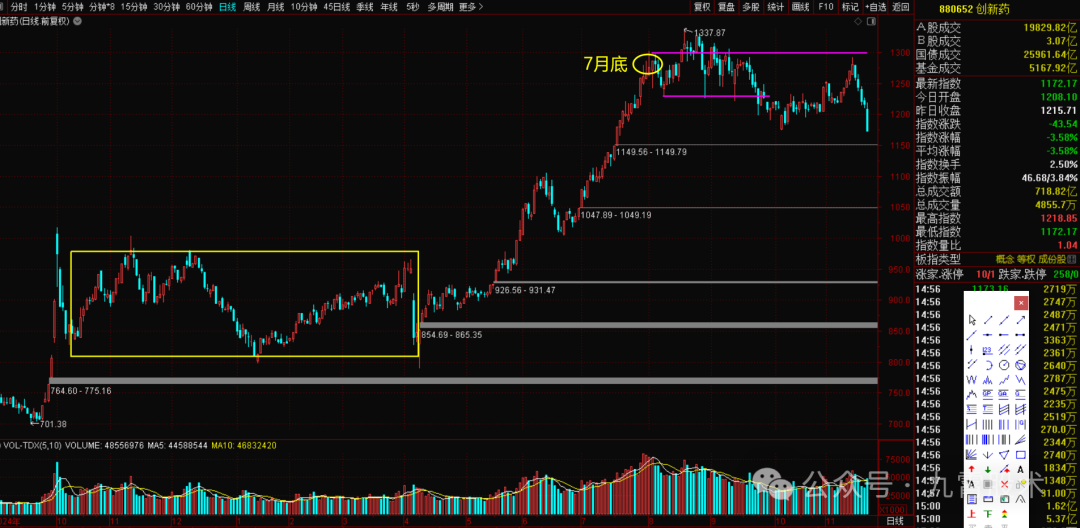 At the end of August, the market hyped the rising logic of CPOs, and now CPOs have also formed a double top.
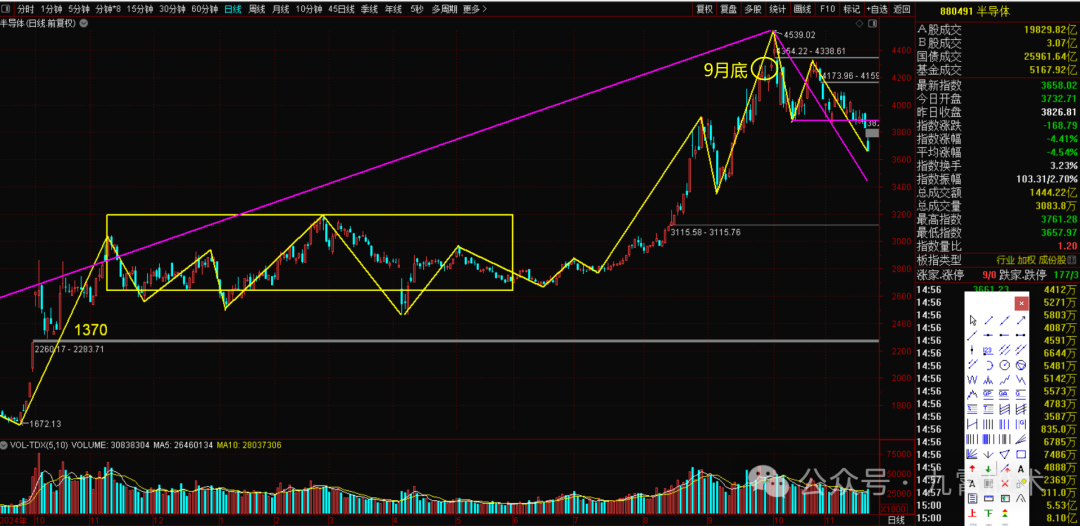
 At the end of September, the hype began around semiconductor storage chips, and now semiconductors have also formed a significant top.
 At the end of October, the hype around AI power storage began, and the same situation has now confirmed a peak.
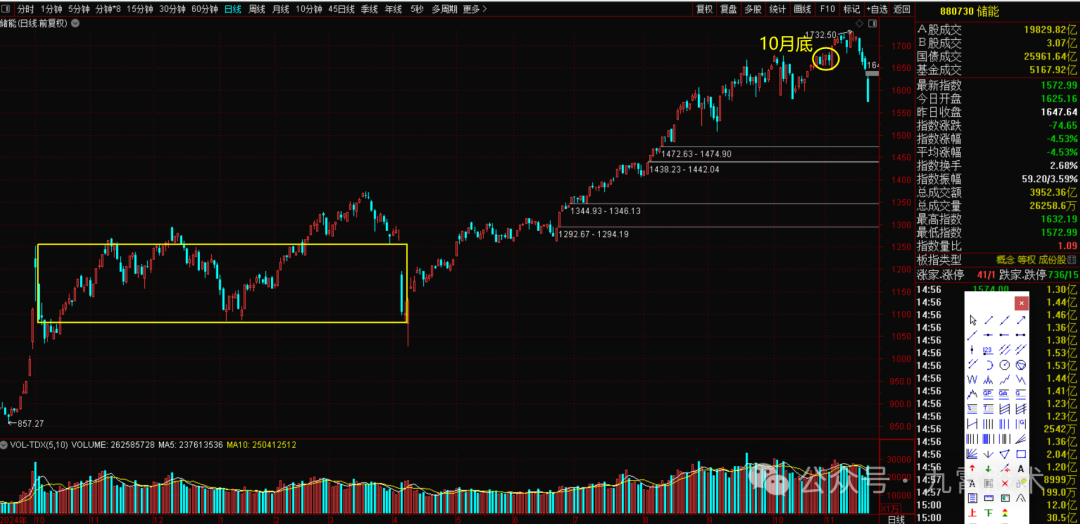 These directions are the ones that have left a deep impression on me in recent months. Before each of these directions peaked, there were numerous bloggers spreading their rising logic.If you hold stocks in the above directions that have already risen significantly, I suggest you abandon your fantasies and face reality. Any rebound is an opportunity to escape; don’t wait until your investment is halved to ask what to do.The only lesson history teaches is that it forgets all lessons. In the stock market, every peak is a repetition of past stories, and the most common phrase humans say is: this time is different.As for why we switched to AI software applications, the first reason is that this direction is still relatively low and has not yet started its main rise. This is the most fundamental and reliable buying logic.Secondly, the performance of AI hardware infrastructure is tangible and real, generating actual profits. The shovels have already been sold, so it is only natural that gold will be dug up next. Just like when the 4G network was built, should we worry about the lack of related 4G applications? It’s all a natural progression.Once the AI hardware infrastructure is established, it lays the groundwork; we do not know what kind of applications will emerge, but we can be certain that something suitable for this environment will grow.As for when this direction will specifically start to take off, we cannot predict that either, just like when we positioned ourselves in semiconductors back in May. All we can do is patiently wait.As long as the large-scale upward structure remains intact, there is nothing to worry about. It’s just a matter of some turbulence before the main rise starts. Once the main rise begins, we are currently in the bottom area.However, the vast majority of retail investors have a habit of always wanting to avoid corrections. This mindset is understandable; after all, avoiding corrections and capturing the main rise can yield more profits. But achieving this is logically contradictory.Because the main rise often involves large-scale increases, only by using large-scale buy and sell points can one hope to capture the main rise.In the adjustment phase of a large-scale upward structure, there are small-scale downward structures. If one trades using small-scale buy and sell points, unless they can buy back promptly after each small-scale buy point forms, they are likely to miss the main rise. The normal washout before the main rise will inevitably touch small-scale sell points, which is unavoidable.So, if you really want to avoid the adjustment phase and catch the main rise, you can only focus on operating one or two stocks, selling at each small-scale sell point, and buying back promptly at each small-scale buy point.There are two challenges here: one is the technical buy and sell points, whether they can be accurately judged and executed in time. The other is the psychological pressure from frequent trading; many people find it difficult to trade frequently without losing their rhythm.Frequent trading is not difficult; the root cause of most retail investors’ losses lies in frequent trading. However, trading frequently and maintaining rhythm is very challenging, as it requires confidence in the trading system to strictly execute every operation instruction.Why establish a short-term trading group? It’s not to expect that these lightly held short-term stocks will bring us significant profits, but rather to develop a conditioned reflex habit of executing buy and sell points through frequent execution.Short-term gains and losses are influenced by emotional strength; when emotions are good, the probability of making money is high, and when emotions are bad, the probability of losing money is high. When to make money and when to lose is determined by the market. What we can do is to do less when emotions are poor and more when emotions are good.Therefore, after clearing out the last remaining short-term stock in the group on Thursday, no new short-term stocks were purchased. Because the current market sentiment is weak, the probability of making money is low. We need to wait for market sentiment to strengthen before our odds improve.In summary, the first half of the bull market has ended. Regardless of whether one made money in the first half, the market will not repeat the first half of the bull market just because someone did not make money.Missed opportunities are no longer opportunities; instead, they become tempting traps. The revenge psychology after missing out in the market makes it easy for us to miss out on profits when the market is up and to get hit when the market is down. Facing the current reality is the most basic quality for trading.So now we should not consider which opportunities we missed in the first half of the bull market; having captured the main rise in semiconductors during the first half is already sufficient. Now we should consider how to seize opportunities in the second half of the bull market, as for the vast majority of retail investors, the second half is the real bull market.In the first half of the bull market, large-cap stocks generally drive the index up, completing the “weight lifting” action. During this phase, if you do not hold those few large-cap stocks that drive the index up, you are basically not making money.Coincidentally, the vast majority of retail investors do not like to buy large-cap stocks, thinking that large-cap stocks cannot move the market, so it is quite normal for retail investors to miss the first half of the bull market.In the second half of the bull market, small-cap thematic stocks generally emerge to catch up with the large-cap stocks that have driven the index. This phase sees small and mid-cap stocks blooming everywhere. During this phase, those large-cap stocks that performed well in the first half of the bull market generally do not show much performance.Retail investors who prefer to buy small-cap stocks find it relatively easier to make money at this time. If they are attracted back to buy the large-cap stocks that performed well in the first half of the bull market, they may end up missing out on both sides and not benefiting from either.I remember saying at the beginning of the bull market that there is a type of person who is guaranteed to make money in a bull market: the “fool” who sticks to a high-certainty direction until the end of the bull market will inevitably reap a reward.However, those with money to invest in stocks are often very smart. They think about eating a wave here when it starts and then eating a wave there when it starts. If they have that ability, they can indeed make more money. However, the vast majority of retail investors do not have that ability but still want to achieve this, resulting in the outcome of missing out on big profits while being present during downturns.When the market structure confirmed the weekly-level upward structure in April last year, I shifted the funds used for defense in bank stocks to tech stocks, often saying: To eat the biggest piece of meat, I am willing to endure the most painful hits.Over the past two years, to capture the two major rises in semiconductors, how many hits have I taken? The truly big rising days are just a few short days, while over 90% of the time is either taking hits or sitting on the sidelines.Smart people always think, I’ll wait until it starts before I go in. First, I’ll dabble in other directions to earn some extra cash. This is indeed human nature; after all, who doesn’t want to earn a little more?If I were to stop you from making more money, you would probably see me as an enemy. As the saying goes, blocking someone’s financial path is like killing their parents. In a bull market, people are restless, and I can only try to be cautious. If you are willing to trust me, I will say a few more words; if not, feel free to disregard.Especially with the upcoming surge in small and mid-cap thematic stocks, once it starts, the volatility will be huge. Executing some operations from a risk-averse perspective often leads to missing out on limit-up opportunities. Missing one limit-up might be bearable, but missing several will likely make you feel like you want to kill me.In the stock market, no one can predict the future; we can only make decisions based on our understanding of the market. Whether right or wrong, that can only be known afterward. Our operations require responses to the present, not post-event commentary.However, human nature tends to want to stand in a position of hindsight and omniscience, fantasizing about what operations should have been performed. This should not have been bought, that should not have been sold, this should have been bought, that should have been sold, and so on.Ultimately, this creates an illusion that if I had listened to Jiu Xiao, I could have made at least this much in this bull market.The stock market is so magical; it causes people to sink into greed, anger, ignorance, doubt, and slowness, ultimately learning how to find excuses for losses while losing the courage to find methods for making profits.To truly stand up in the stock market, it has never been about summarizing the reasons for losses. There are only two things: first, facing the real self, and second, facing the real market. Do not deceive yourself, do not fantasize about the future.If you didn’t make money in the first half of the bull market, it’s okay. There’s still the second half. If you don’t make money in the second half of the bull market, then for most people, you can only wait for the next bull market.Alright, it seems I’ve written quite a bit, so I’ll stop here. I hope that in the upcoming second half of the bull market, we can successfully earn our share of profits. Good luck!