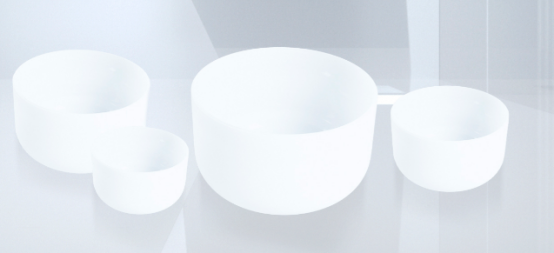
Chip manufacturing has extremely stringent requirements for the quality of raw material silicon wafers, particularly in terms of purity, defect density, dislocations, and impurity content (oxygen, carbon, metal ions). Quartz crucibles are key consumables in the production of semiconductor silicon wafer raw materials.
Source: Meijing New Materials
As a carrier of molten polycrystalline silicon, quartz crucibles are in direct contact with silicon materials and their molten liquids. Especially in high-temperature (1,420℃) production environments, the performance levels of purity, strength, thermal properties, bubble content, and surface condition significantly affect the quality, yield, and consistency of semiconductor silicon wafers. Compared to solar quartz crucibles, semiconductor quartz crucibles have stricter requirements for the impurity content of raw quartz sand during the manufacturing process, and the standards for ash content of graphite electrodes, the grades of chemical solutions used in production, coating materials, and pure water also have higher requirements based on different inner layer positions.
01
Difficulty in Sourcing, Tight Supply of High-Purity Quartz Raw Materials
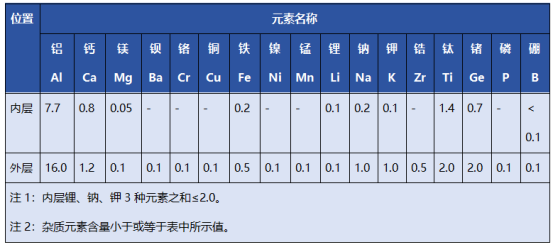
In the semiconductor industry, quartz crucibles have high requirements for the impurity content of alkali metals and transition metals. Alkali metal impurities can affect the thermal characteristics of quartz crucibles, reducing the temperature resistance of quartz products, lowering their melting point, and degrading high-temperature performance. Transition metal impurities can reduce conductivity, shorten the lifespan of semiconductors, and high impurity content can lead to defects such as bubbles and color spots, reducing the transparency of quartz crucibles, and in severe cases, affecting the molding of quartz crucibles.
For example, the local standard “DB 13/T 5631—2022 Technical Specifications for the Production of Quartz Crucibles for Monocrystalline Silicon Growth” outlines the stringent requirements for the raw materials used in electronic special materials for monocrystalline silicon growth.
Local Standard “DB 13/T 5631—2022 Technical Specifications for the Production of Quartz Crucibles for Monocrystalline Silicon Growth”
Impurity Element Content in Quartz Sand (measured in micrograms)
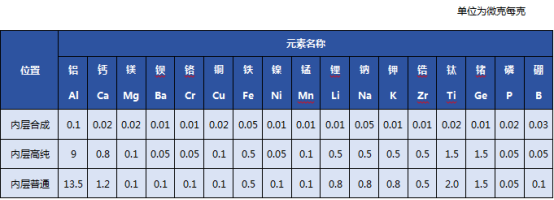
Drafted by Inner Mongolia Oujing Technology Co., Ltd., Jiangxi Zhongyu New Materials Technology Co., Ltd., and Jinzhou Youxin Quartz Technology Co., Ltd., the group standard “Production Specification Standards for Quartz Crucibles for Semiconductor Monocrystalline Silicon Growth” stipulates the standards for the main raw materials used in semiconductor monocrystalline silicon growth quartz crucibles.
“Production Specification Standards for Quartz Crucibles for Semiconductor Monocrystalline Silicon Growth”
Impurity Element Content in Quartz Sand
The core raw materials in the upstream supply chain of the semiconductor quartz crucible industry are mainly high-purity synthetic quartz sand and high-purity natural quartz sand. A stable supply of semiconductor quartz crucibles is contingent upon ensuring sufficient raw material sources, yet the supply of high-purity synthetic quartz sand and high-purity natural quartz sand is tight. High-purity synthetic quartz sand is made from silanol salts and is an ideal raw material for high-purity quartz glass products, currently primarily supplied by Mitsubishi Chemical globally. High-purity natural quartz sand typically meets the IOTA-STD grade of the U.S. Silicon Valley Company, and there are currently few companies globally that can supply it, including only the U.S. Silicon Valley Company (formerly Unimin Corporation) and Norway’s TQC.
02
Detailed and Stringent Technical Requirements
Semiconductor quartz crucibles are characterized by uniformity and high purity (the inner layer of high-purity semiconductor synthetic quartz crucibles requires a purity of over 8N). Compared to some developed countries, China started later, and there are certain gaps in some production processes compared to internationally leading companies. In terms of product stability and micro-bubble control, Japanese companies can control temperature-induced deformation within a small range (±0.75mm), and some synthetic quartz sand crucibles can achieve zero internal bubbles, while domestic crucibles currently cannot meet this standard. Regarding the size of quartz crucibles, some foreign manufacturers can produce semiconductor quartz crucibles with a diameter of 32 inches, while only a few leading domestic companies can produce large-sized semiconductor quartz crucibles.
The preparation technology for semiconductor quartz crucibles is still mainly mastered by leading semiconductor material manufacturers in the U.S. and Japan. The purity of quartz crucibles, the control level of trace elements, the distribution of bubble layers, thermal properties, and the degree of chemical reaction between the inner surface and silicon liquid will significantly affect the microscopic structure, electrical performance, yield, stability, and consistency of the crystals. High-quality semiconductor quartz crucibles need to achieve a perfect balance among various technical parameters, and how to control these parameters is the core technology of advanced quartz crucible manufacturers, especially for the preparation technology of large-sized semiconductor quartz crucibles, which remains a core secret of leading companies in the industry.
The global semiconductor quartz crucible market is highly concentrated, with suppliers that have leading technological process advantages, cost control advantages, and downstream silicon wafer manufacturer certifications holding a solid competitive position, occupying a significant portion of the overall market share.
Currently, the major market shares are concentrated in Momentive Technologies, Shin-Etsu Quartz, and SUMCO JSQ Division. Momentive Technologies announced in June 2022 the acquisition of Coorstek’s quartz crucible product line. China has a high degree of localization in the field of semiconductor quartz crucibles of 18 inches and below, having basically replaced overseas semiconductor quartz crucible brands; some technologically advanced semiconductor quartz crucible manufacturers have the capability to supply 24-28 inch semiconductor quartz crucibles in bulk and are gradually gaining recognition from downstream silicon wafer manufacturers; only a few leading quartz crucible manufacturers can produce semiconductor quartz crucibles of 32 inches and above. Domestic semiconductor quartz crucible manufacturers include Dunyuan Juxin, Jinzhou Youxin, Zhejiang Meijing, Zhongyu Technology, Oujing Technology, and Changzhou Yuneng.
03
Complex Verification System, Long Certification Cycle
The semiconductor industry is highly concentrated, and downstream manufacturers have significant influence globally, with extremely high requirements for product stability, reliability, and consistency. Before becoming a qualified supplier and joining their global division of labor system, they must undergo strict quality management system audits and product performance testing certifications.
Silicon wafer manufacturers typically choose suppliers with high-quality products and good reputations to form long-term stable partnerships for production stability. Quartz crucible manufacturers usually deliver quartz crucible samples to customers for testing based on product testing standards after communicating their cooperation intentions. Only after passing the tests can they be included in the list of qualified suppliers for continuous supply, especially since the certification cycle for semiconductor quartz crucibles is long (generally over 3 years), leading to high time and financial costs. Due to the high costs and complicated processes of changing suppliers for silicon wafer manufacturers, as well as the differences in parameters among different manufacturers’ quartz crucibles, it can significantly impact the production efficiency of silicon wafer manufacturers. Therefore, once a cooperation relationship is established with quartz crucible manufacturers, it tends to be stable and not easily changed.
04
Development Trends: Large Size, High Purity
The semiconductor industry is a strategic and foundational industry that supports social and economic development and ensures national security. With the rise of artificial intelligence, the Internet of Things, and cloud computing, the demand for high-performance chips will further increase, and the performance levels and size requirements for semiconductor silicon wafers are also continuously rising.
Large-sized, high-purity semiconductor quartz crucibles will become mainstream
In terms of performance levels, high-end chips have stricter technical indicators for silicon wafer surface micro-roughness, silicon single crystal defects, metal impurities, intrinsic crystal defects, and surface particle sizes. The technological innovation in the semiconductor silicon wafer industry chain also imposes higher requirements on semiconductor quartz crucible products in terms of size, tolerances, black spots, and impurity levels.
Additionally, semiconductor manufacturing is moving towards “larger wafers” and “smaller processes” to reduce manufacturing costs and power consumption. Currently, the mainstream sizes are 8-inch/12-inch wafers, and with the high-intensity R&D investments of leading domestic semiconductor companies, significant progress has been made in the R&D of key technologies for 12-inch wafers, and advanced process wafer technology is accelerating breakthroughs. The increasing size of downstream semiconductor wafer industries is driving the demand for large-sized, high-purity semiconductor quartz crucibles.
The market share of domestic semiconductor quartz crucibles is expected to increase
As the global semiconductor industry shifts towards China, the market share of domestic semiconductor quartz crucibles is expected to rise. With the support of national policies, the construction of China’s semiconductor industry continues to strengthen, thereby significantly driving the growth of demand for upstream quartz crucibles in the industry chain. In the future, as the process of domestic substitution in the semiconductor field advances, the market share of domestic quartz crucibles in the semiconductor sector will further increase.
References:
China Powder Network. If you don’t understand this, stop wasting quartz sand!
Dunyuan Juxin Prospectus, Meijing New Materials Prospectus
Note: Images are for non-commercial use; please notify for deletion if there is infringement! For quartz flow group, please add WeChat: 13661095071! Please note your company, position, and name.