
Yesterday, a friend sent me a WeChat message late at night: “Brother, I’m about to collapse. I’ve been using LangGraph for three months, and the performance is completely inadequate. Users are constantly complaining, and my boss is pushing me every day. I’m afraid that switching frameworks will waste the initial investment. What should I do?”
This reminded me of myself two years ago, struggling late at night in the office. At that time, I was working on an AI system that needed to handle thousands of user sessions simultaneously, and the latency and memory usage of traditional frameworks were giving me headaches. In the end, I chose to switch to Agno (Multi-Agent Framework), and this decision changed my perception of Agent frameworks.
But what I want to discuss today is not the specific framework choice, but a deeper question: In the world of AI Agents, are we destined to make a single choice between performance, usability, and ecosystem?

The Cognitive Traps Behind Framework Wars
Most people fall into a cognitive bias when choosing an Agent framework—overly focusing on a single dimension.
Some are obsessed with performance data: <span>Which framework starts faster? Which has lower memory usage? Which can handle more concurrent requests? But real production environments are often not about benchmark competitions, but about stable performance in complex scenarios.</span>.
Others are addicted to feature lists: <span>How many tools can be called? How many models are supported? How many templates are built-in? These seemingly rich features may be 80% unused in actual projects.</span>.
Many are bound by the ecosystem: <span>Is this framework community active? Are there many tutorials? Can solutions be found when problems arise? This is indeed an important consideration, but over-reliance on community support often means you are always following others' ideas instead of creating your own solutions.</span>.
I have seen too many teams spend months researching the pros and cons of various frameworks, only to find that the real problem lies not in the tools, but in the complexity of the business scenarios far exceeding the capabilities of the tools themselves.
A friend who works on customer service robots put it particularly well: “I don’t need a framework that runs super fast; I need a framework that allows my business logic to run fast.”
This made me think: perhaps we need to look at the choice of Agent frameworks from a different angle.
What Truly Determines Success is the Ability to Abstract Business Models
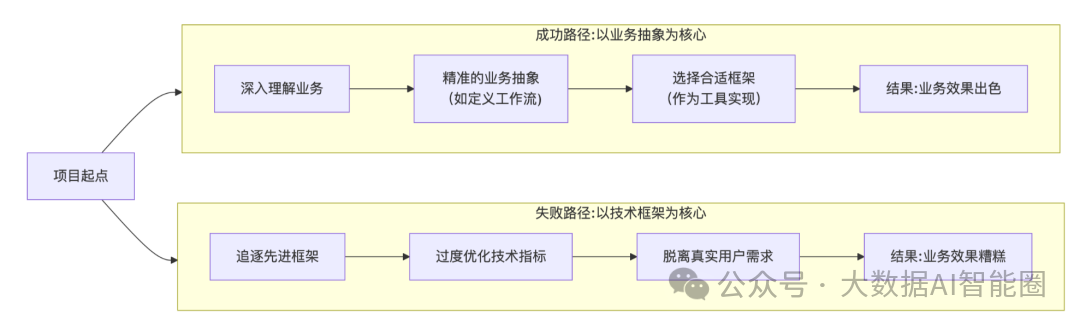
After engaging with AI Agent projects from a dozen different companies of varying sizes, I discovered an interesting phenomenon: truly successful projects often do not use the most advanced frameworks, but rather have the clearest business abstractions.
What is business abstraction? It is expressing real-world business logic in a way that Agents can understand.
For example, in a customer service system, it is not simply saying “<span>I want an AI that can answer questions</span>“, but rather abstracting it as: User Intent Recognition → Specific Question Classification → Professional Answer Generation → Satisfaction Tracking → Human Intervention Mechanism
This ability to abstract is more important than the choice of framework. Because whether using LangGraph, Agno, or other frameworks, it ultimately comes back to the expression of business logic.
I have a client who implemented a banking consultation Agent using very traditional programming methods. The performance was average, but the results were excellent. The reason is simple: they had a deep understanding of banking business, knowing when to use which tools, when to require human intervention, and when to trigger risk control mechanisms.
Conversely, I have seen technically strong teams create high-performance Agents using the latest frameworks, but the actual business results were poor. They spent too much time optimizing the framework itself without deeply understanding the real needs of users.
This reminds me of a metaphor: frameworks are like toolboxes, and the ability to abstract business is like an engineer’s design ability. No matter how good the toolbox is, it cannot replace the creative thinking of the engineer.
The Real Challenges of Production-Level Implementation
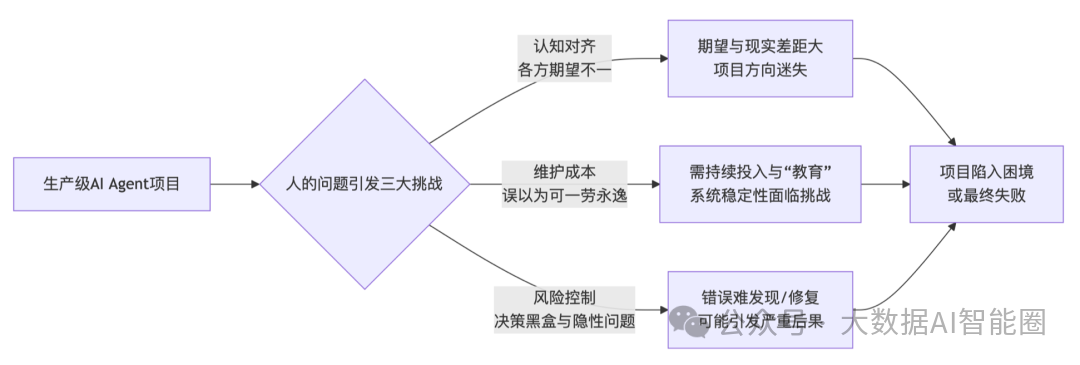
When it comes to production-level applications, many people think the biggest challenge is technical issues. But practical experience tells me that the biggest challenges are often human issues.
First is cognitive alignment.
The technical team thinks the Agent should handle all problems, the business team thinks the Agent should immediately resolve all complaints, and users think the Agent should be smarter than human customer service.
This cognitive difference often leads to projects getting lost in “<span>unrealistic expectations</span>“.
I have encountered the most typical scenario: the business team hears that AI Agents are powerful and expects it to handle 80% of customer service issues. However, actual testing reveals it can only stably handle 30% of the problems, with the other 70% requiring human intervention. The huge gap between expectations and reality puts the project in jeopardy.
Next is maintenance costs.
Many people think that once the Agent is online, it can be “left alone”; in reality, the Agent requires continuous training, tuning, and updates. Every model update, tool upgrade, and process optimization can affect the stability of the existing system.
A friend in e-commerce put it well: “<span>Agents are not a one-time solution; they need continuous education and guidance like children.</span>“
Finally, there is risk control.
Errors made by Agents in production environments are often harder to detect and fix than in traditional systems. This is because the decision-making process of Agents is often a black box, making it difficult to pinpoint the cause when problems arise.
I have seen the most severe case where an Agent from a financial company provided erroneous investment advice due to misjudging user intent. It was later discovered that a change in an API interface affected the Agent’s reasoning logic.
Such hidden issues are more challenging to handle than obvious system failures.
Conclusion
After all this, I do not want to tell everyone which framework is good or bad. Instead, I want to share a perspective: In choosing an Agent framework, there is no absolute right or wrong, only what is suitable for your business scenario.
I suggest evaluating using three dimensions:
First, business complexity: How many types of scenarios does your Agent need to handle? Are there clear boundaries between scenarios? Complex businesses require more flexible frameworks, while simple businesses may need more stable frameworks.
Second, team capability: How well does your team understand the framework? What is the trade-off between learning costs and development efficiency? Do not choose a framework that exceeds your team’s capabilities too much.
Third, evolution expectations: How will your business develop? Can the framework support changes in the business? Choose a framework that can grow with the business.
Finally, I want to summarize: The most important thing is not the framework itself, but the depth of your understanding of the business. As the saying goes: “<span>In the AI era, the real competitive advantage lies not in the technology itself, but in how you deeply integrate technology with business.</span>“
I hope that everyone exploring the path of Agents can find their own “<span>sweet spot</span>“. Technology is important, but never forget that technology is just a means, and business value is the goal.

🔗 Scan the QR code below  Note 【DA】 to join the 【Big Data AI Smart Circle】 for learning and communication👇


Click below blue text to follow the Smart Circle
#BigData #Digitalization #AI #ArtificialIntelligence #Agent