✅ Author Bio: A research enthusiast and Matlab simulation developer, skilled in data processing, modeling simulation, program design, complete code acquisition, paper reproduction, and research simulation.
🍎 Previous reviews, follow the personal homepage:Matlab Research Studio
🍊 Personal motto: Seek knowledge through investigation, complete Matlab code and simulation consultation available via private message.
🔥 Content Introduction
1. Technical Background: The 3D Scene Requirements for Robot Motion Control and the Limitations of Traditional DCM
In the motion control of complex robotic systems such as humanoid robots and quadrupedal robots, dynamic balance is a core technical challenge — robots need to adjust their limb postures and forces in real-time during actions like walking, turning, and climbing stairs to avoid tipping over. Traditional motion control methods are often based on 2D plane assumptions (e.g., only considering forward/backward and left/right directions), but in practical applications, robots often operate in 3D environments (e.g., walking on slopes, crossing height obstacles, working on uneven terrain), requiring them to simultaneously handle forces and motion changes in three dimensions: x (forward/backward), y (left/right), and z (up/down). 2D control methods struggle to meet the balance and trajectory accuracy requirements in 3D scenarios.
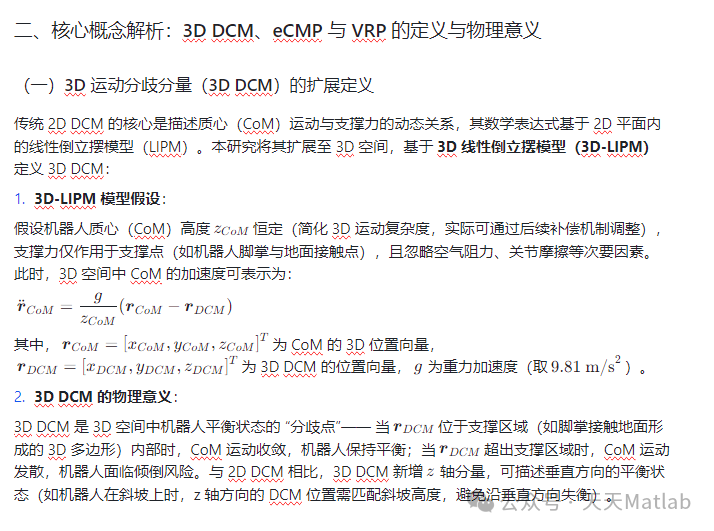
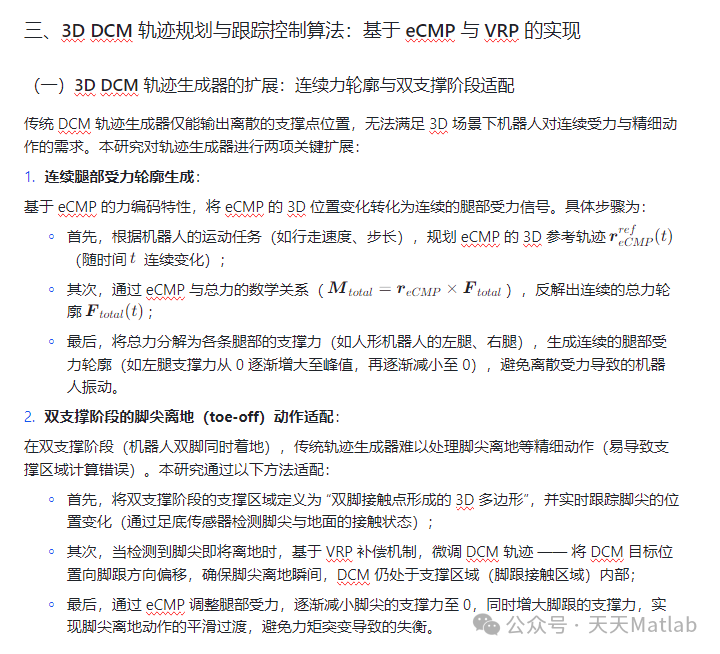
The Divergent Component of Motion (DCM), also known as the “Capture Point,” is a classic theory for dynamic balance control in robots. It describes the relationship between the robot’s center of mass (CoM) motion and the support area to assess motion stability — when the DCM is within the support polygon, the robot remains balanced; if it exceeds, it faces the risk of tipping over. However, traditional DCM is only applicable to 2D plane scenarios and has two major limitations: first, it cannot encode 3D force information, only handling gravity and ground support forces in the plane, making it difficult to cope with external forces along the z-axis in 3D environments (e.g., vertical collision forces, forces on slopes); second, it has insufficient trajectory generation capability, as traditional DCM trajectory generators can only output discrete support point positions and cannot generate continuous leg force profiles. Additionally, during the double support phase (e.g., when both feet are on the ground), it struggles to adapt to fine actions like toe-off, limiting the robot’s motion flexibility in complex 3D scenarios.
To address these issues, this study extends DCM theory to 3D space, proposing two core concepts: “Enhanced Center of Mass Moment Point (eCMP)” and “Virtual Repulsion Point (VRP),” enabling the encoding of the direction and magnitude of external forces and total forces (external forces + gravity) in 3D environments. This leads to the construction of a real-time planning and tracking control framework for robot DCM trajectories in 3D scenarios, providing technical support for stable robot motion in complex 3D environments.
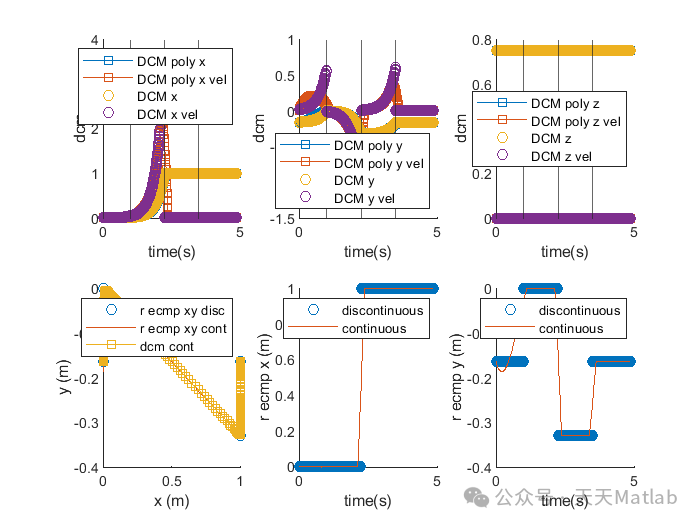
⛳️ Operating Results
📣 Sample Code
function xi_d = get_xi_d(t, t_step, b, r_vrp, xi_eos)
xi_d = r_vrp + exp((1/b)*(t-t_step)).*(xi_eos – r_vrp);
end
🔗 References
Englsberger, Johannes, Christian Ott, and Alin Albu-Schäffer. “Three-dimensional bipedal walking control based on divergent component of motion.” IEEE Transactions on Robotics 31.2 (2015): 355-368.
🎈 Some theoretical references are from online literature; if there is any infringement, please contact the author for removal.
👇 Follow me to receive a wealth of Matlab e-books and mathematical modeling materials.
🏆 The team specializes in guiding customized Matlab simulations in various research fields to support your research dreams:
🌟 Various intelligent optimization algorithm improvements and applications
Production scheduling, economic scheduling, assembly line scheduling, charging optimization, workshop scheduling, departure optimization, reservoir scheduling, 3D bin packing, logistics site selection, cargo location optimization, bus scheduling optimization, charging station layout optimization, workshop layout optimization, container ship loading optimization, pump combination optimization, medical resource allocation optimization, facility layout optimization, visual field base station and drone site selection optimization, knapsack problem, wind farm layout, time slot allocation optimization, optimal distributed generation unit allocation, multi-stage pipeline maintenance, factory-center-demand point three-level site selection problem, emergency supply distribution center site selection, base station site selection, road lamp post arrangement, hub node deployment, transmission line typhoon monitoring devices, container scheduling, unit optimization, investment portfolio optimization, cloud server combination optimization, antenna linear array distribution optimization, CVRP problem, VRPPD problem, multi-center VRP problem, multi-layer network VRP problem, multi-center multi-vehicle VRP problem, dynamic VRP problem, two-layer vehicle routing planning (2E-VRP), electric vehicle routing planning (EVRP), hybrid vehicle routing planning, mixed flow shop problem, order splitting scheduling problem, bus scheduling optimization problem, flight shuttle vehicle scheduling problem, site selection routing planning problem, port scheduling, port bridge scheduling, parking space allocation, airport flight scheduling, leak source localization, cold chain, time windows, multi-vehicle fields, site selection optimization, port bridge scheduling optimization, traffic impedance, redistribution, parking space allocation, airport flight scheduling, communication upload and download allocation optimization.
🌟 Machine learning and deep learning time series, regression, classification, clustering, and dimensionality reduction
2.1 BP time series, regression prediction, and classification
2.2 ENS voice neural network time series, regression prediction, and classification
2.3 SVM/CNN-SVM/LSSVM/RVM support vector machine series time series, regression prediction, and classification
2.4 CNN|TCN|GCN convolutional neural network series time series, regression prediction, and classification
2.5 ELM/KELM/RELM/DELM extreme learning machine series time series, regression prediction, and classification
2.6 GRU/Bi-GRU/CNN-GRU/CNN-BiGRU gated neural network time series, regression prediction, and classification
2.7 Elman recurrent neural network time series, regression prediction, and classification
2.8 LSTM/BiLSTM/CNN-LSTM/CNN-BiLSTM long short-term memory neural network series time series, regression prediction, and classification
2.9 RBF radial basis function neural network time series, regression prediction, and classification
2.10 DBN deep belief network time series, regression prediction, and classification
2.11 FNN fuzzy neural network time series, regression prediction
2.12 RF random forest time series, regression prediction, and classification
2.13 BLS broad learning system time series, regression prediction, and classification
2.14 PNN pulse neural network classification
2.15 Fuzzy wavelet neural network prediction and classification
2.16 Time series, regression prediction, and classification
2.17 Time series, regression prediction, and classification
2.18 XGBOOST ensemble learning time series, regression prediction, and classification
2.19 Transform various combinations time series, regression prediction, and classification
Covering wind power prediction, photovoltaic prediction, battery life prediction, radiation source identification, traffic flow prediction, load forecasting, stock price prediction, PM2.5 concentration prediction, battery health status prediction, electricity consumption prediction, water body optical parameter inversion, NLOS signal identification, subway parking precision prediction, transformer fault diagnosis.
🌟 In image processing
Image recognition, image segmentation, image detection, image hiding, image registration, image stitching, image fusion, image enhancement, image compressed sensing.
🌟 In path planning
Traveling salesman problem (TSP), vehicle routing problem (VRP, MVRP, CVRP, VRPTW, etc.), drone 3D path planning, drone collaboration, drone formation, robot path planning, grid map path planning, multimodal transport problems, electric vehicle routing planning (EVRP), two-layer vehicle routing planning (2E-VRP), hybrid vehicle routing planning, ship trajectory planning, full path planning, warehouse patrol, bus time scheduling, reservoir scheduling optimization, multimodal optimization.
🌟 In drone applications
Drone path planning, drone control, drone formation, drone collaboration, drone task allocation, drone secure communication trajectory online optimization, vehicle collaborative drone path planning.
🌟 In communication
Sensor deployment optimization, communication protocol optimization, routing optimization, target localization optimization, Dv-Hop localization optimization, Leach protocol optimization, WSN coverage optimization, multicast optimization, RSSI localization optimization, underwater communication, communication upload and download allocation optimization.
🌟 In signal processing
Signal recognition, signal encryption, signal denoising, signal enhancement, radar signal processing, signal watermark embedding and extraction, electromyography signals, electroencephalography signals, signal timing optimization, electrocardiogram signals, DOA estimation, encoding and decoding, variational mode decomposition, pipeline leakage, filters, digital signal processing + transmission + analysis + denoising, digital signal modulation, bit error rate, signal estimation, DTMF, signal detection.
🌟 In power systems
Microgrid optimization, reactive power optimization, distribution network reconstruction, energy storage configuration, orderly charging, MPPT optimization, household electricity, electric/cold/heat load forecasting, power equipment fault diagnosis, battery management system (BMS) SOC/SOH estimation (particle filter/Kalman filter), multi-objective optimization in power system scheduling, photovoltaic MPPT control algorithm improvement (perturb and observe method/incremental conductance method), electric vehicle charging and discharging optimization, microgrid day-ahead optimization, energy storage optimization, household electricity optimization, supply chain optimization.
🌟 In cellular automata
Traffic flow, crowd evacuation, virus spread, crystal growth, metal corrosion.
🌟 In radar
Kalman filter tracking, track association, track fusion, SOC estimation, array optimization, NLOS identification.
🌟 In workshop scheduling
Zero-wait flow shop scheduling problem (NWFSP), Permutation flow shop scheduling problem (PFSP), Hybrid flow shop scheduling problem (HFSP), zero idle flow shop scheduling problem (NIFSP), distributed permutation flow shop scheduling problem (DPFSP), blocking flow shop scheduling problem (BFSP).
👇