Large size semiconductor silicon carbide (SiC) materials mainly refer to silicon carbide single crystal substrates with diameters of 6 inches or even larger. Utilizing these substrates, high-quality epitaxial films can be obtained, which in turn can be used to manufacture high-performance power chips. Driven by the “dual carbon” goals, the large-scale application of semiconductor silicon carbide materials and chips is on the horizon. As a fourth group compound semiconductor material, silicon carbide possesses excellent characteristics such as a wide bandgap, high thermal conductivity, high breakdown field strength, high electron saturation drift rate, and good chemical and thermal stability. As an emerging power semiconductor material, silicon carbide devices offer higher operating temperatures, higher breakdown voltages, faster switching speeds, lower conduction resistance, and better durability compared to silicon power devices, making it promising for large-scale applications in the field of power electronics—especially in areas related to new energy.
The main technical innovation direction for large size semiconductor silicon carbide materials is to increase the size and thickness of silicon carbide single crystals and reduce the defect density of silicon carbide single crystals, aiming to achieve lower costs and higher quality silicon carbide substrates. The size of silicon carbide single crystals is continuously increasing, with the mainstream silicon carbide substrate size currently at 6 inches. Global research institutions and companies are competing to develop 8-inch silicon carbide single crystal and substrate technology, actively promoting its industrialization. Currently, the thickness of silicon carbide single crystals generally ranges from 10 to 30 mm, and there is still a long way to go to reach the meter level of silicon single crystals. The bulk defects in silicon carbide, such as micropipes, have been largely eliminated, but other defects such as line defects and dislocations are still prevalent, generally on the order of 10^3/cm^2, and need to be further reduced.
The technology for silicon carbide power diodes is already quite mature, but the performance of its power metal-oxide-semiconductor field-effect transistors (MOSFETs) still requires significant improvement. First, the ion activation rate in the MOSFET injection region urgently needs to be enhanced, which is closely related to the ion implantation during device fabrication and subsequent high-temperature annealing. Second, optimizing the critical technical parameters of thermal oxidation and subsequent annealing processes to reduce interface defects and oxide layer defect density is an important issue to consider for improving MOSFET channel electron mobility and gate oxide reliability. Finally, the reliability of MOSFETs must be significantly improved, which involves technologies for improving gate oxide and post-annealing, short-circuit robustness, surge and avalanche resistance, and radiation hardening.
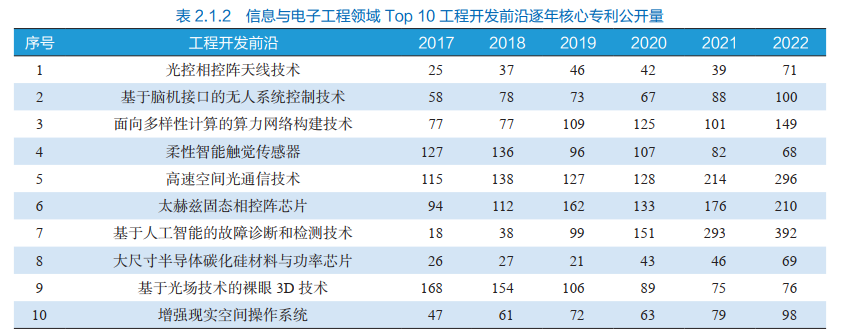
The core patents involved in this development frontier and their annual disclosure from 2017 to 2022 are shown in Tables 2.1.1 and 2.1.2.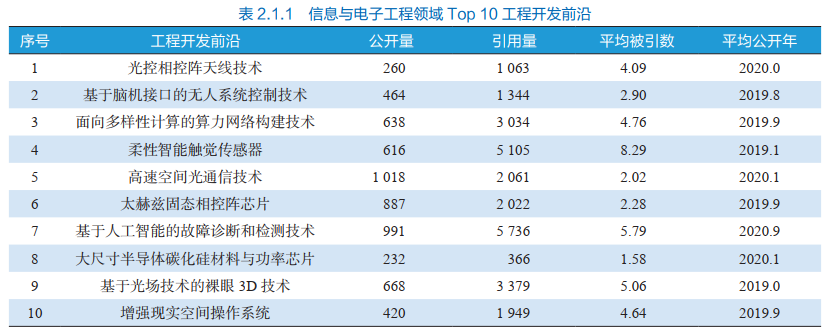
 (Content taken from “Global Engineering Frontier 2023″)

Pi Xiaodong,Director of the Semiconductor Materials Research Institute at Zhejiang University, dual-appointed professor at the National Key Laboratory of Silicon and Advanced Semiconductor Materials at Zhejiang University and the Advanced Semiconductor Research Institute at Zhejiang University Hangzhou International Innovation Center, and deputy director of the Key Laboratory of Wide Bandgap Power Semiconductor Materials and Devices in Zhejiang Province. He is a leading talent in technological innovation under the National Ten Thousand Talents Program and has received funding from the National Natural Science Foundation of China for outstanding youth. He obtained his Ph.D. from the University of Bath in the UK in 2004 and was awarded the Novel Research Medal. He subsequently conducted research at McMaster University in Canada and the University of Minnesota in the USA. He joined the National Key Laboratory of Silicon and Advanced Semiconductor Materials at Zhejiang University in 2008 and was promoted to professor in 2012. In 2020, he was dual-appointed as a professor at the Advanced Semiconductor Research Institute at Zhejiang University Hangzhou International Innovation Center. His main research focuses on semiconductor materials and devices, particularly on impurity and defect control in large size silicon carbide crystals and nanoscale silicon crystals, achieving high-performance large size silicon carbide crystals and nanosilicon crystals, and subsequently fabricating high-performance devices.
About This Journal
Frontiers of Information Technology & Electronic Engineering (abbreviated as FITEE, Chinese name 《信息与电子工程前沿(英文)》, ISSN 2095-9184, CN 33-1389/TP) is a comprehensive English academic monthly journal in the field of information electronics, indexed in SCI-E and EI, with the latest impact factor of 2.7, placed in the JCR Q2 zone. It originated from the English edition C of Zhejiang University Journal: Computer and Electronics, founded in 2010, and was renamed to its current title in 2015. It is now a sub-journal of the Chinese Academy of Engineering’s journal in the field of information and electronic engineering, covering fields such as computer science, information and communication, control, electronics, and optics. The types of articles include research papers, reviews, personal viewpoints, and commentaries. The current editor-in-chief is Academician Pan Yunhe and Fei Aiguo from the Chinese Academy of Engineering. It implements an international peer review system, with initial feedback generally provided within 2-3 months. Once accepted, articles will be published online quickly.
In 2019, it was funded by the Action Plan for Excellence in Chinese Scientific Journals launched by the China Association for Science and Technology and six other ministries (Tiered Journals). From 2021 to 2022, it was successively selected in the high-quality scientific journal grading directories in the fields of information and communication (organized by the China Communication Society) and computing (organized by the China Computer Federation), both listed as the highest T1 level; selected in the recommended directory of international academic conferences and journals by the China Computer Federation-2022 (cross-disciplinary/integrated/emerging).
Official Website:http://www.fitee.zjujournals.com
Journal Springer Homepage:
http://www.springer.com/computer/journal/11714
Submission:http://www.editorialmanager.com/zusc
Postal Distribution Code: 32-324
Address: 148 Tianmushan Road, Xihu District, Hangzhou, Zhejiang Province
Phone: +86-571-88273162
Email: [email protected]
Follow Us ID: fitee_caeThis official WeChat account is for the journal “Frontiers of Information Technology & Electronic Engineering (English)” (SCI-E, EI indexed journal), providing functions such as disseminating academic articles of the journal; offering convenient services for related scholars (readers, authors, reviewers, editorial board members, etc.); publishing information related to academic writing, review, editing, and publishing; introducing academic figures, thoughts, and achievements in the field of information and electronic engineering, showcasing scientific research progress in this field; and providing a friendly interactive platform for scholars at home and abroad in this field.