
Exploring the Working Principles of Sensors with DeepSeek

 01Problem Context01Problem Context
With the development of information technology, especially the application of big data in the Internet of Things, the functions of information systems are becoming increasingly powerful, and the technologies used in information systems are also becoming more diverse. As one of the core hardware components of information systems, sensors play a crucial role. A sensor is a detection device that can sense the information being measured and convert that information into electrical signals or other required forms according to certain rules, to meet the needs of information transmission, processing, storage, display, recording, and control. Due to the abstract and difficult-to-understand working principles of sensors, there are several teaching challenges.
(1) The essence of signal conversion is difficult to understand, making it hard to grasp the transition from “non-electrical physical quantities (temperature, light intensity, etc.) to electrical parameters (voltage, resistance, etc.)”; there is confusion regarding the conversion points between analog and digital signals, and the position and role of A/D conversion in the process are unclear.
(2) The relationships between working stages can easily be confused, leading to isolated memorization of the stages “sensitive element → conversion element → data processing → output control”, which cannot be linked into a complete chain.
 02Solution0Temperature SensorTemperature Sensor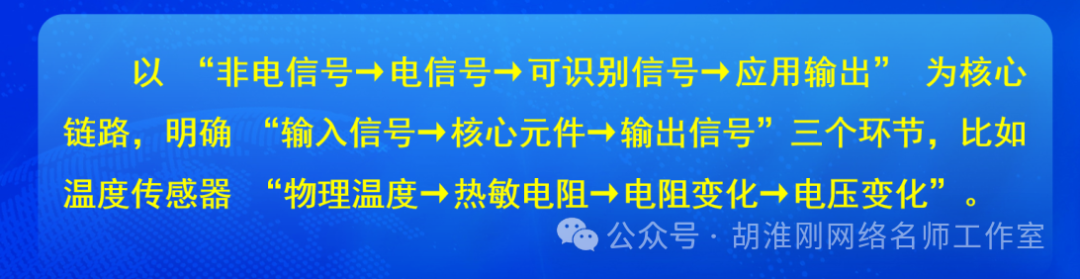
 03Video Demonstration
 04Prompt Word Optimization
Please create a teaching webpage to explore the working principles of sensors, and create an animation for the temperature sensor with three stages: (1) Display the increase in temperature in the physical world (2) Show the change in internal resistance of the sensor, and the corresponding change in electrical signals (3) The electrical signal passes through the A/D converter, converting the analog signal into a digital signal, and displaying the temperature value on the screen (e.g., from 20℃ to 40℃), indicating the relationship between physical changes and electrical signals.
 END
END Smart Applications
Video Production: Lu Ye
Review: Liu Chaoping, Hu Yaoliang