01Basic Understanding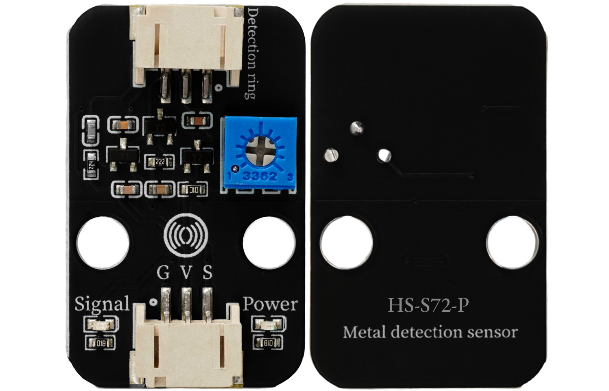
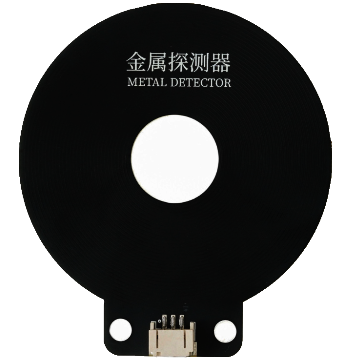 Model:HS-S72-PName:Metal Detection SensorSeries:Level Detection ModuleDescription:This is a metal object detection module based on the principle of electromagnetic induction, integrating a high-frequency oscillation circuit and a signal processing unit. It can identify metal objects by detecting disturbances in the alternating electromagnetic field and outputs a digital signal (high/low level). It features non-contact detection, rapid response, and strong anti-interference capabilities, making it a core component for metal foreign object detection and object classification.Usage Scenarios:Metal impurity screening in industrial production lines (e.g., detecting metal impurities in food packaging); security inspection equipment (rapid screening of metal items in luggage); waste classification assistance (identifying metal waste and automatically sorting it); archaeological teaching exploration tools (detecting underground metal objects during outdoor practice for middle and primary school students); interactive toy design (triggering sound and light effects when near metal, such as a “treasure detector”). This aligns with the “Guidelines for Artificial Intelligence General Education in Primary and Secondary Schools (2025 Edition)”, helping to understand the principle of electromagnetic induction by building a “metal sorting device” and cultivating engineering practical abilities.Disciplinary Integration:Physics, MathematicsEngineeringInformation TechnologyEthical Education:Metal detection data (e.g., types of metal items carried in public places) may involve privacy issues, requiring clear boundaries for detection and data usage; false alarms (e.g., belt buckles triggering alarms) may cause unnecessary panic, necessitating algorithm optimization; in metal waste recycling detection, attention must be paid to environmental responsibility and resource reuse balance; differences in detection sensitivity for different metals (iron, aluminum, copper) may lead to classification bias, discussing the necessity of “inclusive detection”; over-reliance on automatic detection may reduce manual identification skills, requiring a balance between technical efficiency and basic skills.Note: Images are sourced from the internet, and the product is based on the actual purchase.
02Technical Parameters
Working Principle:
The module generates a high-frequency alternating electromagnetic field (achieved by a high-frequency oscillator and detection coil). When a metal object enters the magnetic field range, eddy currents are induced within the metal, causing disturbances in the original magnetic field, leading to changes in oscillation amplitude. The signal processing circuit detects this change and outputs a low level (metal detected) through a comparator; when no metal is present, the magnetic field is stable, outputting a high level. The detection distance can be adjusted by a potentiometer (more sensitive for copper than for ferromagnetic materials).
Parameter Analysis:
G(GND): Power input negative/cathode
V(VCC):Power input positive/anode
S(Signal):Signal output interface (digital signal)Detection objects: Ferromagnetic metals (iron, steel, etc.), non-ferrous metals (copper, aluminum, etc.)Detection distance: 0-50mm (for iron plates, distance varies with metal size and material)Response time: ≤10ms (delay from metal entering to signal change)Output level: High level 5V (no metal), low level 0V (metal detected)Detection coil diameter: 20mm (standard detection range)03Code Example
The link pin is D3.
04Safety Measures
1. Power must be turned off before wiring, confirm VCC is 5V and the polarity is correct; excessive voltage may burn out the oscillation circuit;
2. Do not use in strong electromagnetic field environments (e.g., near large motors or transformers), as it may cause false alarms;
3. Avoid applying pressure or collision to the detection coil, as it may deform the coil and affect the magnetic field;
4. In humid environments, a moisture-proof shell should be added, as moisture may cause circuit short circuits;
5. When detecting high-temperature metals (over 100℃), maintain a distance of more than 10cm to prevent the module from overheating;
6. If frequent false alarms occur during debugging, check if there are metal objects nearby (e.g., sensor brackets);
7. When not in use for a long time, store the module away from metal objects to prevent coil aging.
05Extensions
Students can try the following methods:
1. Create a “metal sorting machine”: combine a servo with a conveyor belt, triggering the servo to push detected metal into a dedicated collection box;2. Build a “treasure detector”: connect a buzzer and OLED screen, with the buzzer frequency changing with distance to metal, and the screen displaying “Metal Found!”;3. Design a “security check gate”: an array of multiple sensors that light up an LED strip to show the approximate location when metal is detected;4. Develop a “metal composition identification device”: roughly distinguish materials like iron, aluminum, and copper by comparing differences in detection distances (calibration required). Arduino Sensors: HS-S01A Infrared SensorArduino Sensors: HS-S02P Infrared Sensor (Obstacle Avoidance)Arduino Sensors: HS-S03P Ultraviolet SensorArduino Sensors: HS-S05P Sound SensorArduino Sensors: HS-F07P Active BuzzerArduino Sensors: HS-S08P Flame SensorArduino Sensors: HS-S09LB Raindrop SensorArduino Sensors: HS-S09PC Soil Moisture Sensor
Arduino Sensors: HS-S10P Mist Sensor
Arduino Sensors: HS-S11-L Gas Sensor
Arduino Sensors: HS-S20P Ambient Light Sensor
Arduino Sensors: HS-S21P Tilt SensorArduino Sensors: HS-S22P Grayscale SensorArduino Sensors: HS-S24P Digital Temperature SensorArduino Sensors: HS-S26A Temperature and Humidity SensorArduino Sensors: HS-S28P Knob Potentiometer
Arduino Sensors: HS-S31P Touch Sensor
Arduino Sensors: HS-S37PS Water Level Sensor
Arduino Sensors: HS-S38P Human Sensor
Arduino Sensors: HS-S40P Hall Magnetic Sensor
Arduino Sensors: HS-S45P Barometric Pressure Sensor
Arduino Sensors: HS-S46P Weighing Sensor
Arduino Sensors: HS-S59P Slot Photoelectric Sensor
Arduino Sensors: HS-S70P Heart Rate and Blood Oxygen Sensor
Arduino Sensors: HS-S71P Resistive Thin Film Pressure Sensor
Arduino Sensors: Infrared Receiver Module
Arduino Sensors: Infrared Transmitter Module
Arduino Sensors: Clock Module
Arduino Sensors: Rotary Encoder Module
Arduino Sensors: Dual-axis Joystick Module
Arduino Sensors: Gyroscope Module
Arduino Sensors: Voice Broadcast Module
Arduino Sensors: Voice Recognition Control Module
Arduino Communication Module: Bluetooth Module
Arduino Control Module: Self-locking Button Module
Arduino Storage Module: SD Card Module
Arduino Control Module: Conductive Switch Module

— Previous Recommendations —