Weather conditions severely impact optimal direct air capture siting
Weather conditions severely impact optimal direct air capture siting
Paper Overview
Achieving carbon neutrality requires not only reducing emissions but also actively removing carbon dioxide from the atmosphere. The recently emerging Direct Air Capture (DAC) technology is a key player in this effort. However, the efficient operation of a DAC plant depends not only on the equipment itself but also on—the weather. A recent study by a German research team indicates that: temperature and humidity, seemingly ordinary meteorological factors, may determine the economic viability and deployment patterns of DAC.
Direct Air Capture: A New Tool for Carbon Extraction from the Air
DAC is a technology that separates carbon dioxide from the air, with the advantage of not relying on specific emission sources, allowing deployment worldwide.
● Two main technological routes:
○ Low-Temperature Solid Adsorption (LT-DAC): Utilizes amine materials to adsorb CO₂ at lower temperatures, then releases it upon heating.
○ High-Temperature Liquid Absorption (HT-DAC): Absorbs CO₂ using potassium hydroxide solution, which is then released through high-temperature decomposition of calcium carbonate.
The paper points out that solid adsorption technology is nearing commercialization, while liquid absorption is still in the demonstration phase, but both have significant future cost uncertainties—ranging from 100 to over 1000 euros/ton CO₂.
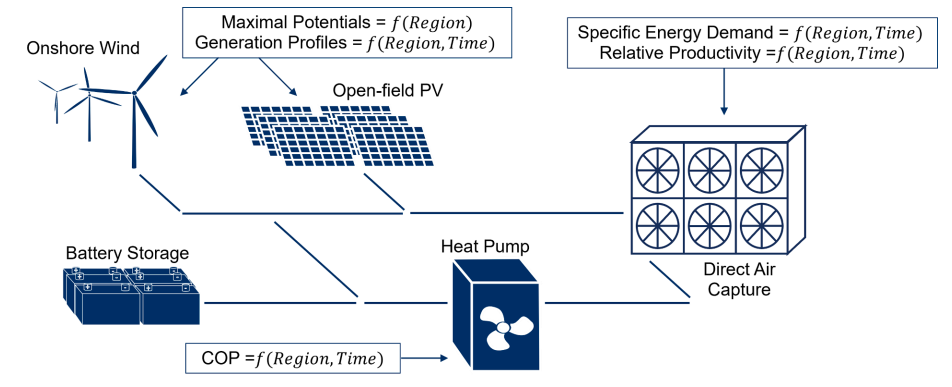
Illustration of the coupling of DAC systems with renewable energy, serving as a popular science diagram.
How Significant is the Weather Impact?
The research team utilized hourly meteorological data (temperature and relative humidity) from over 11,000 towns in Germany to simulate the energy consumption and output of DAC at different locations and times. The conclusions are surprising:
● Significant fluctuations in energy consumption:
○ LT-DAC’s thermal demand can fluctuate by over 100% throughout the year. Higher humidity increases the heat required for desorption.
○ HT-DAC’s electricity demand fluctuates by about 30% annually, primarily influenced by temperature.
● Variability in productivity: High summer temperatures and severe winter cold can affect the CO₂ capture rate.
● Spatial differences: The humidity differences between eastern and western Germany can lead to over 10% variation in annual thermal demand for similar equipment.
In short: “Location-specific strategies” are crucial.
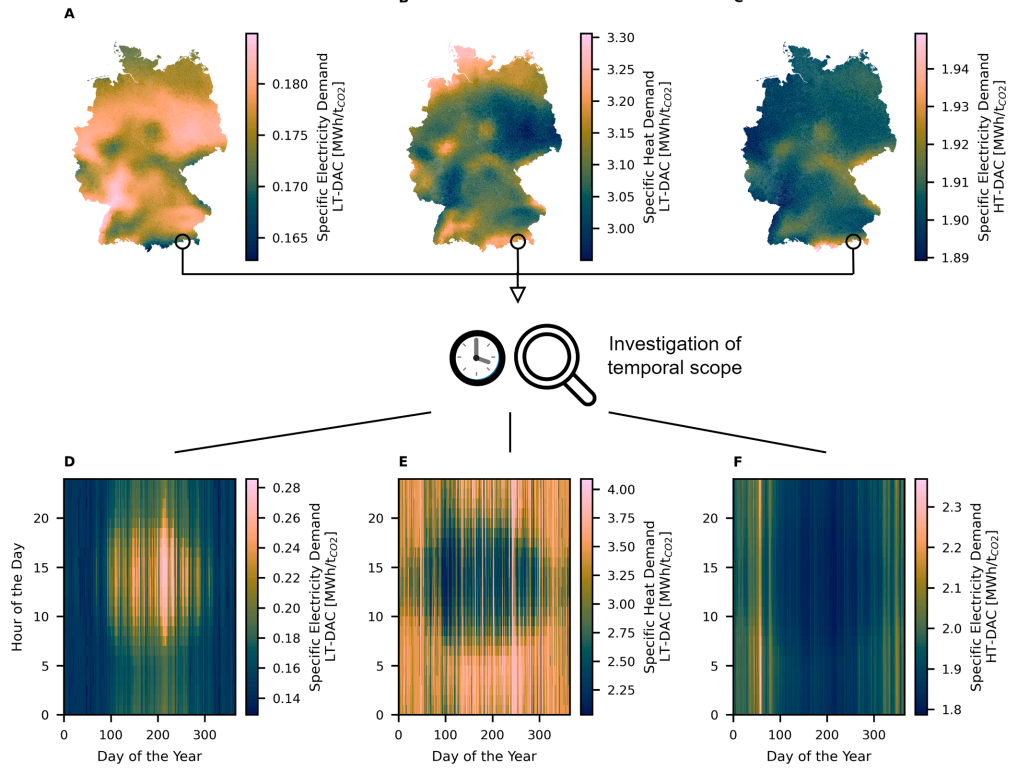
Spatial distribution map of DAC energy consumption across Germany, visually presenting the differences between the east and west.
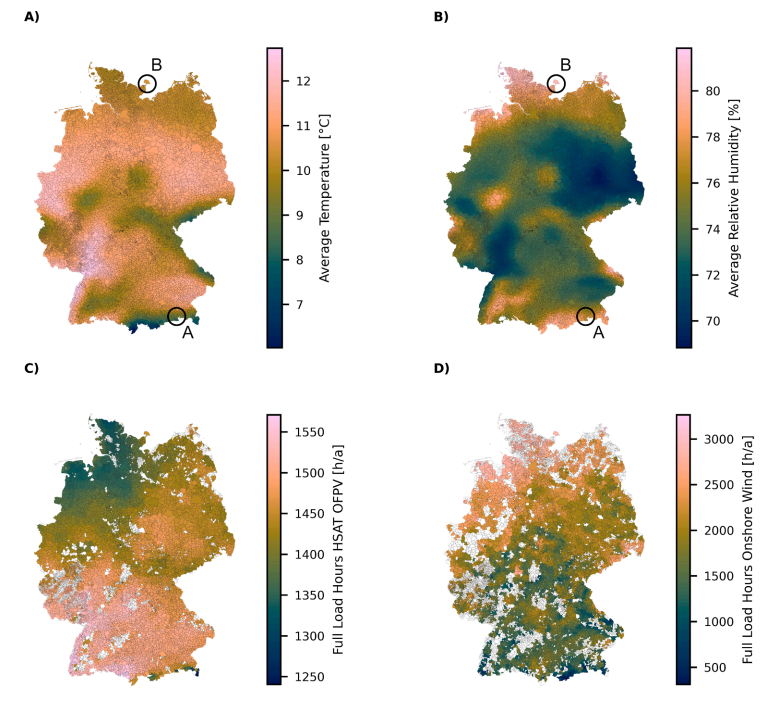
Hourly temperature and humidity curves in Germany for 2018, which can help illustrate temporal fluctuations.
Cost Drivers: Energy Supply is More Critical than Equipment
The total cost of DAC consists of equipment investment and energy supply.
● The average cost for solid adsorption is about 285 €/tCO₂, while for liquid absorption it is about 265 €/tCO₂ (projected to 2045).
● However, regional differences are significant: in the north, where wind resources are abundant and humidity is high, costs can be as low as 200 €/tCO₂; in the south, due to a lack of renewable energy, costs can exceed 800 €/tCO₂.
● The key driving factor is not DAC itself, but the availability and price of renewable energy—wind and solar resources determine the cost of energy supply.
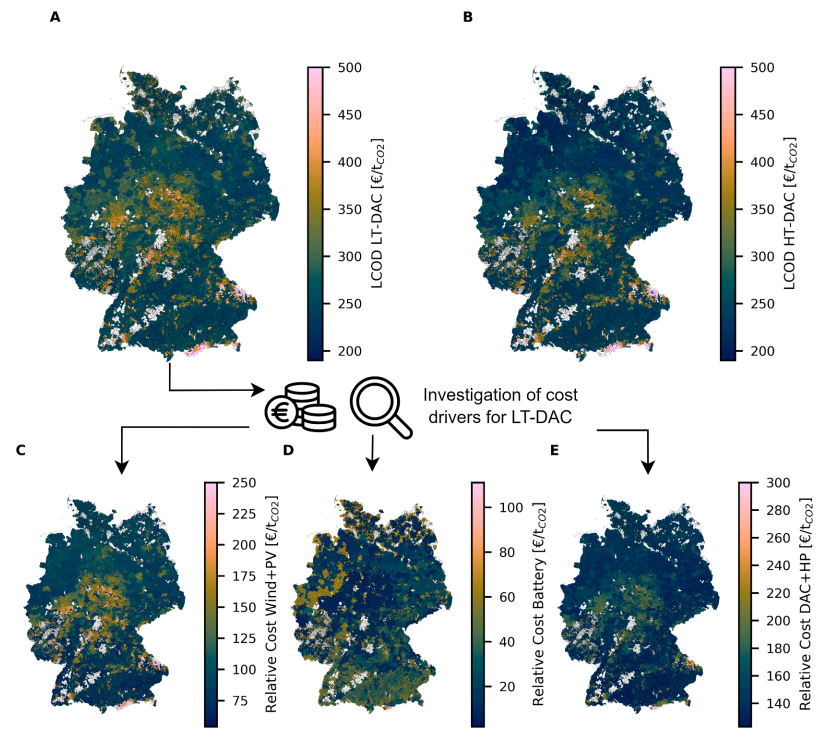
Map of the levelized cost of direct air capture (LCOD) across different regions in Germany.
Insights for Energy Systems
The research also provides broader insights:
● Temporal resolution should not be overlooked. The supply and demand fluctuations of DAC are similar to those of renewable energy, with an optimal operating load factor of about 60–70%, much lower than the commonly assumed 90%.
● Renewable coupling is key. A hybrid solution of wind and photovoltaic systems is optimal; relying solely on photovoltaics requires large-scale energy storage to maintain stability.
● Global relevance. Germany is only in a single climate zone; in countries with greater climate variability, such as China and the United States, the impact of weather will be even more pronounced.
Future Outlook
The paper warns: Future DAC deployment must consider high temporal and spatial resolution meteorological and energy data.
● In planning, it is essential to find locations that have both low humidity or suitable temperatures and sufficient renewable energy—”dual advantages”.
● Technically, it is necessary to enhance system flexibility, such as through hybrid energy configurations, energy storage, and dynamic operating strategies.
As the authors summarize—”Weather does matter“. In the global race for carbon neutrality, weather is not just a backdrop but an “invisible player” that influences costs and outcomes.
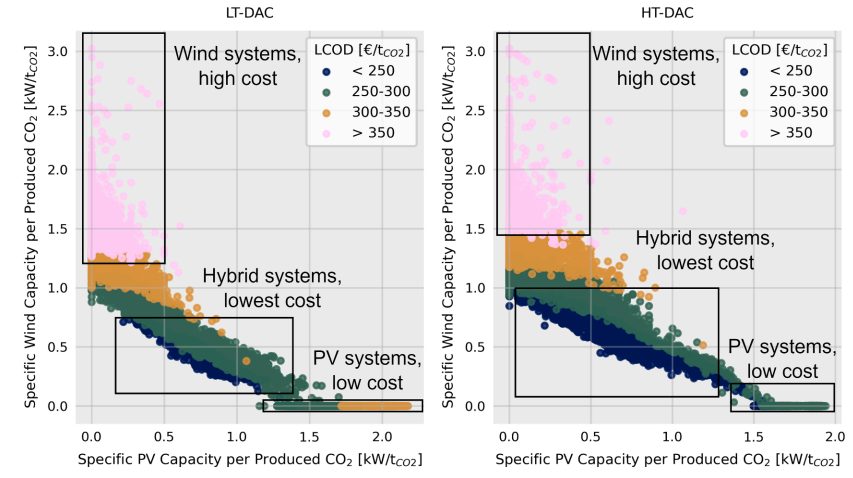
The impact of photovoltaic and wind power installations on costs across different regions can serve as a summary chart.
DAC is a cutting-edge but cost-sensitive technology. For policymakers and energy companies planning to deploy in China and globally, the value of this research lies in reminding them: Understand the weather before selecting a site. Only by fully utilizing local climate and renewable resources can “carbon capture from the air” truly become an economically viable climate solution.
Paper Introduction
Abstract:Direct air capture (DAC) is rapidly gaining attention as a key technological approach to mitigating climate change. While techno-economic assessments increasingly incorporate DAC, they often overlook the influence of weather variability on both energy demand and plant productivity. In this study, we analyze how local weather patterns affect the two most promising DAC approaches: the solid sorbent and the liquid solvent processes. We reveal for a German case study, that the integration of DAC with renewable energy sources necessitates temporal and spatial considerations, as fluctuations in energy supply and demand can significantly impact operational feasibility. We demonstrate energy demand fluctuations of DAC exceeding 100 % over the course of a year and estimate future DAC costs in Germany in a range from 197 €/tCO2 to 1035 €/tCO2, depending on the region and technology. These results emphasize the need for detailed, site-specific assessments to ensure future cost-optimal DAC deployment.
Highlights:
-
System level evaluation and comparison of the two furthest developed Direct Air Capture (DAC) approaches, the solid sorbent and the liquid solvent approach.
-
High spatial and temporal resolution applied to incorporate weather effects on both the DAC unit and the connected renewable energy system.
-
Hybrid photovoltaic and wind systems as promising energy sources for DAC plants.
-
Considerable variation in carbon dioxide removal cost even across neighboring regions.
Original Link
https://www.sciencedirect.com/science/article/pii/S266679242500023X
Citation Information
Henrik Wenzel, Freia Harzendorf, Kenneth Okosun, et al. Weather conditions severely impact optimal direct air capture siting [J]. Advances in Applied Energy, 2025, 19:100229.
DOI:10.1016/j.adapen.2025.100229.


Journal Introduction


“Southern Energy Construction” is a globally recognized open-access academic journal focusing on clean energy generation and engineering technology, adhering to the joint publication by academicians and engineers, focusing on the construction of new energy systems and new power systems, addressing energy security and low-carbon transition, energy technology and industry development, energy system reform, and more, publishing industry dynamics and innovative practices, disseminating advanced technologies and concepts, and assisting society in accelerating the cultivation of new productive forces and promoting high-quality energy development. The journal was selected as the first core journal in China and as a case of “scientific journals serving high-quality innovative development” in 2024, and is indexed by international databases such as Scopus, DOAJ, etc.
Scopus, DOAJ
Core Journal in China
RCCSE Core in China
Energy and Power Discipline Q2
ISSN: 2095-8676
CN: 44-1715/TK
Journal Impact Factor (JIF): 1.205
CiteScore: 1.7

Journal Website:https://www.energychina.press/
Submission Link:https://www.manuscripts.com.cn/nfnyjs
Contact Email:[email protected]
Contact Phone:020-32119015;020-32116683
2025 No.3
2025 No.2
2024 No.1
2024 No.6
2024 No.5
2024 No.4
2024 No.3
2024 No.1
2023 No.6

Click the image to read more, please indicate the source when reprinting!
Copyright statement: Source from the paper in “Advances in Applied Energy“, used for academic exchange, please delete if infringing.
Note: You can read and download all selected articles for free on the official website of “Southern Energy Construction” journal. We hope these articles will be helpful to you.

|
Click to read the original text |
|
Read all articles |
|
Please give a “like“ |
|
Let me know you are “reading this“ |