
Click the blue text to follow “Textile Bulletin”


Sleep is an indispensable part of human life. The “China Sleep Research Report (2022)” shows that the average daily sleep duration of Chinese people has been decreasing year by year over the past decade, and sleep quality has been continuously declining. In the past, doctors evaluated sleep conditions based on subjective descriptions from the subjects, but due to the influence of subjective factors, the results can have a significant margin of error. As a result, more and more people are actively concerned about healthy sleep, leading to an increased demand for sleep monitoring devices.
Polysomnography (PSG) is a commonly used method for clinical sleep monitoring, but its process is cumbersome, expensive, and uncomfortable, making it unsuitable for home environments. Currently, popular sleep monitoring tools on the market are smart wristbands, but their monitoring results are not accurate enough. Therefore, the ability to conduct relatively accurate sleep monitoring without disturbing the subject’s normal sleep has always been a research direction in sleep medicine.
Textile sensors have good flexibility and breathability, allowing for better monitoring performance while ensuring the comfort of the subject, and have become an important research direction. Current research on flexible fabric sensors is focused on improving the quality, stability, and comfort of sleep monitoring devices by changing the sensor structure, materials, and circuit design.
The common physiological signal changes during sleep, corresponding collection technologies, sleep staging algorithms, and evaluations are shown in the table. Due to the convenience of collecting electrocardiogram (ECG), respiration, and body movement signals, there is a lot of research using these signals to assess sleep quality.
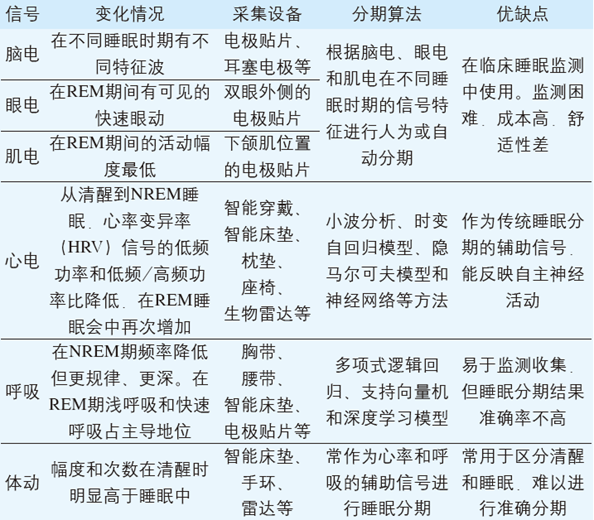
The different physiological signals and their changes during sleep, collection devices, and staging algorithms
“
Bioelectrical
Signals
”
Electroencephalogram (EEG) signals are the most direct indicators of changes in brain activity, often used to stage sleep and identify sleep disorders. EEG signals are typically collected using Ag/AgCl wet electrodes, but prolonged use can cause skin allergies, and during long-term monitoring, the quality of EEG signals can significantly degrade. To avoid the drawbacks of wet electrodes, dry electrodes that directly contact the skin have been developed. However, due to the high impedance of the outer skin layer, a capacitance forms between the electrode and the well-conductive dermis, resulting in weak signals. Rigid electrodes can cause discomfort during human sleep, making flexible electrodes more suitable for sleep monitoring. Textile electrodes have good conductivity and flexibility, meeting user demands for high comfort, safety, miniaturization, and lightweight monitoring devices.
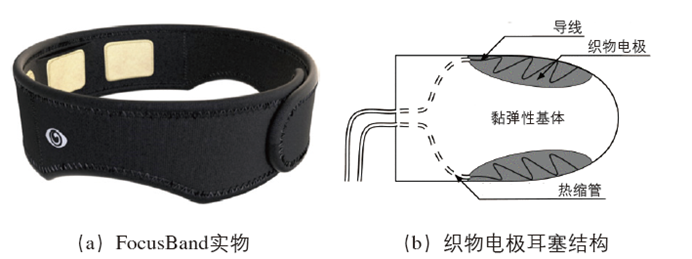
Dry electrodes for EEG signal collection
Electrocardiogram (ECG) signals
Research on human ECG signal collection methods includes both wet/dry electrode-skin contact types and non-contact capacitive types.
Traditionally, Ag/AgCl wet electrodes are used to collect ECG signals, with a basic working principle similar to that of EEG wet electrodes, and they also share the common drawbacks of wet electrodes. Increasingly, studies are using fabric dry electrodes; for instance, some researchers have placed fabric electrodes on belts to monitor ECG signals. While this improves comfort, the collected signals tend to have higher noise and are weaker due to the absence of conductive gel as an electrolyte. Electrodes that directly contact the skin are not suitable for individuals prone to allergies, so non-contact electrodes designed using capacitive coupling principles can collect ECG signals even with a gap between the electrode and human skin.
Capacitive coupling electrodes, clothing, and human skin together form a coupling capacitance, allowing the ECG signal to be transmitted to the input of the signal processing circuit through capacitive coupling. By placing plates at two points on the body surface and subtracting the signals coupled from the two plates, a capacitive coupled electrocardiogram can be obtained.
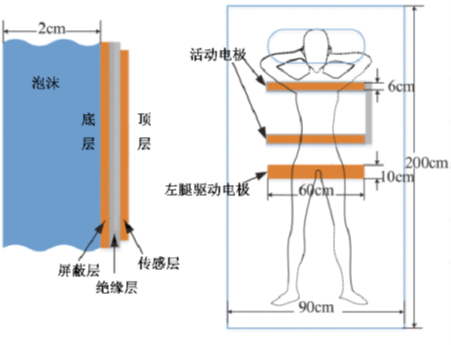
Smart mattress embedded with active electrodes
During a full night’s sleep, non-fixed electrodes are prone to sliding, making measurement results susceptible to artifacts. Therefore, reducing sensitivity to motion artifacts is a key issue that non-contact electrode research must address. There are three main sources of artifacts for non-contact electrodes: high impedance between the electrode and the skin; relative displacement between the electrode and the skin; and friction between the electrode and insulating layers (such as fabric or hair). Additionally, since ECG signals are relatively weak and exhibit strong randomness and individual differences, non-contact detection is challenging, and research in this area is still in its early stages.
Since both EEG and ECG are spontaneous weak electrical signals generated by the human body, the challenge in collecting them lies in improving collection accuracy. However, textile electrodes have high contact impedance and polarization voltage, leading to further attenuation of the electrical signal strength during transmission, making them susceptible to noise caused by various interferences. Therefore, for textile electrodes collecting EEG and ECG signals, efforts should be made to minimize the skin-electrode contact impedance. Some studies have also attempted to reduce motion artifacts caused by friction by moistening the electrodes, but this method increases electrode size and thus reduces comfort.
“
Biophysical
Signals
”
Cardiac activity
Detection of slight periodic pressure changes in the body caused by cardiac ejection is referred to as the ballistocardiogram (BCG). BCG also exhibits periodicity, and processing BCG can yield heart rate information. There are various types of sensors used to collect BCG, with commonly used ones including piezoelectric films, strain gauges, and micro-bend optical fiber sensors. When used for sleep monitoring, these sensors are typically integrated into mattresses or pillows to measure cardiac activity.
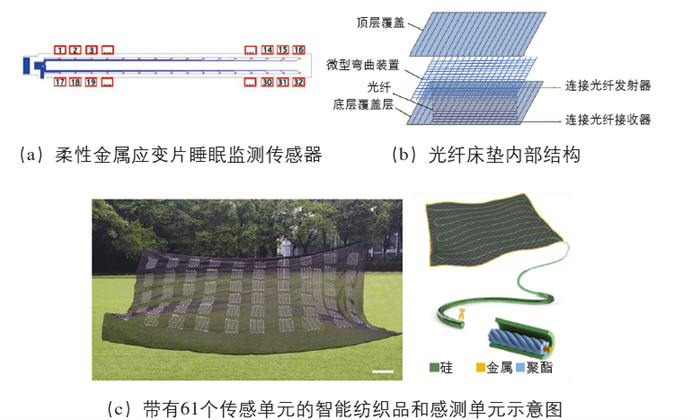
Ballistocardiogram signal collection device
Respiration signals
Respiration signals are the most commonly used indicators for detecting sleep conditions, with two common detection methods: direct measurement of respiratory airflow and monitoring chest and abdominal movements during breathing.
The direct measurement method requires devices to be attached to the mouth and nose or placed within a mask; while accurate, this can reduce comfort. For monitoring respiratory movements, pressure sensors are often fixed on the chest and abdomen to form measurement belts, but using such belts can create a sense of restriction. During ECG measurement, body movements caused by breathing can lead to changes in ECG amplitude, and algorithms can be used to separate respiration signals from ECG signals, such as obtaining respiration signals through smart mattresses. Additionally, BCG signals collected from body vibrations are mixed signals, and suitable filters can be used to separate respiration signals due to the different frequencies of breathing and heartbeats.
Body movements and changes in sleeping posture
The frequency of changes in sleeping posture during sleep can also be used to infer sleep states. An array of pressure sensors can be laid out on the bed to display pressure distribution from different sleeping postures, allowing for the tracking of changes in sleeping posture throughout the night.
For more content, please follow Textile Bulletin 2023 Issue 3 “Sleep Quality Monitoring Technology Based on Flexible Textile Sensors”.





【Review】 Previous quality WeChat articles:

Welcome to reprint, please indicate the source, thank you!
“Textile Bulletin” magazine is a guiding technology journal sponsored by the China Textile Information Center, aiming to provide in-depth reporting and analysis of developments in textile technology, authoritative interpretation of technology policies and industry rules, serving as a barometer for government agencies and industry organizations on technology policy trends, and an important window for helping industry and corporate decision-makers grasp the current state of textile technology and the context of the technology market.
Textile Bulletin Official Website:www.texleader.com.cn
Textile Bulletin Sina Weibo:Search for “Textile Bulletin”
Welcome to subscribe to “Textile Bulletin”:Post code 82-908
Issuance Hotline:010-84463638-8850
Advertising Inquiries:010-84463638-8830