Copyright Statement
Source: Intelligent Investor (Capital-nature), Book Sharing Community (readsharecn)
Guests: Jensen Huang, Founder and CEO of NVIDIA
Elon Musk, CEO of Tesla
Introduction
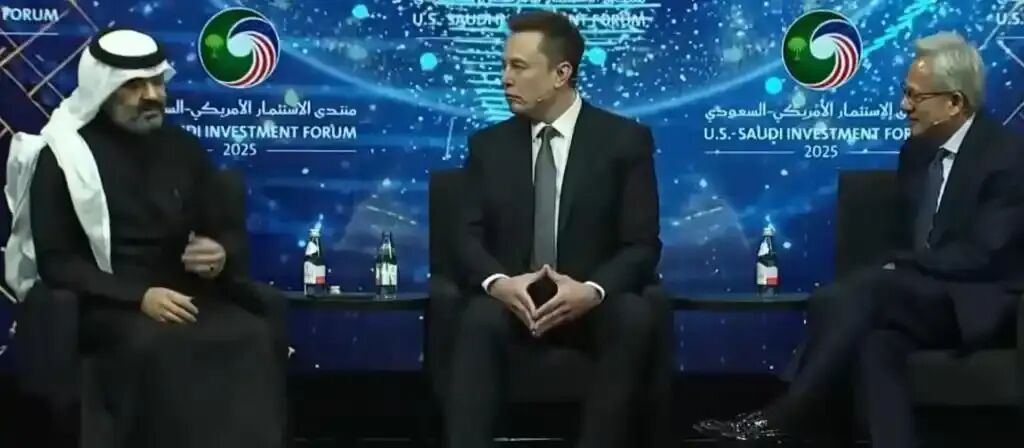
At the main venue of the US-Saudi Investment Forum, two top figures in the tech industry, Musk and Huang, rarely shared the stage to discuss hot topics such as AI and space computing. Following this discussion, NVIDIA released its third-quarter financial report, with Q3 revenue reaching $57.006 billion, a 62% year-on-year increase. NVIDIA’s Q3 net profit also saw a significant 65% year-on-year growth, with both revenue and profit growth exceeding market expectations, leading many media outlets to describe the report as “explosive”.
During the meeting, both parties announced a major AI infrastructure investment: Musk’s xAI will collaborate with NVIDIA and the Saudi national AI company Humane to build a 500 MW AI data center in the desert.
1
Humanoid Robots Will Become the Largest Industry or Product in History
Host: Thank you very much, Your Excellency. It’s a pleasure to see you this morning. Let’s give a warm welcome to Elon Musk, CEO of Tesla, founder of SpaceX, and founder of xAI, along with Jensen Huang, founder and CEO of NVIDIA.
Please take your seats. We should give a more enthusiastic round of applause for one of the greatest leaders in history. To get to the point, the topic we are discussing today involves a market value scale that has reached $70 to $80 trillion (I can hardly count it), but we are gathered here to celebrate a historic moment—namely, the scene from last night’s dinner.
Thank you all for being here under the support of the esteemed President and Crown Prince Mohammed. Last night, we were fortunate to hear an important announcement: this is the greatest alliance between the Kingdom of Saudi Arabia and the United States. In the past, you helped us build an energy-based economy that powered the industrial age; now, we are rapidly entering the intelligent era, which will support fields such as AI factories, robotics, and autonomous flying vehicles. Speaking of which, Musk, if you don’t mind, let’s start with you, and Huang can add comments at any time.
You have a great obsession with something. We all admire “first-principles thinking”—which Huang sometimes refers to as “first-principle scaling”—and it is this kind of thinking that has allowed you to reduce battery costs from $1,000 per kWh to below $100. Now, you are applying the same cost optimization in the robotics field with servo rotors and motors for actuators. So I want to hear how you consistently disrupt every industry with this kind of thinking?
Musk:Actually, it’s mostly not about “disruption” but about “creation”. For example, SpaceX’s reusable rockets; before that, there were no reusable rockets at all, but to fundamentally change space travel, the key lies in reusability.
If every launch requires discarding the rocket, the cost of space exploration would be outrageous. Let’s talk about electric vehicles; when we first started making electric cars, there were no electric cars available for purchase (as far as I know). So Tesla’s goal is to create electric cars that are both attractive and affordable.
As for humanoid robots, there are currently no truly practical products, only some gimmicks. But I believe Tesla will create the first truly useful humanoid robot, and this will be a huge revolution.
I believe everyone will want one—after all, who wouldn’t want their own personal C-3PO or R2-D2? (Yes, I still remember those two characters from Star Wars). In the future, there will be a large number of robots in the industrial sector providing products and services. That’s why I say humanoid robots will become the largest industry or product in history, larger than smartphones or anything else, because everyone will want one, or even multiple.
And the demand in the industrial sector will also be enormous.
Huang:I just want a “R2-D2 with a C-3PO shell”.
Musk: Well said! In fact, humanoid robots will be even more powerful than R2-D2 and C-3PO combined, even ten times stronger.
People often talk about eliminating poverty. How long has this topic been discussed? There has been a lot of discussion, and many NGOs have tried, but in reality, there has been no success, and the evidence is clear.
But AI and humanoid robots will truly eliminate poverty—and Tesla will not be the only company producing humanoid robots. I believe Tesla will pioneer this field, but more companies will join afterward. The only way to make everyone wealthy is through AI and robotics.
2
Why We Need AI Factories
Host:When talking about robots, we cannot ignore AI factories.
Yesterday was a historic day for both countries as we celebrated the signing of the US-Saudi AI strategic partnership, witnessed by the esteemed President and Crown Prince—committing to invest capital, energy, and land to energize the US AI ecosystem, building reasoning nodes and training nodes, to become the country with the most extensive AI applications globally. Huang, what’s the next step in the development of AI factories?
Huang:Saudi Arabia is transforming its refineries into AI factories, and this story is very beautiful. I have always said that AI is an infrastructure, and the reason is simple: from a technological perspective, AI is disrupting every industry, and the application of digital intelligence is pervasive across various fields. In the future, every company, every industry, and every country will use it. In this sense, it is foundational and thus part of the infrastructure.
From a computer science perspective, the innovation of AI lies in: past computing was mainly “retrieval-based computing”—someone inputs a piece of text, creates a painting, or designs four versions of digital ads, all of which are pre-made, and the system just needs to retrieve the appropriate version for you.
Hadoop and many past frameworks and operating systems were designed to help you retrieve relevant information. But now, software will generate in real-time—based on context, scenarios, user identity, the questions you ask, and prompts, generating unique content for you each time.
For example, when using Groq, each result is different, depending on your prompts and specific scenarios. So the computing model has shifted from “retrieval-based” to “generative”, and since it is generative and each result is different, AI factories around the world are needed to generate content in real-time—that’s why we need AI factories.
This computing method is unprecedented, but the benefit is that all content is not pre-set but is contextually relevant and intelligent.
3
Work Will Become “Optional”
Host:So with AI factories and robotics, last night the Crown Prince also mentioned his vision: to enhance the workforce by deploying tens of millions of robots, injecting the next wave of productivity and progress. But this also raises concerns about future employment. Musk and Huang, what are your thoughts?
Musk:Of course, in the long run (I don’t know if long run means 10 years or 20 years, for me that’s long run), my prediction is: work will become “optional”.
Host:This is interesting.
Musk:Yes, just like sports or video games. If you want to work, go ahead—just like you can buy vegetables at the store or grow them in your backyard.
Growing vegetables in the backyard is obviously more troublesome, but some people will still do it because they enjoy gardening. The future of work will be like that, it will be optional. And before we reach that state, we have a lot of work to do.
Musk:I always recommend everyone read Isaac Asimov’s “Foundation” series to get a feel for a possible positive future with AI.
Interestingly, in those books, currency no longer exists. I guess if AI and robotics continue to advance (which seems very likely), at some point in the future, currency will become irrelevant. Of course, electricity, materials, and other basic physical resources will still be constraints, but I believe currency will ultimately lose its significance.
Host:Huang, what are your thoughts?
4
AI Will Make You Busier
Huang:Since we are talking about currency…
I want to say that we can look at it from different time dimensions.
First, everyone’s way of working will change—this is certain. Students’ learning methods and people’s working methods will be different because many things we currently find trivial, laborious, or difficult will become very simple in the future, so our productivity will increase significantly.
I want to say that for most people or companies, if life becomes more efficient and things that were once difficult become simple, then you will have more time to pursue more ideas.
I guess Musk will become busier because of AI, and so will I. The reason is that we both have many ideas, and there are many backlog projects in the company that we want to push forward.
If productivity increases, we can achieve these goals faster. So in the short term, all evidence suggests that we will become more efficient, but at the same time, we will also be busier because we have too many things we want to do.
Huang:I can give an example: I just talked to Musk about how radiology has basically been driven by AI now.
Many excellent companies are doing this, and surprisingly, it was previously predicted that “radiologists would be among the first to lose their jobs”, but the reality is quite the opposite—now the hiring of radiologists has actually increased.
The reason is simple: the core goal of radiologists is not to “study images” but to “diagnose diseases”. Now that image analysis has become very efficient, they can analyze more images, more modalities, and spend more time communicating with patients, thus being able to take on more patients.
Today, the global volume of radiology diagnosis is increasing, and disease diagnosis is more accurate. This is the short-term result of AI in productivity. As for what will happen in the long term—like when currency becomes irrelevant, remember to tell me in advance.
Musk:You will notice it in advance, just like…
Huang:Just like we often send messages, just send a text when that time comes. Yes, we often communicate via text.
Host:I completely agree with both of your views. Because looking at every technological wave, every general technology ultimately brings net positive benefits to the world and humanity. I also want to share two stories.
Huang:I think that’s the reason—innovators like Musk have too many great ideas…
Host:You too. Yes.
Huang:Thank you.
5
Building a 500 MW AI Data Center in the Desert
Host:I want to share the stories of two Saudi innovators whose achievements are inseparable from NVIDIA’s strong support.
The first is Professor Ouyaji, the first Saudi-American to win a Nobel Prize for his achievements in creating a new field of chemistry. He utilized NVIDIA’s AI accelerators and models like Rock to pioneer new chemistry in the field of metal-organic frameworks (MOFs)—creating a “sponge” with a pore size of only 0.33 nanometers that can capture water and carbon dioxide from the air.
The second story also involves NVIDIA-accelerated AI and models like Rock: nanorobots (measuring 500 nm x 1000 nm) that can treat sickle cell anemia using CRISPR gene editing technology.
Both projects originated from research conducted 20 years ago, but AI has accelerated the transformation of results, allowing us to enter a new value domain. I believe that in terms of labor and productivity, humanity can always shift to new value domains with the technological wave. But today we have some major news to announce; Musk, let’s start with your collaboration with xAI.
Musk:We are excited to announce that we will collaborate with Saudi Arabia to build a 500 MW (yes, 500 MW) project… wait, if it were 500 GW, it would cost $8 trillion.
So, xAI and the Kingdom of Saudi Arabia will collaborate to build a…
Host:500 MW project, starting with a first phase of 50 MW, and will collaborate with NVIDIA. Congratulations to the Humane team and the Target team for doing an excellent job. Huang, I think you also have some important news to announce this week, right?
Huang:Yes.
Huang:We have a lot of news to announce. Our collaboration with Humane is progressing very well—first, we helped this company get started, and now they have a heavyweight client: Musk.
It’s hard to imagine a startup with almost zero revenue is about to build a 500 MW data center for Musk; the scale is enormous, and this company has suddenly established itself. In addition, we are also collaborating with Amazon Web Services (AWS), as you know…
Host:Congratulations to the Humane team for their collaboration with AWS: the first phase starts with 100 MW, aiming for 1 GW, and the scale is continuously expanding.
Huang:So AWS will also collaborate with Humane, and we are utilizing NVIDIA’s Omniverse Digital Twins technology—AI is not just about agents and chatbots; cognitive AI is crucial to the world, but AI applications span all fields: chemistry, proteins, genes, physics, fluid dynamics, particles, and of course, robotics and drive systems.
We have built the Omniverse platform, where robots can learn how to become excellent robots in this physics-based environment. We are working with Humane to apply Omniverse technology in various scenarios such as digital factories, robotics, and warehouses. This is another important collaboration.
We are also building a supercomputer in Saudi Arabia for simulating quantum computers and using our computers for control and error correction—quantum error correction requires massive computing power. So we are doing a lot of excellent work in this area. The collaboration with Humane is fantastic; they have made leapfrog progress right from the start.
6
Space AI is Inevitable
Host:: This is the practical action of the Kingdom of Saudi Arabia—yesterday, the esteemed President and Crown Prince announced the US-Saudi AI strategic framework and partnership, and today we are engaging in large-scale cooperation with Musk and Huang. Thank you for the opportunities you have brought. Now I am informed that there are only two questions left. Many people hinted at these two questions during last night’s dinner (as the agenda seemed to have leaked).
The first question is for Musk, and the second heavyweight question is for Huang, so get ready. The question is: Is AI feasible in space?
Musk:Feasible. If human civilization can continue to develop (which is very likely), then space AI is inevitable.
Of course, I must first clarify: we cannot take the survival of civilization for granted; we need to ensure that civilization remains on an upward trend.
Anyone who studies history knows that the development of civilization is not always upward; in fact, civilizations have life cycles. I hope we are currently in a strong upward phase—I believe we are—but we cannot be complacent.
To understand space AI, we can think from the perspective of the Kardashev Scale: if human civilization wants to utilize even a millionth of the sun’s energy, it must deploy solar-powered AI satellites in deep space.
When you think from the perspective of “how much solar energy can civilization convert into useful work”, you will find that space is the key—Earth receives only about one in 20 billion of the sun’s total radiation. So if you want to obtain a million times more energy than the total electricity generation on Earth, you must go into space. And having a space company (referring to SpaceX) is very helpful in this regard.
Huang:It’s also easier to cool chips in space.
Musk:Exactly. There is no water in space, so we must use a waterless cooling method—essentially radiation cooling. My estimate is that long before the energy potential of Earth is exhausted (possibly in less than five years), the cost-effectiveness of AI computing in space will far exceed that on the ground. In other words, within five years at most, the cheapest way to compute AI will be solar-powered space satellites.
Huang:Look at the supercomputers we built together: each rack weighs about 2 tons, of which 1.95 tons may be cooling equipment. Imagine what it would be like if we made these supercomputers (like the GB300 rack) into miniaturized devices.
Musk:And generating electricity has become a challenge. If you want to scale AI computing, both generating electricity and cooling will find that space has significant advantages.
For example, if you want to achieve 200 to 300 GW of AI computing power annually, it is almost impossible on Earth—America’s average electricity consumption is about 460 GW per year, and 300 GW is equivalent to two-thirds of America’s annual electricity generation, which is simply impossible to build that many power plants.
If you want to achieve 1 TW of computing power annually, that’s even more impossible; it must be achieved in space. And in space, solar energy is continuous, and batteries are not even needed (because space is always daytime), and solar panels will be cheaper (no need for glass or frames), and cooling can be done through radiation.
Huang:This is where the dream lies, yes, this is our dream.
What We See is Not a Bubble, but a Fundamental Shift from General Computing to Accelerated Computing
Host:Huang, everyone asked me to ask you this question last night—I know you are going to release your financial report today, so I will ask it delicately: Will we see an AI bubble?
Huang:Is this the last question?
Huang: Okay, let me share what we see. I think to understand what is happening globally, we need to return to the fundamental principles of computer science and computing. Currently, three key trends are occurring:
First, we all know that Moore’s Law has reached its end.There is an increasing gap between computing demand and the computing power that general computing can provide, so the world has long begun to shift towards accelerated computing—we have been driving this transformation for over 20 years.
Let me give you a data point: six years ago at the Supercomputing Conference, 90% of the world’s Top 500 supercomputers used CPUs; this year, that percentage is less than 15% (from 90% down to 10%), while the share of accelerated computing has risen from 10% to 90%. This marks a turning point in the high-performance computing field from general computing to accelerated computing.
Second, one of the most data-intensive and computationally demanding tasks in the cloud is data processing—every year, raw data processing alone consumes hundreds of billions of dollars in computing resources, which has nothing to do with AI, just SQL processing, data frame analysis (like everyone’s name, address, gender, age, income, etc.).
The current world (whether in banking, credit card industry, e-commerce, or advertising recommendations) relies on these data frames to operate, and the cost of processing these data frames is extremely high. This is the first impact brought about by the end of Moore’s Law.
Third,the past 15 years have been called the “era of recommendation systems”—how to recommend information to users in social dynamics, how to recommend ads, books, or movies? The internet is so vast that without recommendation systems, our phones would not be able to find the information we need. Recommendation systems are the core engine of today’s internet, butit is shifting from the traditional CPU-based model to a GPU-based generative AI model.
If we only look at these two application scenarios, we will find that many internet companies will deploy a large number of GPU computers, which lays the foundation for the third opportunity—Agentic AI (like Groq, OpenAI, Anthropic, Gemini, etc.).
But let’s not forget that beneath the surface of AI that everyone sees today, there is a comprehensive transformation from general computing to accelerated computing. Considering this, you will conclude that the resources supporting this revolutionary Agentic AI are not only far less than you think, but all resources are reasonable and necessary.
Host:I just received a notification from the team that my boss and your bosses (the esteemed President and Crown Prince) are about to speak, so our conversation time is up. But in summary, everyone present is very fond of Musk and Huang. This US-Saudi alliance has shifted from the energy sector to the digital realm and now to the intelligent era, driven by pioneers like Musk and Huang, aiming to serve humanity, create a new economy, and job opportunities, and build a better future for humanity—all of which cannot be separated from the support of the Kingdom of Saudi Arabia and the United States. Thank you for your lifelong partnership and friendship. Thank you all.